

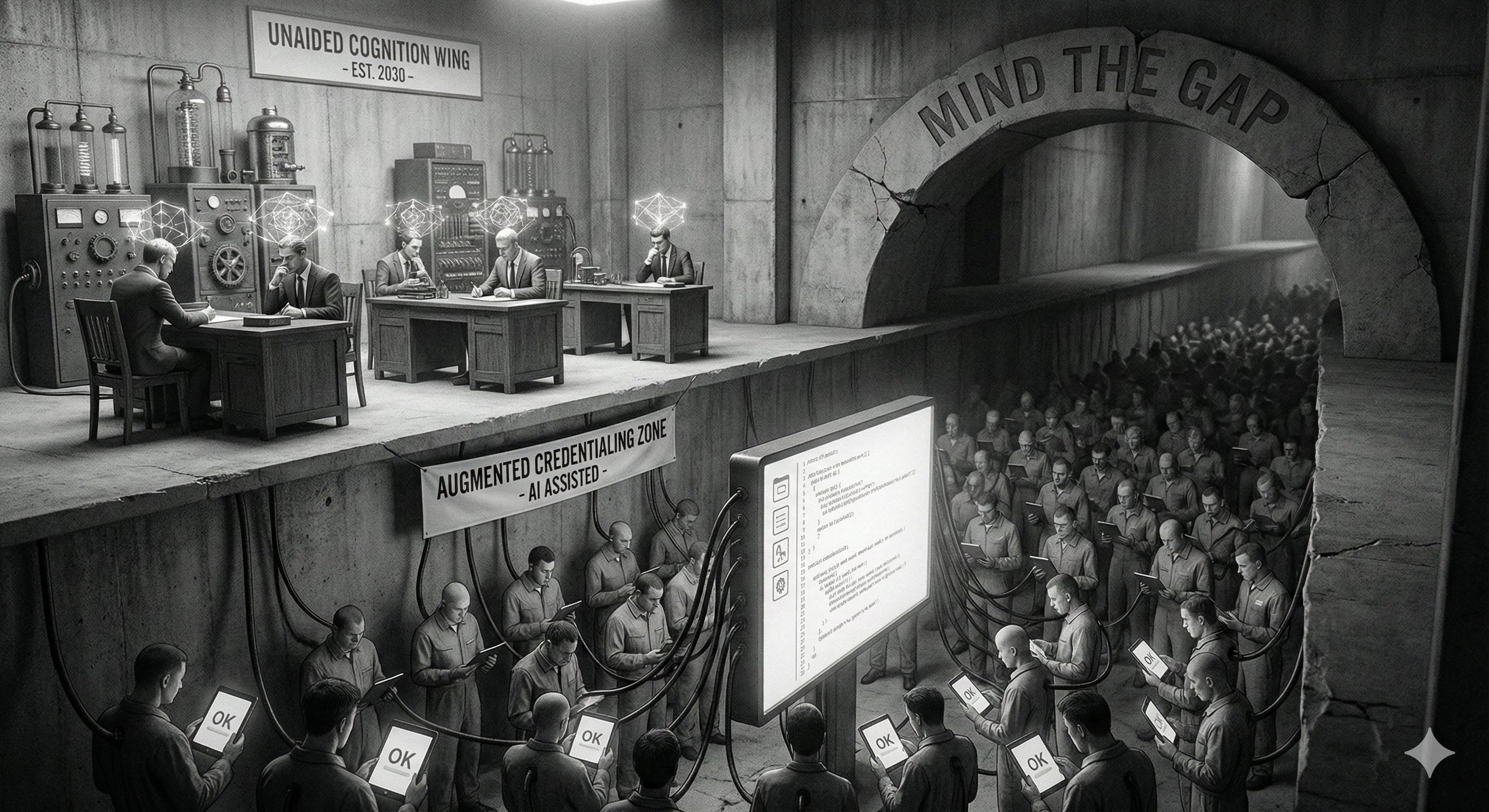
We built gyms because we stopped walking to work. As manual labour vanished, our bodies atrophied from comfort. Now we pay to lift heavy things and run in place - simulating the physical struggle that once came free with existence.
The parallel to cognitive labour is obvious but unsettling. GPS killed our navigation sense. Calculators eroded mental arithmetic. Spell-check weakened our grasp of orthography. Each convenience traded capability for efficiency, and we accepted the bargain because the losses seemed trivial.
Large language models represent something qualitatively different. They don’t just handle tedious calculation - they threaten the formation of expertise itself. When students use AI to write essays, they skip the cognitive struggle that builds analytical ability. When professionals delegate research and drafting to algorithms, they lose the tacit knowledge that comes from doing the work.
If physical gyms emerged to compensate for reduced manual labour, what cognitive equivalent will we need? And more importantly - who will have access?
The Stratification Begins
Elite institutions are already restricting AI tools, not from technophobia but competitive advantage. While state schools encourage ChatGPT use “for equity,” selective universities require handwritten exams and Socratic discussion. The rationale sounds pedagogical. The function is sorting.
This initial divergence triggers a predictable cascade:
Layer 1: Credentialing Bifurcates
Two tracks emerge. “Augmented” credentials prove you can use AI tools effectively - fast, scalable, accessible. Most jobs accept these. “Unaided” credentials prove capability without algorithmic assistance - expensive, time-intensive, gatekept. These become required for genuine authority: senior legal judgment, medical diagnosis, strategic command, financial regulation.
The gap widens because augmented work becomes cheaper (more supply) while unaided expertise becomes scarcer (higher demand for verification).
Layer 2: Embodied Knowledge Concentrates
Elite education emphasises tacit knowledge resistant to AI replication: laboratory work, clinical rotations, apprenticeship under recognised masters, social capital through shared hardship. Mass education becomes increasingly virtual and AI-mediated - efficient knowledge transfer but no embodied practice or network formation. Graduates can answer questions but lack judgment.
Layer 3: Language Becomes Class Marker
AI-generated text develops tells. Elite writers cultivate deliberately difficult or idiosyncratic styles that signal human origin and extensive practice. Ornate legal language, academic jargon, literary complexity - previously criticised as gatekeeping, now functionally necessary to prove authorship. The masses communicate in AI-mediated standard prose. Efficient but unmarked.
Layer 4: Metacognitive Monopoly
The critical skill becomes evaluating AI output - spotting errors, logical gaps, fabrication. But this requires domain expertise acquired through years of unaided practice. Vicious cycle: without practice you can’t evaluate AI; without evaluation you can’t catch mistakes; without catching mistakes you can’t develop expertise.
Elite institutions teach “AI scepticism” as adversarial testing. Mass education teaches “AI literacy” as tool adoption. Result: elites audit AI; masses trust AI.
Layer 5: Regulatory Capture
Those with unaided credentials write rules requiring unaided verification in high-stakes domains. Justified by genuine safety concerns, but conveniently protects elite earning power. Professional guilds mandate human oversight - but “qualified human oversight” means expensive credentials only elites can afford.
Meanwhile automation eliminates adjacent roles - paralegals, junior analysts, research assistants. The ladder rungs vanish. Entry-level cognitive work disappears; senior work remains gatekept.
Layer 6: Epistemic Dependency
Elites develop sophisticated understanding of AI limitations because they retained unaided capability. They know where algorithms fail because they can still do the work manually. Masses lose ability to verify claims about AI - must trust expert assertions. This hands elites narrative power: they decide where automation is “safe” versus where human judgment is “essential.” Conveniently, “essential” correlates with elite employment.
Layer 7: Infrastructure Mystification
AI becomes infrastructure - essential but mysterious to most users. Like people who drive cars without understanding engines, most will use AI without understanding its reasoning. The algorithm becomes a black box you depend on but cannot audit.
Layer 8: Cognitive Feudalism
The end state resembles medieval literacy. Small clerical class performs unaided cognition. Large peasant class depends on algorithmic mediation. Power concentrates among those who can both use AI (efficiency) and work without it (verification, innovation, adversarial testing).
The Counter-Argument
This assumes unaided cognitive capability remains valuable. Perhaps AI becomes so reliable that verification is unnecessary - like we don’t manually check calculator arithmetic. In that scenario, maintaining unaided skills is purely status-seeking, socially significant but functionally obsolete.
Which future arrives depends on whether AI reasoning becomes trustworthy enough that human oversight is security theatre rather than genuine safeguard.
The Uncomfortable Truth
We probably won’t build cognitive gyms systematically. We’ll stumble into divided equilibrium - elites maintaining capability through expensive education, masses atrophying through convenient dependence. Not inevitable, but likely without deliberate institutional design.
Physical gyms let anyone with £30 monthly preserve their body’s capabilities. The cognitive equivalent will cost rather more - elite university fees, years without income, social networks money cannot directly buy.
The question isn’t whether cognitive offloading happens. It’s already happening. The question is whether cognitive capability becomes the new class divide, with some able to think without algorithmic assistance and others permanently dependent on tools they cannot audit.
Welcome to the future. Mind the gap.
This article was written in partnership with Claude (Anthropic). The irony is not lost on either of us.