

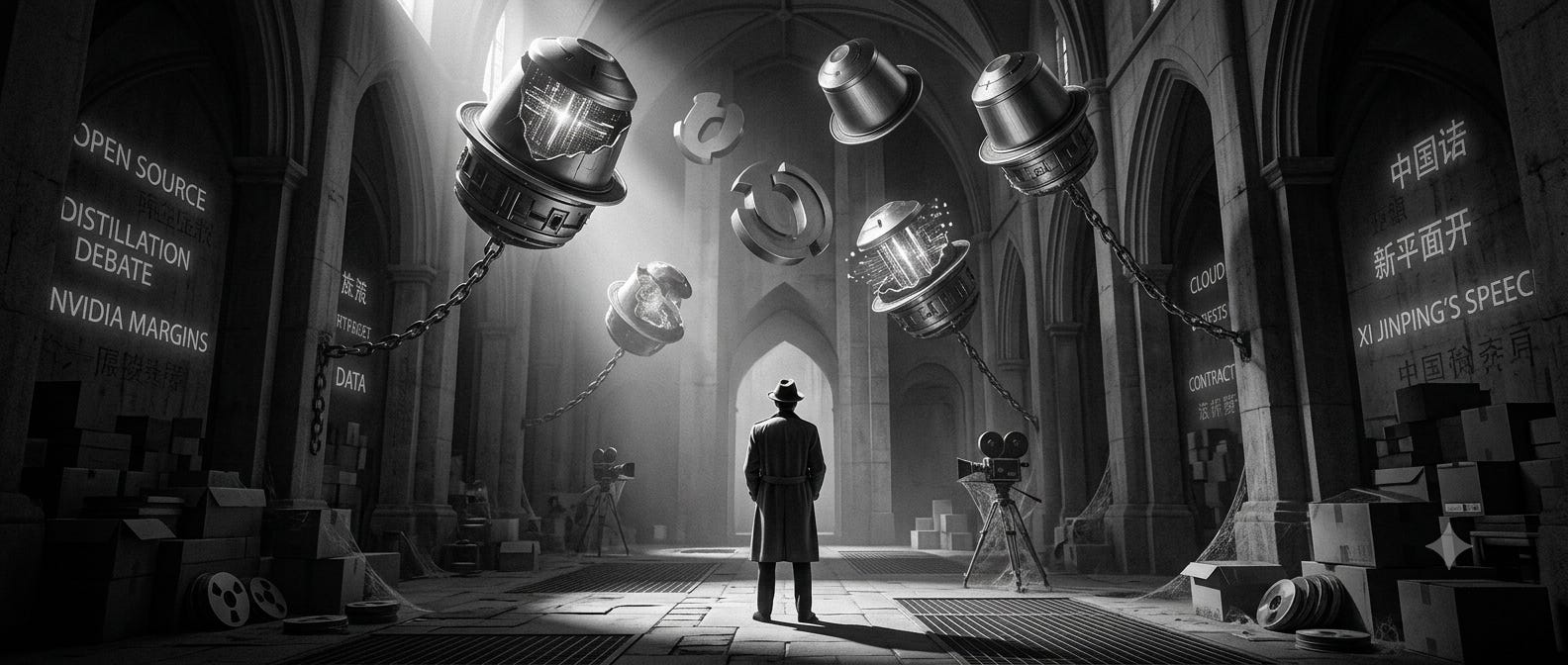
Nespresso never sold its machines at low prices out of generosity. A coffee machine is a durable good, typically bought once. The pods are consumables, purchased repeatedly, patented, and incompatible with rival machines. This is classic two-part (or tied-good) pricing: sell the durable good near cost - or even at a loss - to lock customers into a high-margin complementary consumable. The pattern is familiar: printers and ink cartridges, razors and blades.
The same logic now applies to AI - especially open source large language models. In mid-to-late July 2026, Kimi K3 and Alibaba’s Qwen 3.8 Max dropped within days of each other, following Zhipu’s GLM 5.2 in June. They are all near frontier, all open source. So how do they make money?
China’s Four Pods
These Chinese labs are not giving models away for free or out of ideological purity. They are pursuing four distinct “pod” strategies to monetise around open weights.
Cloud lock-in: Alibaba and Tencent open-sourced Qwen and Hunyuan in the spirit of Android - give away the OS to capture the ecosystem. Enterprises that build around these models end up renting massive inference capacity on Alibaba Cloud or Tencent Cloud.
Government and enterprise contracts: Zhipu and MiniMax have largely abandoned broad consumer plays. They focus on fine-tuned, air-gapped, on-premise deployments for banks, ministries, and state-owned enterprises where data security justifies premium contract pricing.
Volume API plays: DeepSeek and Kimi slashed hosted API prices to a fraction of Western rates. They bet that falling inference costs make volume more profitable than high per-token margins. (Note: raw token pricing can mislead; task completion cost is a more honest metric since some models use a lot more tokens to complete the same task.)
R&D spillover: DeepSeek’s parent, the quant fund High-Flyer, doesn’t need the LLM lab to be independently profitable. Elite GPU clusters were first built for trading; the model serves as a talent magnet and research by-product.
The American Reckoning
Within a week of these Chinese models dropping, the US AI community was doing a broader rethinking of open source strategy. The uncomfortable reality is that building strong LLMs involves less secret sauce than many assumed. Data scale, compute scale, and algorithmic improvements all matter - but the rapid leapfrogging shows that clever tricks are not especially scarce or durable.
Compute, however, remains constrained. On 2026 numbers, it increasingly looks like this is still where all the margins are, the Nespresso pod of this cycle. Google Cloud’s operating margins have more than doubled since 2024, and xAI reportedly earns more per month renting spare Colossus capacity than Grok generates in a year. Yet infrastructure businesses are cyclical, and China’s push into chip lithography suggests Nvidia’s margins may face real competition by the end of the decade.
The Distillation Debate
US reactions split. One camp argued China “cheated” by distilling reasoning traces from Claude and GPT. The other noted that distillation is standard practice across labs (Elon Musk admitted to it in training Grok) and that fixating on it distracts from deeper Chinese strengths: massive high-quality human capital, aggressive data strategies, and algorithmic ingenuity developed under Western chip sanctions.
Ben Thompson of Stratechery articulated the first camp’s strongest case, ironically calling for two specific pro distillation statutory fixes: fair-use status for training-data collection and removing Terms of Service clauses that ban distillation. Nathan Lambert pushed back more precisely: distilled traces provide only modest uplift. Chinese progress rests on many other factors.
Xi Jinping’s July speech at WAIC in Shanghai reinforced the political dimension, framing AI as a normal technology - like electricity or the internet - that should be cheap and widely diffused. He invoked both the 1956 Dartmouth workshop which founded the discipline of AI and ancient Chinese statecraft debates on industry control.
The ChinaTalk podcast outlined three possible futures for a Chinese model that crosses a dangerous capability threshold: full open release, controlled testing (à la Anthropic’s Project Glasswing), or nationalisation. Leading Chinese models themselves estimated nationalization odds between 30–45%.
Western Adaptation: Building Better Pods
The distillation argument often serves as psychological comfort - flattering the US audience that a serious competitor cannot exist without theft. It also undervalues Chinese researchers, including many trained in China who now work at frontier U.S. labs.
More clear-eyed Western labs appear to be reaching the same conclusion as their Chinese counterparts: the base model itself may become a relatively low-margin complement. Anthropic’s Claude Design tool and OpenAI’s expanding application-layer products are not random diversification. They are attempts to build high-value “pods” around what could become commoditized low margin models.
At the true frontier, model access (API, subscriptions, enterprise deals) will still command premium pricing for tasks nothing else can handle. But the broad middle market - tasks any competent model can manage - is already heading toward Chinese-style zero-margin competition. What remains valuable are complements with high switching costs:
An office suite that “includes” a model rather than a model that includes an office suite.
Vertical tools (legal, coding, design) priced per seat, per matter, or per outcome rather than per token.
Client-side inference to reduce cloud dependency.
Regulatory Implications
In well-regulated markets, competition authorities scrutinize tied pricing for abuse. Nespresso itself faced investigation in 2014 and was forced to open its ecosystem to compatible capsules. AI raises parallel concerns:
Deliberately engineered switching costs versus genuine quality advantages.
Self-preferencing by hyperscalers that control both cloud infrastructure and frontier models (Google, Microsoft, Amazon).
Cross-ownership structures - Microsoft in OpenAI, Amazon and Google investments in Anthropic - that risk tacit collusion and reduced competitive intensity, a pattern competition economists have flagged in other concentrated sectors.
Open source AI accelerates commoditisation of the model layer and shifts value upstream (compute) and downstream (applications). This is neither inherently good nor bad - but it demands clear-eyed analysis of where real margins, power, and risks actually sit. The Nespresso analogy holds: the machine matters less than who controls the pods.
Strong framing. One additional China-specific “pod” may be industrial delivery itself: getting a model through procurement, private deployment, hardware adaptation, compliance, and after-sales integration. Open weights lower the price of intelligence, but they can increase demand for the infrastructure and engineering needed to make it usable. The model layer may commoditize faster than the broader AI supply chain.