

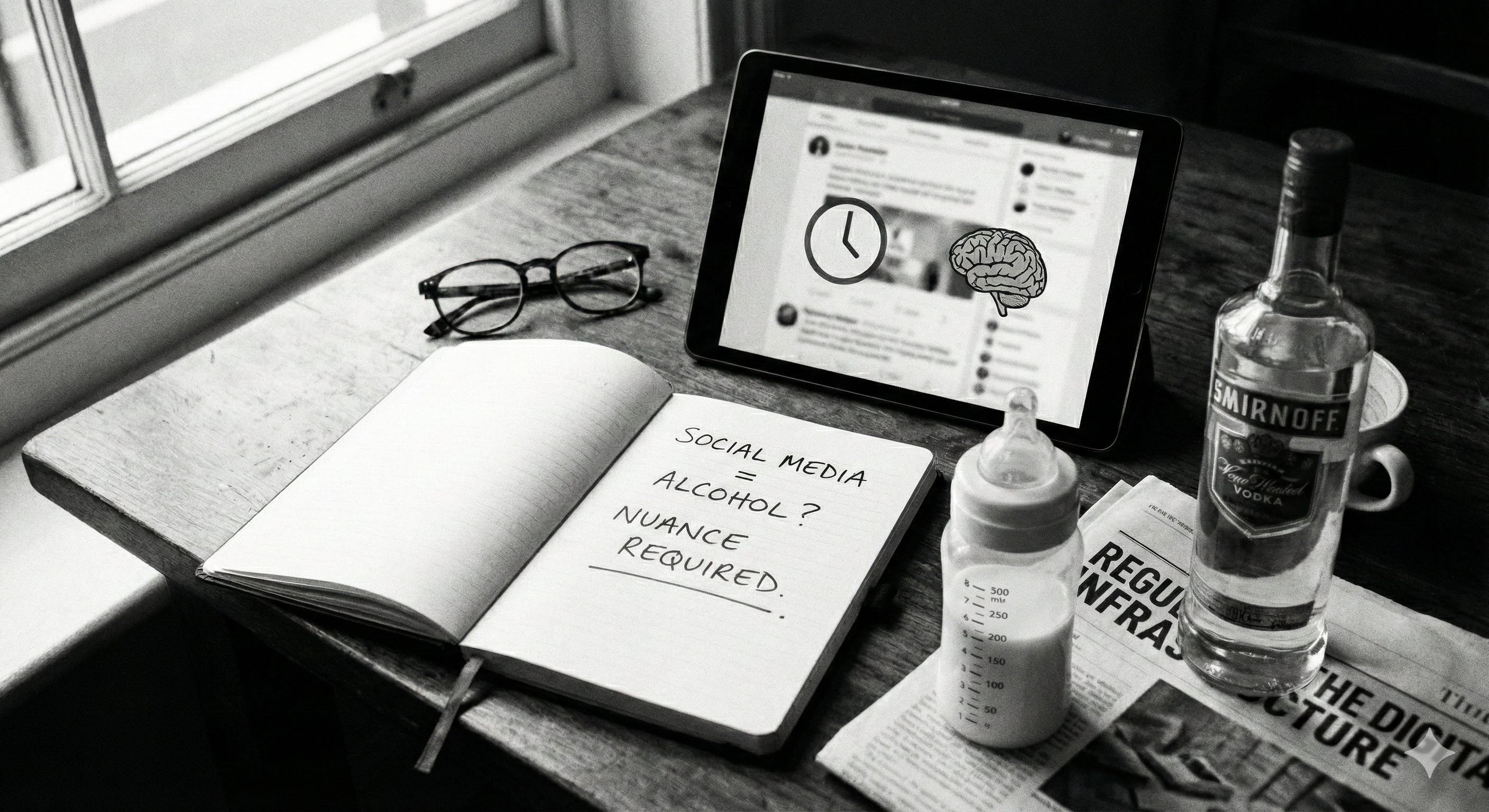
The debate over social media’s impact on young people generates more heat than light. Campaigners declare it a mental health crisis. Others insist the evidence is weak. Parents feel caught between moral panic and permissive neglect.
You wouldn’t give a toddler vodka, would you let it watch TikTok?
The alcohol analogy isn’t perfect. But it clarifies the evidence and sharpens our thinking about regulation. And the differences may reveal why our current approach is doomed.
What the Science Actually Shows
The randomised controlled trial evidence presents a more nuanced picture than either side admits.
Against blanket condemnation:
Large-scale studies find minimal average effects. Orben and Przybylski’s 2019 analysis of 12,672 adolescents found correlations between social media use and wellbeing of just -0.01 to -0.04 - statistically detectable but practically negligible.
When Facebook rolled out across US colleges, researchers found small increases in depression and anxiety, but magnitudes far too small to explain population-level mental health trends.
Most causal estimates cluster near zero once confounders are controlled.
But genuine harms exist:
Randomised controlled trials where participants deactivated Facebook for four weeks showed improved subjective wellbeing and reduced depression and anxiety (though effect sizes remained small, around 0.1 standard deviations).
Instagram deactivation studies found reduced anxiety and improved body image.
Longitudinal work reveals bidirectional effects: anxious teens use more social media, which may worsen symptoms.
What evidence exists suggests average effects are small. But we know that averages can mask what matters.
Where the Alcohol Analogy Works
Social media use has at least 5 parallels with alcohol:
1. Dose-response relationships
Moderate alcohol consumption - one or two drinks daily - shows neutral or even beneficial health associations for some outcomes. Heavy drinking clearly harms. Social media follows similar patterns: under an hour daily often correlates with neutral or positive outcomes (connection, information access). Beyond three hours, outcomes worsen. Both show that “binge” patterns - weekend drinking binges or late-night scrolling spirals - likely prove worse than equivalent consumption spread over time.
Though we should note: measuring social media “dose” by time alone is crude. One hour of supportive Discord community engagement differs biologically and psychologically from one hour doom-scrolling “thinspo” on TikTok. We lack a standardised “unit” equivalent to alcohol content. A pint of beer is different to a pint of vodka.
2. Individual vulnerability
Genetics, family history, and mental health predispose some to alcohol dependency. The same drink affects different people differently. Social media shows similar dynamics: pre-existing anxiety, ADHD, eating disorders, or loneliness predict problematic use. The same exposure produces radically different outcomes between individuals.
3. Context determines impact
Wine with dinner differs from social celebration, which differs from solitary drinking. Similarly: group chats with friends differ from passive comparison with influencers; which differs from experiencing targeted harassment. In both cases, social versus isolating use fundamentally changes the risk profile.
4. Gateway or symptom?
Does drinking cause depression, or do depressed people self-medicate? Does Instagram cause body image issues, or do vulnerable teens seek appearance-validation content? Both involve bidirectional causation that makes targeted intervention tricky.
5. Regulatory challenges
Alcohol faces age restrictions, inconsistently enforced, with ongoing debates between harm reduction approaches (designated drivers, education) and prohibition. Social media sees failed age verification, “digital detox” advice (the Dry January of the internet - temporarily performative, rarely changing long-term patterns) versus proposed under-16 bans, with prohibition driving underground use whilst education and norm-setting may work better.
Where the Analogy Breaks Down
But social media isn’t simply “digital alcohol”.
It’s infrastructure, not a consumable. This is a vital distinction. Alcohol is discretionary. You can abstain from drinking and remain socially integrated. But social media has become the infrastructure of adolescent social life. If you don’t drink, you miss the party. If you aren’t on social media at 15, the party doesn’t exist. Network effects create lock-in that makes “just use less” advice structurally naive in ways that “just drink less” isn’t.
Addiction mechanisms differ fundamentally. Alcohol creates direct neurochemical dependency through GABA and dopamine systems, with genuine physical withdrawal. Social media relies on behavioural conditioning through variable reward schedules but produces no physical withdrawal syndrome. The “addiction” language may be rhetorically useful, but remains mechanistically imprecise.
The business model inverts the incentive structure. Alcohol companies sell a product; the transaction completes. Social media platforms harvest attention. Users become the product. Platforms algorithmically optimise for engagement, not wellbeing, with continuous A/B testing to increase “stickiness”. This structural misalignment has no alcohol equivalent. Diageo doesn’t redesign whisky to be more psychologically manipulative each quarter.
Externalities operate like second-hand smoke. Alcohol produces clear third-party harms: drunk driving, violence, healthcare costs. Social media’s externalities are there too. Viral posts operate like second-hand smoke - you’re harmed by other people’s consumption. Your neighbour’s conspiracy theory habit shows up in your recommendations. More obviously, cyberbullying does create direct victim harms analogous to alcohol-fuelled violence.
Developmental timing operates differently. Brain development concerns apply to both, but social media coincides with identity formation in unique ways. Adolescent social comparison isn’t new. But 24/7 quantified feedback - likes, followers, visible popularity metrics - during critical developmental periods may be. Alcohol doesn’t insert itself into peer validation mechanisms in the same way.
What This Might Mean for Policy
If we regulate social media like alcohol, we should expect alcohol-like outcomes, which aren’t always great. Alcohol kills many million people annually despite centuries of regulatory refinement. It’s not a great success benchmark. Alcohol policy has swung back and forth on the winds of current mores from prohibition to laissez faire. Usually with negligible scientific support.
So social media = alcohol has helpful parallels for thinking about the problem, but little in the way of policy prescription..
Current social media policy is focused on whether or not to impose blanket bans on under 16s as has happened in Australia. Or on “digital literacy” and “parental controls” - interventions that shift responsibility onto users. Maybe we should be thinking differently?
The infrastructure insight suggests different regulatory models:
If social media is infrastructure (like roads), regulate it as such.
Roads have design standards that prioritise safety. We mandate crash barriers, sight lines, and traffic calming in residential areas. We don’t simply teach people to “drive carefully” on objectively dangerous roads and blame them when crashes occur.
Applied to platforms: mandatory design standards that reduce psychological harm. Ban infinite scroll for under-18s. Require chronological feeds as default. Prohibit A/B testing on minors. Remove visible like counts. These aren’t parental opt-ins - they’re structural requirements, like requiring seatbelts in cars.
Crucially: liability. If your road design causes crashes, you’re liable. Extend this to platforms. If your algorithm routes vulnerable teens toward self-harm content, you bear responsibility. This shifts incentives from “maximise engagement” to “minimise harm”.
Alternatively: treat platforms like food providers
Food has mandatory labelling, compositional standards, and advertising restrictions.
Applied to platforms: Algorithmic transparency requirements - disclose what drives recommendations. Content labelling - flag manipulated images, sponsored content, algorithmically amplified material. Restrictions on “serving” harmful content to vulnerable users, similar to restrictions on marketing junk food to children. Prohibition of certain “additives” - features designed purely to maximise compulsion rather than communication.
The difference from alcohol regulation? Food regulation addresses both the product (compositional standards) and the infrastructure (supply chain oversight). Social media requires similar dual-level intervention.
Is competition the answer?
Most of the social media providers are highly monopolistic. Perhaps the best way forward would be to introduce more competition so there is greater choice over more or less harmful social media offerings. Parents would encourage their children to use the safer options. To achieve this policy should have: data portability to enable easy movement between platforms, interoperability requirements to reduce network lock-in, or public interest algorithms that prioritise user wellbeing over engagement.
The Bottom Line
The evidence neither supports “social media is destroying a generation” nor “concerns are moral panic”. The truth is more complex and more interesting.
Social media, like alcohol, creates risks concentrated among the vulnerable, with outcomes depending on dose, context, and individual susceptibility. Average effects tell us little. Distribution matters.
But unlike alcohol, social media has become essential infrastructure that cannot be meaningfully opted out of. And unlike alcohol, platforms actively optimise to increase consumption, with users as product rather than customer.
This suggests we need regulatory interventions more akin to road safety standards or food safety regulation: structural requirements, liability frameworks, and constraints on business models that profit from harm, where liability can be proven. Better still allow more competition.
So we’ve gone from not giving vodka to toddlers to having rules of the road and teaching people to drive. Clearly mixing metaphors is as bad for you as mixing drinks…