

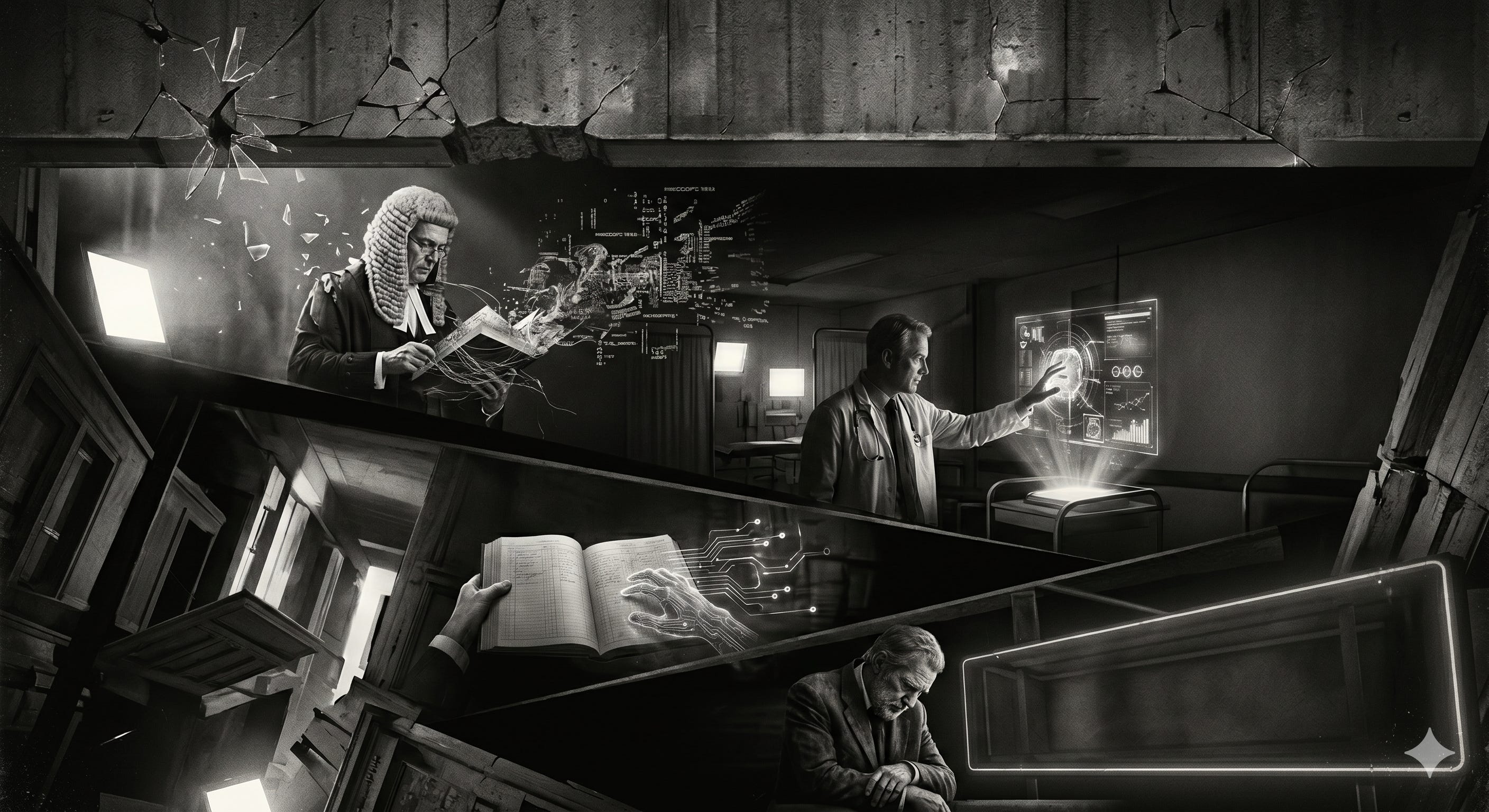
Despite what you saw in Downton Abbey, class in Britain was never really about manners. It was about monopoly - who controlled what others needed, and could charge for access. The aristocracy held land. The professions hold knowledge. AI is about to break knowledge monopolies faster than death duties ever did for Downton Abbey.
Today, professions are not just well-paid jobs. They are legally and socially constructed monopolies of specific bodies of knowledge. These credential monopolies are being removed by AI. The barrister’s silk, the accountant’s qualification, the professor’s chair, the consultant’s MBA - are not just credentials. They are title deeds to a territory of information that clients cannot enter without paying the toll. The asymmetry between expert and client supports fee structures, creates an irreplaceable scarcity, and, with it, a degree of social deference.
In Downton, Dr Clarkson, Downton’s local physician, loses his authority not when he makes a mistake, but when a London specialist arrives with superior knowledge and access to resources he cannot match. His monopoly on medical truth in the village is broken not by any failure of competence, but by the appearance of a better-resourced external authority. The social change matters as much as the economic one: he remains a doctor, but the room no longer defers to him in the same way.
When an AI frontier model provides a diagnosis comparable to a GP’s first assessment, the cultural capital - the knowledge - is no longer scarce. The GP credential remains. Worse, so does the liability. But the scarcity, rents and deference do not.
A monopoly on knowledge is not a monopoly on responsibility. The GP will persist not merely as a repository of facts, but as a legally liable ‘neck to wring’ when things go wrong. While AI provides the diagnosis, the professional provides the accountability. This is a structural barrier that models cannot cross; society may grant deference not to the person who knows the most, but to the person who stands to lose the most.
The outsourcing to AI of knowledge and thinking will happen in many professions. Previous automation waves replaced manual labour and routine clerical work. They did not penetrate the knowledge core. A factory worker displaced by machinery lost income, but had not built a class identity around information scarcity. The solicitor, the radiologist, the financial adviser - their position is partly created by knowing things others don’t. Not for much longer.
The licensing and credential systems exist, in part, to protect the public from incompetent practitioners; they also function as a cartel, restricting supply and sustaining fee levels. AI will create a fork in the road. Either professionals become AI supervisors - retaining legal liability while losing knowledge superiority - or licensing holds firm while AI competence outpaces human practitioners. The second scenario is already visible in radiology, where AI outperforms human readers on certain image classifications, yet radiologists remain the legally required sign-off. For now this protects income. It also stores up a legitimacy crisis: why defer to the professional if the professional is deferring to the model?
The slow internal restructuring of professions may be a sideshow: AI is more likely to route around them entirely, through client-facing platforms that bypass the traditional gatekeepers.
The threat to a law firm is not that AI makes its lawyers more efficient, or that a smarter junior associate replaces a less smart one. It is that the client stops calling the firm at all. Legal AI platforms are already positioned as client-facing, not lawyer-assisting. The same logic applies to financial advice, accounting, and increasingly to medicine. The travel agent didn’t lose out to a better travel agent. The category largely ceased to exist when customers gained direct platform access to Expedia et al.
On the other hand, William Stanley Jevons noticed in 1865 that making coal cheaper increased its consumption rather than reducing it. Just as the spreadsheet did not get rid of accountants, but instead increased the demand for complex financial modelling, counter intuitively, AI may trigger an increase in demand for knowledge work. By automating the routine ‘tolls’ of professional life, we may see a surge in demand for high-level synthesis, strategy, and the navigation of complex cases that were previously too expensive. If it becomes easier to have a legal argument, we might need more solicitors to administer the case and barristers to stand up in court.
Who will capture the value that used to flow to the professional class? Maybe a restructured version of the profession - the accountable, liability bearing, well insured, final human in the loop? Some of the surplus will flow to the owners of the AI infrastructure and models: a smaller, more concentrated group than the professional tier it displaces. The means of production shift, and with them the extraction of value.
Unlike Downton, professional class membership was never simply inherited. It was reproduced through apprenticeship: the junior doctor, the newly qualified solicitor, the second-year analyst. These entry-level roles were not just jobs. They were the process through which cultural capital was acquired - where raw graduates became professionals, built expertise, accumulated the judgment that eventually justified the authority and the fees. The senior partner’s position rested, several decades back, on having once been the paralegal doing the routine work.
Today, AI is reducing demand at the entry tier to knowledge work. Junior legal and consulting roles are contracting, the Big Four accountants are reducing graduate intakes. Not because firms want to harm their junior staff, but because the routine work that juniors performed is precisely what models do well. When that work disappears, so does the apprenticeship. Instead, the next generation will gain access to the higher levels through their skill in using AI: their ability to manage agent swarms, to coordinate and orchestrate data, models and, of course, the relational part, manage clients.
In the final Downton film, the family adapts. Fewer staff, smaller ambitions, a house that functions differently. What doesn’t survive is not the house, but the class meaning the house once had - the hierarchy, the deference, the assumption that knowledge and position were the same thing. The world of Downton Abbey ended slowly over decades. That gave people time to adjust: to a change in circumstances, a change in self-worth, a future that looked different from the one they had been promised.
The professional classes will not have that time.