

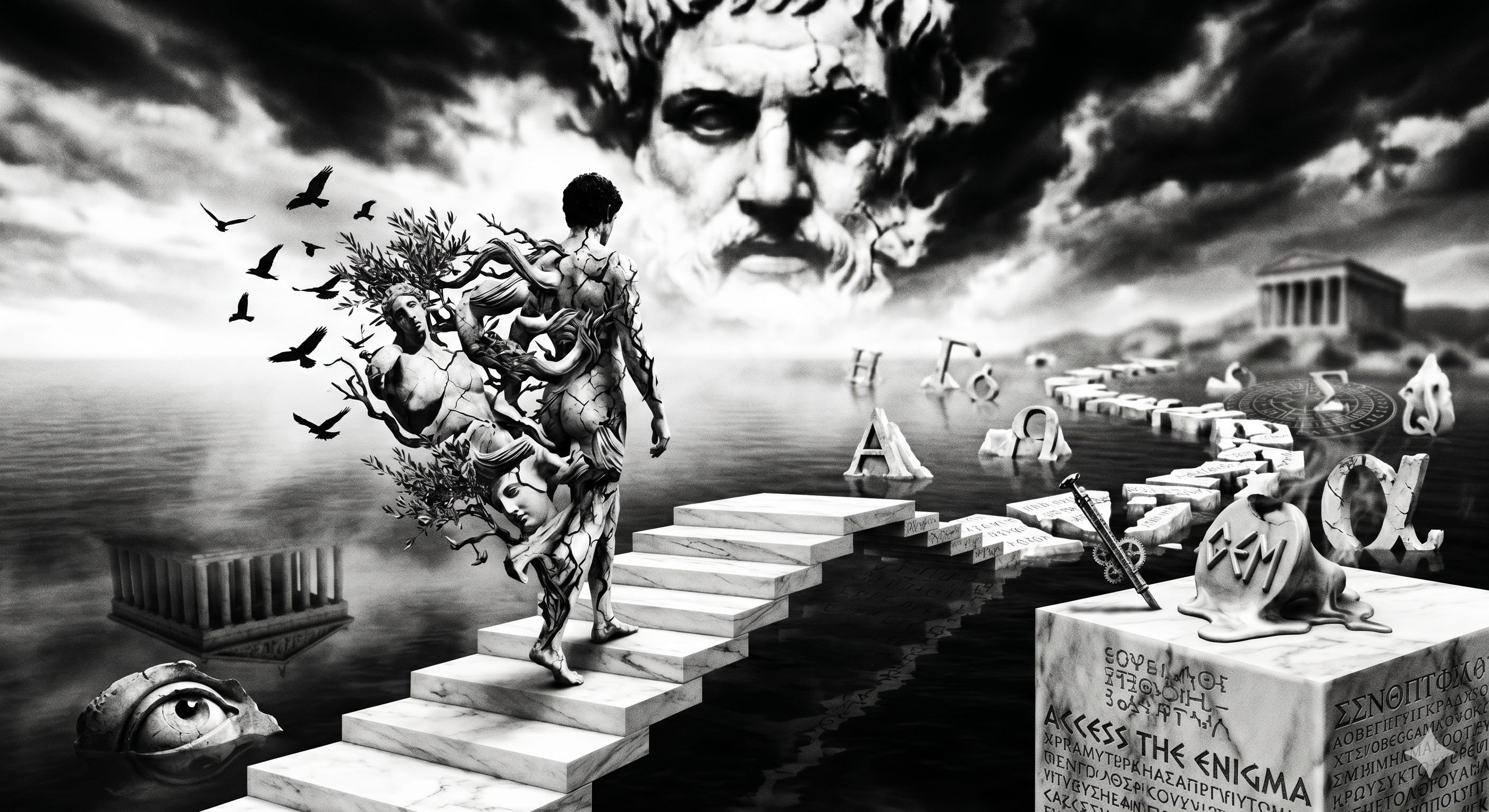
The taverna menu has some fantastic misspellings, crossed out prices and extraordinary translations. Across the road a hotel logo invites guests to “Access The Enigma.” Nobody would mistake this for AI writing. This is authentic.
I am writing this on Thassos, an island in the northern Aegean where the olive trees are very old and the white marble so good that Seneca noted that people considered themselves “poor and miserable” if their swimming pools weren’t lined with Thassian marble.
Since reading Jasmine Sun’s excellent piece on AI writing I have been thinking about writing - specifically about how we have convinced ourselves we can detect machine authorship, and whether we actualy can. Aristotle’s Greece is a good place to think about this. Not just for its authentic menus, but for its historical links to rhetoric.
The tell with AI writing is, as everyone agrees, the rhetoric. AI writing is to smooth. Too structured. It reaches for the tricolon when a single example would do - “clear, concise, and compelling” where “clear” alone would have been enough. It asks a question, then answers it. It builds to a conclusion and announces it’s arrival. It loves an anaphora: the repeated opening phrase marching through a paragraph like a Roman legion that has forgotten where it was going. We stand at a crossroads. We face a choice. We must decide. It deploys chiasmus - the elegant reversal - with the enthusiasm of someone who has just discovered it: ask not what your content can do for you, but what you can do for your content. It closes with sententia, the pithy maxim that lands like a gavel: In the end, clarity is not a style. It is a discipline.
All of this is true. It is also a description of classical rhetoric as taught in every European university from the Renaissance to the nineteenth century. These were not AI hallucinations. Anaphora gave Lincoln the Gettysburg Address. Epistrophe - the repeated closing phrase - gave Churchill “we shall fight on the beaches, we shall fight on the landing grounds, we shall fight in the fields.” Symploce combined both and gave the King James Bible much of its cadence. Chiasmus gave Kennedy his most quoted line. Tricolon gave Caesar his dispatch from Pontus: veni, vidi, vici. The Cambridge scholar who could deploy a well-placed sententia was displaying mastery, not malfunction.
What happened is not that AI invented bad habits. It is that AI was trained on centurie’s of writing that used these devices, absorbed them as the pattern of serious prose, and reproduced them without the judgment that tells a human writer when to reach for the device and when to set it down. The tell is not the rhetoric. It is the overuse.
There is a related habit worth naming: erotema, the rhetorical question used as fake engagement. But what does this mean for the future of writing? And who, really, gets to decide? AI loves erotema because it creates the appearance of depth without the obligation of an answer. Then there is hypophora - asking the question and immediately answering it yourself, a device Cicero used sparingly and AI uses like punctuation. Can we tell the difference? Increasingly, no. And auxesis, the building of intensity through accumulation, each clause weightier than the last, until the paragraph arrives at a conclusion it has been engineering from the first sentence, breathless and inevitable and slightly exhausting.
Which brings me to the next move in this writing arms race.
People have started introducing deliberate errors. A misplaced apostrophe here. A sentence that trails off before it quite. The occasional “teh” left uncorrected as a flag of biological origin and authenticity. The reasoning is understandable: if AI is to smooth, human must mean rough. If the machine never stumbles, the stumble proves the human.
This too has a classical precedent. Pliny the Elder noted that the great Greek painter Apelles would sometimes leave a deliberate flaw in his work to signal that perfection itself was suspect, a mark of the inhuman. The Japanese aesthetic of wabi-sabi builds incompleteness into it’s philosophy of beauty. Persian carpet weaver’s, according to a story that some historians dispute, left an intentional mistake as an act of theological modesty: only God makes perfect things.
The problem is that this arms race cannot be won, only played. Detectors will learn to spot the strategic typo. Writers will learn to make the typo look unstudied. The rhetorical device, deployed with judgment, disappears into the prose. AIs will write with mistakes.
The Thassos taverna menu convinces me precisely because nobody designed it to be convincing. The misspellings are not strategy. The crossed-out prices are not performance. The enigma, it turns out, is not something you access. It is simply an authenticity code you need to break…