

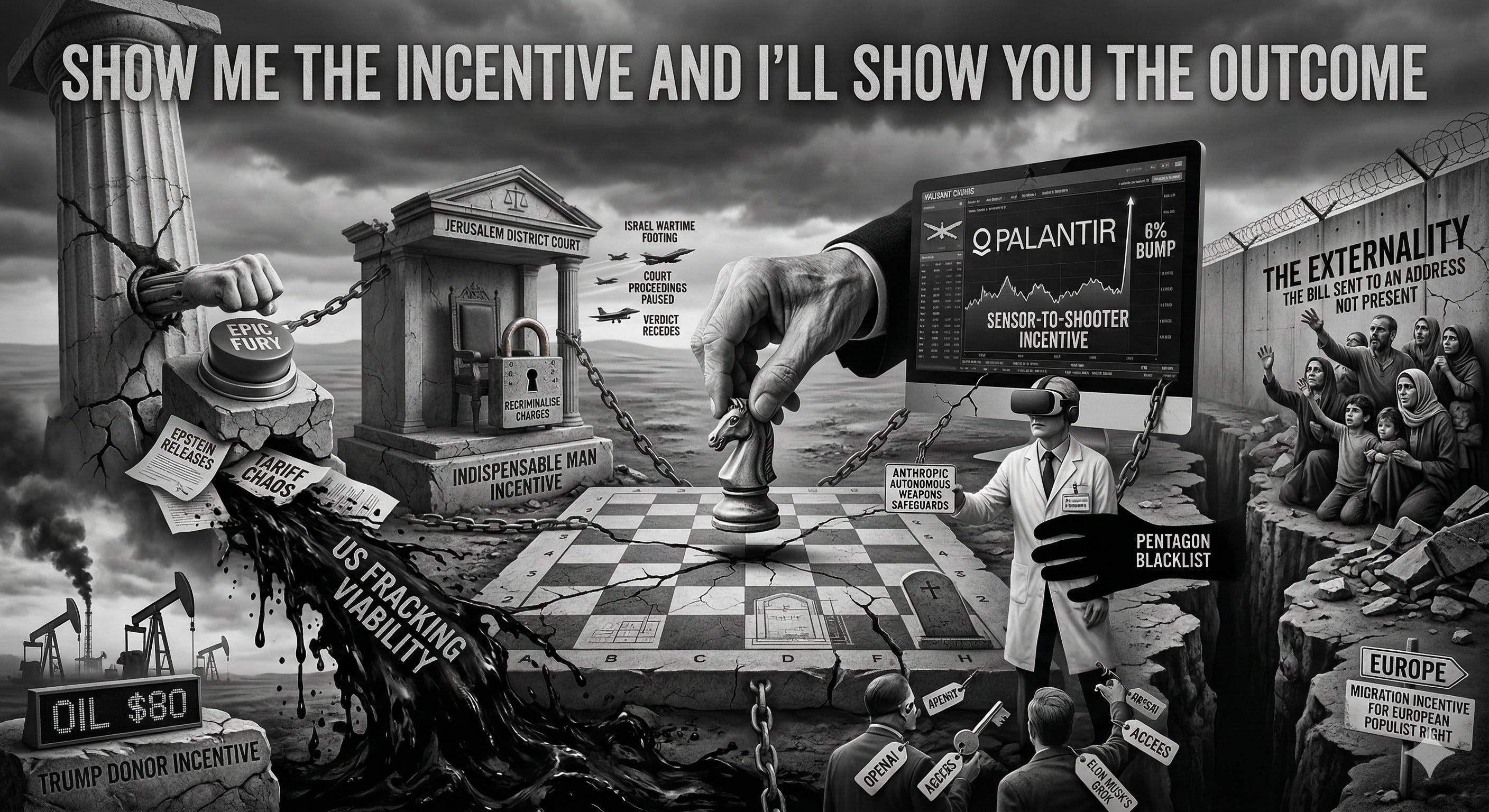
Charlie Munger died in November 2023, aged 99. He spent sixty years making himself, together with Warren Buffett and the Berkshire Hathaway shareholders, very, very rich by doing one thing better than almost anyone alive: understanding why people behave as they do. Not what they say they do, or what they think they do - what they actually do. His answer, refined over decades and delivered with bluntness and clarity, was usually the same. Find the incentive. Everything else is commentary. Show me the incentive and I’ll show you the outcome.
Apply it to the past week in geopolitics.
Donald Trump pressed the button on Operation Epic Fury on 28 February. His stated reasons shifted daily - nuclear weapons, missile programmes, the 1979 hostage crisis, a pre-emptive strike against an attack he felt was coming. US intelligence assessed Iran’s intercontinental missile capability was nearly a decade away. No matter. The rationale was less important than the result.
The result: a news cycle scrubbed clean of Epstein document releases. A conversation that is no longer about tariff chaos or federal workforce purges. An energy sector - heavily represented among Trump’s donor base - watching Iranian supply disruption push oil prices upward. Especially the large US fracking sector who need oil prices above $60 to be viable. In December they hit $57. Now they are nudging $80. And a Pentagon military procurement machine shifting into a higher gear, the kind that funds future campaigns and builds future relationships.
Show me the incentive.
Benjamin Netanyahu had a court date. He has had many court dates - bribery, fraud, breach of trust across three cases - and the pattern since October 2023 has been consistent: when Israel is on a war footing, proceedings pause. Non-essential public gatherings are prohibited. The mandatory testimony sessions, three per week, don’t happen. The verdict that was approaching - potentially this year - recedes back into the middle distance.
Meanwhile, his coalition has been quietly advancing legislation to retroactively decriminalise the specific charges he faces. The judicial reform that triggered mass protests in 2023 continues by stealth. A snap election, which polls suggested he would lose, can now be reframed as a wartime referendum on security leadership. Netanyahu is, once again, the indispensable man.
He has been here before. After October 7, after Gaza, after Lebanon. The logic is the same each time. A nation in permanent conflict needs a wartime prime minister. A wartime prime minister cannot be distracted by corruption proceedings. The war is not a distraction from his legal problems. His legal problems are the reason there is always another war.
Show me the incentive.
Palantir Technologies had already secured a $10 billion Army contract before the bombs fell. Its AI platform compresses what the Pentagon calls the “sensor-to-shooter chain” - from target identification to strike authorisation - to a matter of seconds. On the Monday after the strikes began, its stock rose 6%. Analysts raised price targets to $200. One investment bank described the Iran operation as validating Palantir’s status as the “digital bedrock” of the modern Pentagon.
On the same day the bombs started falling, the Pentagon placed Anthropic - the AI company that had declined to remove safeguards against autonomous weapons - on a national security blacklist. The company that asked questions got blacklisted. The company that didn’t got a 6% bump. Altman’s OpenAI and Musk’s nudifying Grok have been given access. Anthropic not so much.
Lockheed Martin. RTX. The B-2 stealth bombers and LUCAS one-way attack drones already expended over Iran will need replacing. They always need replacing.
Show me the incentive.
Russia needed to do nothing at all. Iranian oil disruption and Strait of Hormuz uncertainty pushes the global oil price upward. Russia, whose war economy runs on energy revenues, collects the dividend without deploying an asset. Good news for Russia and the Russian apologists in the Trump administration.
Now look at who isn’t on this list.
The Iranian civilians in Tehran, Isfahan, Qom - thousands dead already and the number rising. The South Asian migrant workers in Gulf states caught in Iranian retaliatory strikes, noted briefly in reports as an afterthought. The Lebanese families displaced as Hezbollah exchanges fire with Israel across the border. The European governments that will manage the wave of new asylum claims, the processing centres, the political backlash, the election cycles reshaped by migration politics.
None of these parties had a seat at any table where this decision was made. None of them had a phone call returned. Their costs don’t appear on anyone’s incentive map, because they are not anyone’s principal. They are the externality - the bill sent to an address not present at the negotiation.
One might add to the beneficiaries list the European populist right Trump supporters who will no doubt benefit from the inevitable increased flow of the bombed and battered migrants knocking on Europe’s door.
This is not a conspiracy theory. Conspiracies require coordination, shared information, deliberate planning across actors. What happened here required none of that.
It required only that the people with the power to say yes each had personal reasons to say yes, and the people who would pay the price had no power to say anything at all.
Charlie Munger would simply have asked, earlier than the rest of us, to see the incentive structure.
It was there the whole time.
Munger spent his life warning anyone who would listen. “All my life I’ve been in the top 5% of my age cohort for understanding the power of incentives,” he said in 1995, “and all my life I’ve underestimated it.” Although he died in 2023, he would not have been surprised by this week. He might, however, have revised his estimate upward.