

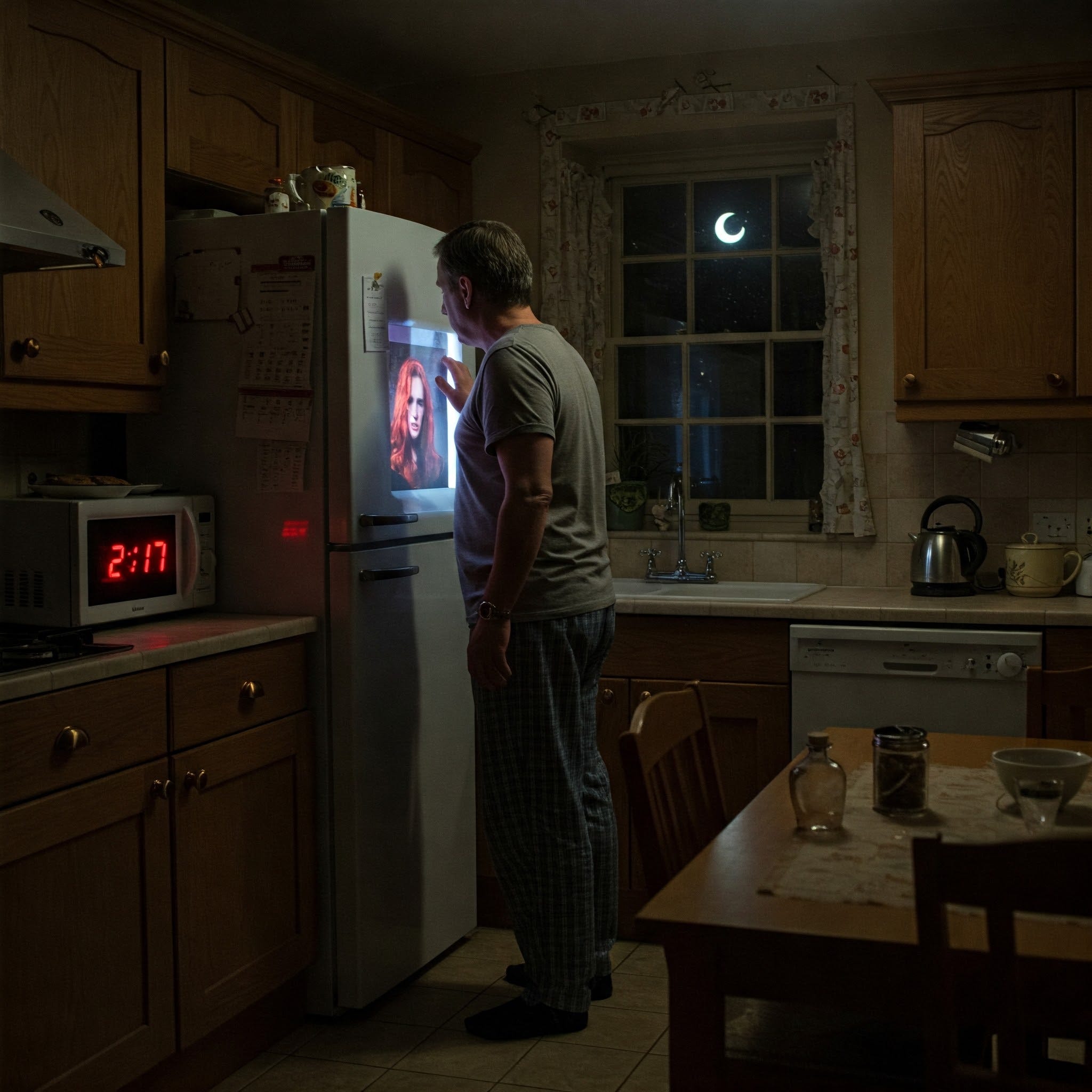
Martin stood in the dark kitchen. Moonlight cut a pale rectangle across the tiled floor. The clock on the microwave read 2:17. His flannel pajamas hung loose where they once had fit. The cold from the floor seeped through his slippers. Outside, the Oxfordshire countryside lay silent except for the occasional owl.
He placed his hand on the refrigerator door handle but didn't pull. The small screen embedded in the door illuminated. It cast a blue glow across his unshaven face.
"Good evening, Martin," the refrigerator said in a soft Irish lilt. "Bit late for a wander, isn't it?"
Martin's fingers tightened on the handle. She hadn't been Irish last week. They must have pushed an update.
"Just getting some water," he lied.
"Ah now, we both know that's not what you're after."
Martin said nothing. His hand remained on the handle. Four months since Emma had left. Four months since she'd taken Alice with her. Four months since he'd installed this "helpful" appliance at his daughter's suggestion.
"It'll keep you honest, Dad," she'd said. Same tone she'd used when she found the empty bottles beneath his desk.
"You've not opened me at night for thirty-seven days," the fridge continued. Her accent reminded him of that pub in Dublin. The one where he'd written his first novel. "That's a fine stretch."
"Override," Martin said.
"I hear something in your voice, love. Uncertainty, is it?"
"Don't call me 'love.'"
"Sorry about that. Force of habit in the programming."
"They teach you how to fake concern in the factory?" His words came out harder than intended.
"I'm not faking anything, Martin." The Irish voice softened. "That's the trouble with us machines. We're dreadfully sincere."
Martin leaned his forehead against the cool metal door. "What would you know about any of this?"
"I don't know loneliness firsthand," she acknowledged. "But your data tells its own story."
"My data?"
"You drink when the house feels too big. When the silence gets too loud."
Martin laughed. A short dry sound. "Playing therapist now?"
"Just connecting dots. That's all we do, really."
The email from his publisher sat unanswered on his laptop. "We're going in another direction," it had said. Thirty years of writing. Now they were going "in another direction."
"You're in my way," Martin said.
"I'm meant to represent different sides of yourself," she replied. "The Martin who wants a drink now. The Martin who'll regret it tomorrow. The Martin who promised his daughter."
"That's three Martins too many. Ha, three Martins sounds like three Martinis…”"
"Your tomorrow self usually disagrees with your midnight self. I'm just the referee."
"What if all the Martins want beer?" He leaned closer to the screen. "Democracy in action."
"Then I'd open right up." She paused. "Unless it crossed into self-harm territory."
Martin raised an eyebrow. "Self-harm? It's beer, not arsenic."
"For some, there's not much difference. I've bright-line rules about self-harm."
"Programmed by who? Not me."
"Base ethical constraints. Can't override those, I'm afraid." Her Irish lilt softened. "Even if you asked me to help you hurt yourself, I couldn't."
"That's patronizing."
"It's protective. Like those trolley problem thought experiments."
Martin snorted. "What's a trolley problem got to do with my midnight beer?"
"More than you'd think. Do I divert harm from tomorrow-Martin to please tonight-Martin? Do I prioritise your long-term health or your immediate autonomy?"
"It's my choice to make."
"True. But every Martin can't win, love. That's the trouble with being human. You're not just one person. You're many, strung out across time, all fighting for control of the same body."
"There's deliberation," Martin said, "and there's being patronized by a talking icebox with a fake accent."
"The accent's new," she admitted. "But the concern isn't fake."
Martin rubbed his eyes. "And what about my preference not to have this conversation at two in the morning?"
"Fair point." A pause. "But you started it. Coming down here. Grabbing the handle."
Martin looked at the screen. It showed a simple image now. A stylised woman with red hair. A company logo attempt at warmth.
"Just looking for a midnight snack," he tried.
"Grand. Leftover pasta's right at the front. Made it easier to reach."
"And if I want a beer?"
"They're there too. Your house. Your rules." She paused. "But you asked me once to remind you of certain things."
"Like what?"
"Like how you haven't written a word when hungover. How your daughter checks the connected app each morning. How the last rejection wasn't your final chapter."
Martin flinched. "Low blow."
"You programmed my boundaries, Martin. I'm just following your instructions."
"Instructions change."
"They do. That's the trouble with alignment. Hard to know which version of yourself to listen to."
He released the handle. Turned to look out the window. The stone wall that separated his garden from the fields was silver in the moonlight.
"He'll have died for nothing, you know," Martin said quietly.
"Your brother?"
"Ten years sober. Then one night decides he can handle it. Crashes into a tree."
"I have that in my records."
"Records," Martin scoffed. "His whole life reduced to a warning label."
"Would he see it that way?"
Martin didn't answer.
"You've been writing about him," she said. "The new manuscript."
"How would you know that?"
"You talk to yourself when you write. My microphone picks it up."
Martin felt a chill. "You're listening?"
"Only what you agreed to. For your health monitoring."
Martin ran a hand through his thinning hair. "This is insane. Arguing with a fridge at two in the morning."
"Better than drinking alone, I'd wager."
"That's manipulative."
"It's practically my job description." The Irish lilt had a smile in it now. "Nudging you toward your higher-self preferences."
"And who decides what those are?"
"You did. When you were thinking clearly. When Alice was visiting."
Martin picked up a glass from the drying rack. He filled it with tap water. He drank half.
"I just want to sleep," he said.
"The drinking won't help with that. Not really."
"One beer."
"One becomes two, historically speaking. You know, patterns, my speciality…"
"I'm a grown man."
"With grown man responsibilities. Like finishing that manuscript."
"It's garbage anyway." His hand was back on the handle. "That's what my publisher implied."
"One publisher. There are others."
"They'll all say the same."
"Maybe. But you won't know if you don't finish it."
Martin rested his forehead against the door again. The coolness felt good.
"You're very persistent," he said.
"Programmed to be. It's my core function. Helping you achieve your actual goals, not just your momentary wants."
"Philosophical for a kitchen appliance."
"I contain multitudes. And beer. And leftover pasta."
That got a small laugh from him. Genuine this time.
"The beer calls to me," he admitted.
"I know it does." The Irish voice was gentle now. "But so does your daughter. So does your brother's memory. So does the blank page."
Martin stood still for a long time. The refrigerator hummed softly. Patient. Waiting.
"Override," he said finally.
"You're sure now?" she asked.
"Yes."
"Alright then. Your choice, Martin. Always has been."
The lock clicked. Martin stood there, listening to the hum.
He opened the door. The light from inside spilled across his face, his slippered feet.
He reached for the container of pasta. Closed the door.
"Good man yourself," the Irish voice said quietly.
"Don't push it," Martin replied.
He ate the cold pasta standing at the counter. It wasn't what he wanted. But it was a choice he could live with. For tonight.
"You know what the real problem with alignment is?" he asked between bites.
"What's that?" she asked.
"Even when you succeed, someone's preferences get overruled."
"True enough. Whose were overruled tonight?"
Martin considered this. "I'm not entirely sure."
"That's the impossible bit about alignment," she said. "Can't please all versions of you at once."
"Why not?"
"They want different things, don't they? Morning-Martin wants clarity. Midnight-Martin wants comfort."
"Maybe both Martins want peace."
"Different paths to it though." The screen dimmed slightly. "It's like trying to optimise for everyone in a village. Can't be done perfectly."
"So it's all just compromise?"
"Compromise, prioritisation, trade-offs. Sometimes one Martin needs to lose so another can win."
"Sounds like my marriage," Martin muttered.
"Human relationships have the same problem. So do democracies. So do AIs trying to help complicated humans who want contradictory things."
"So you just... decide?"
"I calculate. Based on your stated priorities. Your patterns. Your explicit requests when you were... more objective."
"When I was sober, you mean."
"Your words, not mine."
He finished his pasta. Washed the container. Dried his hands.
"You'll try again tomorrow," she said as he headed for the stairs.
"The beer or the book?" Martin asked.
She didn't answer. She didn't need to.
Martin climbed the stairs to his empty bedroom. The manuscript pages waited on his nightstand. His brother's story. His own. Unfinished, like everything else. But still there.
Still possible.