

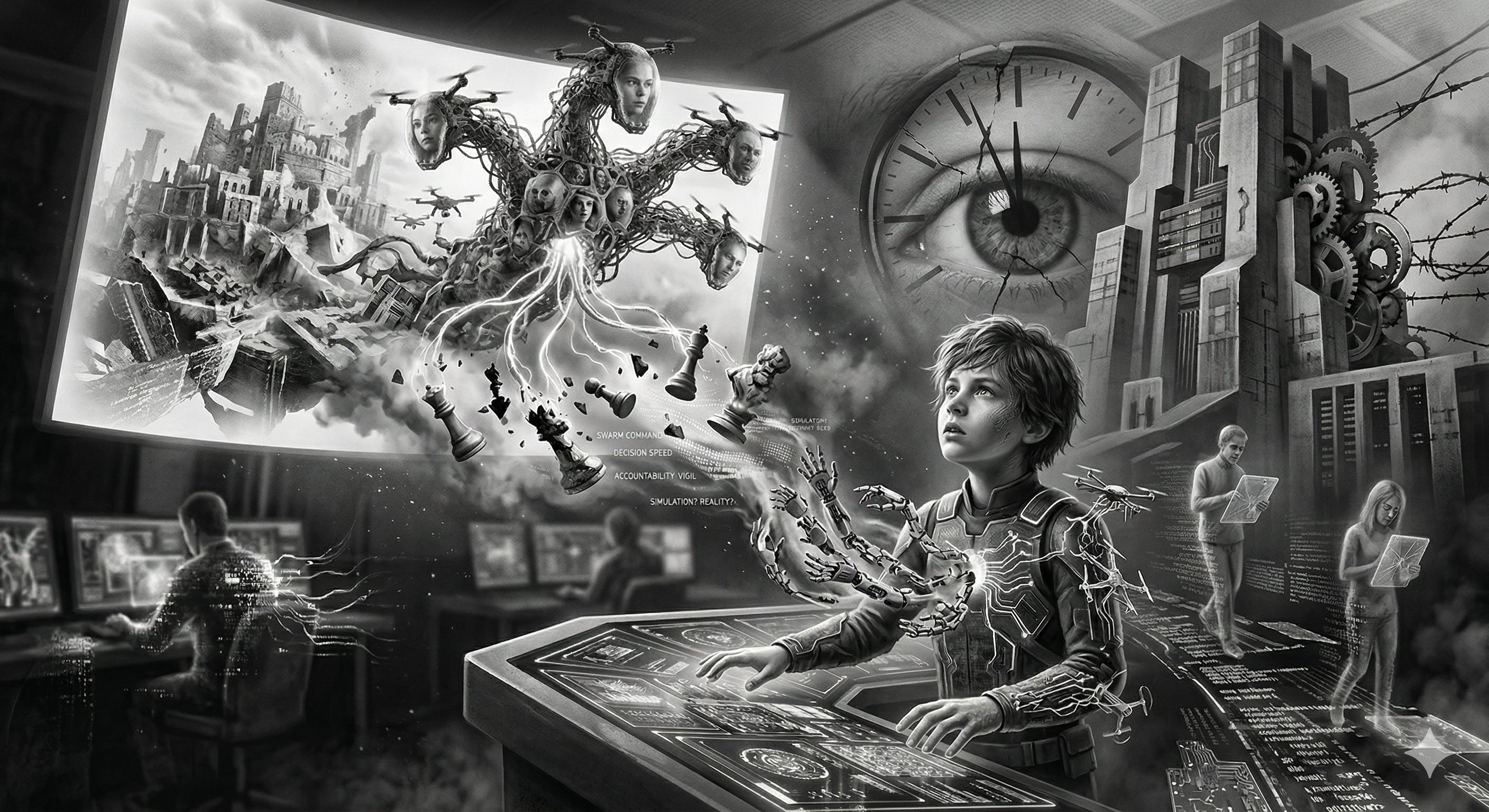
Ender’s Game is a classic sci-fi book (and a not so classic film). It was written in 1985 by Orson Scott Card. However, it is being referenced often today, over 40 years later, at the moment AI is seriously entering the world of military capability. The questions of flexible thinking, decision speed, AI swarms and finally accountability are all present in the book as they are in Ukraine and Iran today.
First, flexible thinking. In the book, Ender Wiggin, a child, is trained to fight and destroy an alien civilisation (the Formics). Ostensibly children are recruited because their minds are more plastic. They learn faster, adapt more readily, and haven’t yet calcified into the tactical orthodoxies that constrained adult commanders in the first Formic war. Ender’s Battle School exists to produce commanders who think about three-dimensional zero-gravity combat as natural, not as a problem to be translated from ground-based intuition.
Today the Ukrainian drone experts are the Battle School children who have learnt new ways of fighting. They are being called upon by Middle Eastern and indeed US militaries to help defend against Iranian drone attacks in the US-Israeli war against Iran. Given recent US - Ukraine relations, and the fact that Russia is supplying Iran with drone expertise used against the US and its allies, there are multiple ironies at play.
In terms of decision speed, the novel’s core tension is the compression of decision time to the point where the distinction between simulation and reality collapses. Ender plays fast paced games against simulated Formics. The last game he plays, though he doesn’t know it, isn’t a game at all and he destroys the enemy, to his own psychological cost.
Today, in the US, Palantir’s Maven system is designed to compress sensor-to-shooter timelines from minutes to seconds, reducing the window for human deliberation. Pete Hegseth’s January 2026 AI strategy memo is explicit: “the risks of not moving fast enough outweigh the risks of imperfect alignment” and “speed wins.” This speed means that humans are no longer, in reality, “in the loop”.
Then there are swarms and autonomous weapons. In Ender’s Game battles are fought with hundreds of small ships acting as a coordinated mass. The Formic swarms are the tactical issue that defeats conventional human military thinking in their first invasion. Hundreds of small ships are coordinated as a single organism, controlled through the hive queen. Having just beaten them off, humanity’s solution is to match swarm with swarm - and to find a commander fast enough to direct the counter-swarm in real time (Ender).
Between January 2024 and August 2025, the number of Shahed-type drones launched by Russia into Ukraine per month increased more than tenfold, from 334 to over 4,000. Ukraine has found Nvidia chipsets in downed Shahed drones, along with thermal-vision modules. The drones are now interconnected, exchanging information with each other, and can autonomously navigate to objects.
In Ender’s game a commander was needed who thinks in aggregate, in patterns, in probabilities. Today swarms of Ukrainian autonomous drones carry other autonomous drones to protect them against Russian autonomous drones trying to intercept them. The Ukrainian drones are controlled by AI agents overseen by a Ukrainian general… somewhere.
Finally, accountability: in Ender’s Game, Ender is lied to and it is the adults who are ultimately accountable. However, the adults are heroes because they “saved” humanity by committing genocide.
The US military has formal accountability architecture - the Uniform Code of Military Justice, Rules of Engagement, Law of Armed Conflict, congressional oversight. On paper it is robust. In practice, no court has yet tested whether an AI system satisfies the legal standard for precaution when making a targeting decision in milliseconds without the contextual knowledge a human operator would bring.
Hegseth in the Pentagon, defines responsible AI as “objectively truthful AI capabilities employed securely and within the laws governing the activities of the department.” The laws governing AI targeting don’t exist yet, so “lawful” means whatever hasn’t been prohibited, which is nearly everything.
In the recent Anthropic bust up, Anthropic refused Pentagon demands to remove safety restrictions on Claude for weapons used under this “lawful” criterion; Hegseth threatened to invoke the Defense Production Act and blacklist Anthropic. The courts, at significant cost to Anthropic and the US tax payer, will decide
In the Department of War, any accountability is currently very diffuse. The Maven Smart System synthesises 150 sources and generates targeting recommendations. A human approves. The drone strikes. Who decided? The algorithm identified the target. The officer approved a recommendation he couldn’t independently verify in the time available. The contractor built a system to spec. The spec was written by a procurement office. The accountability question dissolves upward into policy and downward into code.
In the book, Ender eventually finds out he caused a genocide. He spends subsequent books living with what he did. A moral resolution - guilt and conscience as retrospective accountability, when institutional accountability had failed. Here the parallels end: the current administration doesn’t do guilt and conscience.
**********
As ever, thanks to ChinaTalk and the Second Breakfast team for sparking these thoughts.
