

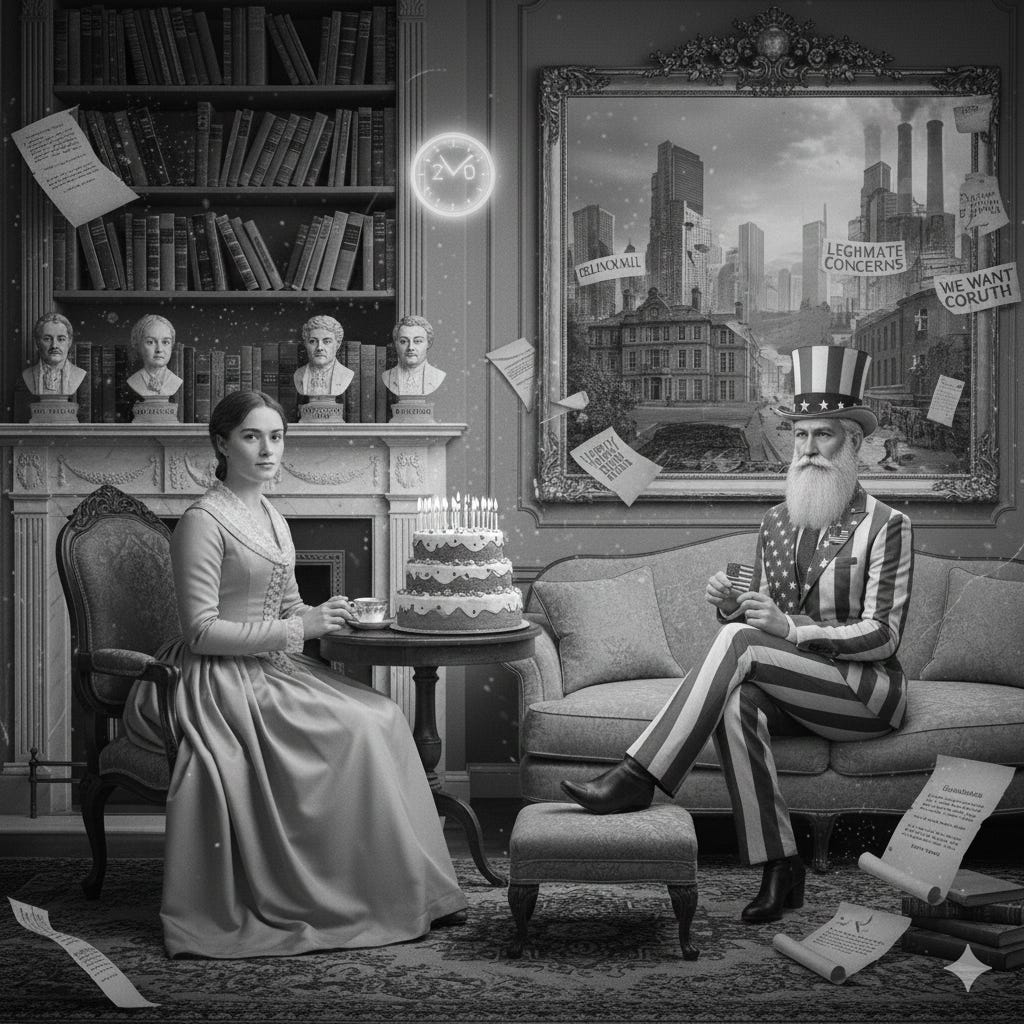
Scene: A drawing room, somewhere outside time. Miss Austen arranges herself with precision; America lounges confidently, flag pin gleaming.
AMERICA: Jane! Great to finally meet. Two-fifty feels pretty good. We’ve done some amazing things.
AUSTEN: You have indeed. I confess I was sceptical at first - a nation founded by men who fled taxation whilst owning other humans. But you proved the doubters wrong. Mostly.
AMERICA: Exactly. Land of opportunity. Free markets. Freedom of expression. We built the greatest economy in history.
AUSTEN: The Boston Tea Party! Such a principled stand against protectionism and arbitrary tariffs imposed by a distant power more interested in its own revenues than colonial prosperity. I assume that spirit of free trade endures?
AMERICA: We believe in... fair trade. Reciprocal. Looking after our own.
AUSTEN: Ah. You know, I gave Mr. Darcy ten thousand a year precisely so he would not need to protect his interests. True wealth, I always felt, is generous. It is only the anxious rich who hoard - Sir Walter Elliot selling off parcels of Kellynch to maintain appearances. A great estate, slowly diminished by a man convinced of his own superiority.
AMERICA: That’s not really…
AUSTEN: And your Constitution! The separation of powers. In my own small way, I understood the principle. Elizabeth Bennet succeeds because she is checked - by Jane’s gentleness, her father’s irony, even Darcy’s challenge to her prejudices. Unchecked judgment becomes first satire, then… well, ruin, I suppose.
AMERICA: I’m not sure I....
AUSTEN: I was thinking of Mr. Collins, actually. Have you read my books? He is a clergyman who believes himself eloquent. The comedy arises because everyone sees through him - his patroness Lady Catherine, the Bennets, even poor Charlotte who marries him. He is protected only by the impossibility of his ever recognising his own absurdity.
AMERICA: (shifting) Again, I’m not sure what…
AUSTEN: The danger, you see, is when others stop seeing through such men. When they are laughed at in private, but deferred to in public. Charlotte marries Mr. Collins knowing precisely what he is. She simply decides comfort matters more than truth.
(She adjusts her teacup.)
I wonder sometimes what happens when so many people make Charlotte’s choice.
AMERICA: People have legitimate concerns…
AUSTEN: Oh, certainly. Mrs. Bennet’s concerns were legitimate. Five daughters, an entailed estate, no security. One understands her panic. But panic made her vulgar, and vulgarity made her push Lydia toward Wickham, and Wickham very nearly destroyed them all. Legitimate concerns, very poor judgment.
AMERICA: People were scared, anxious…
AUSTEN: Wickham was so charming. So plausible. He told Elizabeth exactly what she wished to hear about Darcy - confirmed her every prejudice. It was only later she thought to ask: why does this man speak so freely to a stranger? What does he want? What’s in it for him?
AMERICA: Are you suggesting...
AUSTEN: I made Wickham handsome, you know. Deliberate choice. The genuinely dangerous are rarely ugly. They are agreeable. They flatter. They promise.
AMERICA: Not everyone who’s popular is a con man.
AUSTEN: No indeed. But I notice you have become defensive. Have I offended you?
(Long pause.)
Tell me about your peaceful transfers of power. Every four years, I understand, since Washington himself.
AMERICA: (staring at floor) It’s, er, complicated…
AUSTEN: Complicated. Yes. In Mansfield Park, I wrote about the Crawfords - Henry and Mary. Glittering, sophisticated, modern. Everyone admires them. But when the crisis comes, they reveal themselves. Henry seduces a married woman; Mary tries to minimise it. “Folly,” she calls it. A matter of poor management, getting caught.
The Bertrams are not ruined by the Crawfords. They are ruined by their own refusal to see what was always visible.
AMERICA: These elliptical references. What are you saying exactly?
AUSTEN: I am saying that in my novels, people get what they deserve. I am sometimes accused of cruelty for this. But I notice that Lydia ends bored and poor, Mr. Collins remains ridiculous, and Sir Walter must let Kellynch to a naval officer - a working man - while he retreats to Bath to economise.
Choices have consequences. That is the nature of plotting.
AMERICA: So…
AUSTEN: (standing to leave) I wrote comedies. In comedies, the sensible prevail, the foolish are exposed, and everyone gets married. Tragedies… well, not so often.
(Pause.)
But you will have noticed I set all my novels in small villages and country houses - even Bath, which I confess I detested. I never attempted a canvas as large as a nation. Perhaps at that scale, your scale, the calculus is different. Perhaps the foolish can prevail, if enough Charlottes decide a comfortable life matters more than truth.
AMERICA: That’s not an answer.
AUSTEN: Like my novels, I merely observe.
(She pauses at the door.)
I will say this: Elizabeth Bennet was not a perfect judge of character. She was wrong about Darcy, wrong about Wickham. What saved her was the willingness to change her mind when confronted with evidence.
Whether that is available to everyone, I cannot say. It requires a particular kind of courage - admitting one has been ridiculous. Most would rather persist in error than confess to it.
AMERICA: (quietly) We’ve changed before.
AUSTEN: You have. Yes, perhaps you have.
[Austen leaves. America remains, turning the Stars and Stripes pin over in their hands.]