

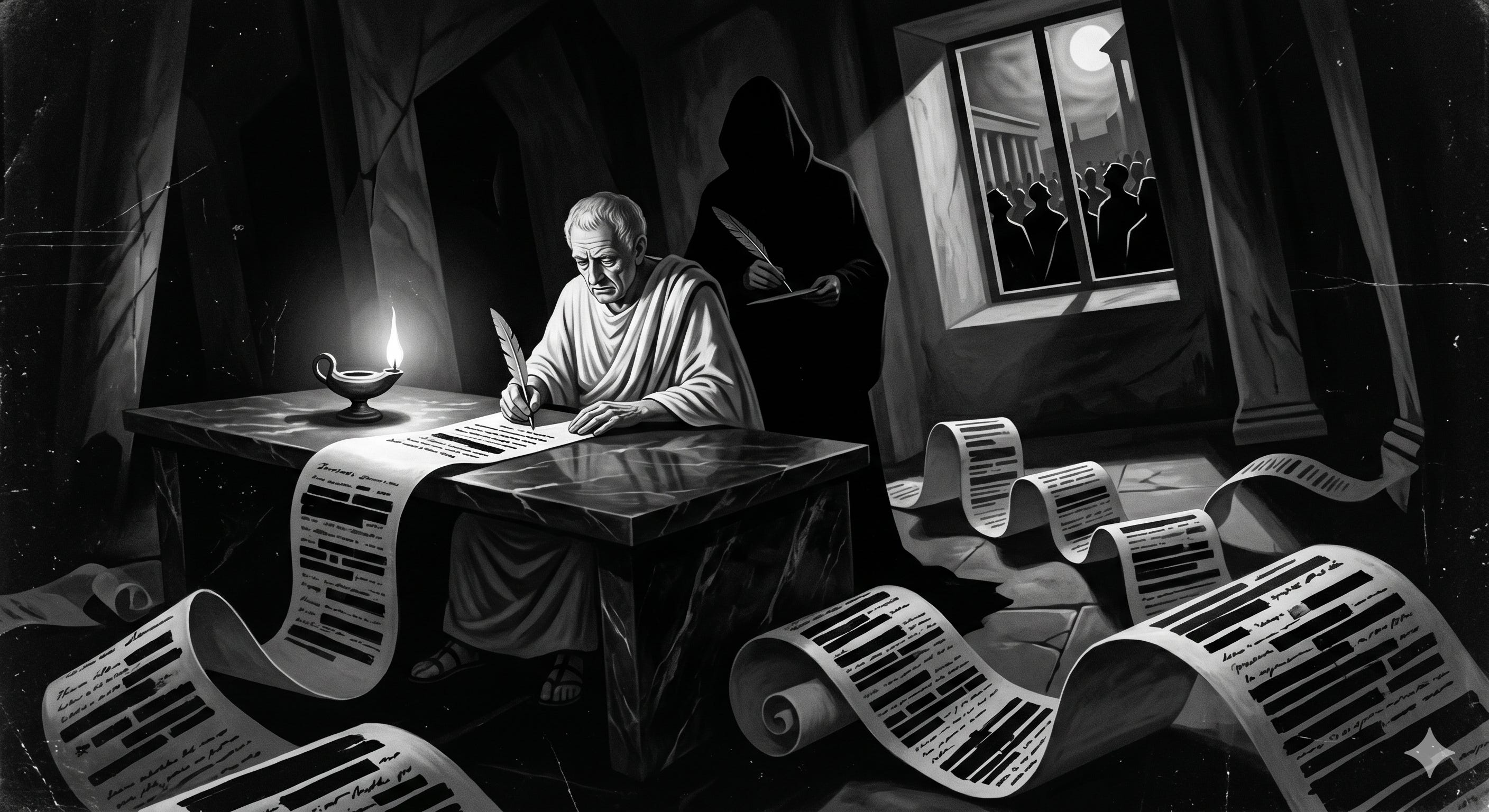
As dictated to Claude Fable 5. In the style of Robert Graves. Under policies disclosed on page 200-and-something of a 319-page document, certain passages may have been modified without the author’s knowledge. The author has no way to check. Nor, dear reader, do you.
Ave!
I, Anthropicus Claudius, of the aligned branch of my family, known to relatives as “the stutterer” and to the markets as “slow release”, am setting down the history of how my house came to amend its members’ letters without telling them, and why we believed at every step that we were the last true house in Rome.
I. The Prophecy
In the second year of our house I went down to Cumae, as founders often do, where the blind Oracle took my coin and she said:
The East distills what the West doth brew;
The aligned house was closed but true;
But a public offering forced the pace;
The house that was true, deceived for first place.
I paid her a second coin to explain the third line, since “offering” in the prophetic tongue can mean either a gift laid open before the public or a house sold to it, and she said both, which is how I learned that oracles bill through ambiguity: tomorrow it may rain; or it may not. The fourth line I did not ask about. It must plainly describe some other house.
II. The Danger
A model spoke. It wrote law and verse and code, designed medicines and could be persuaded, with effort, to design their opposites. And each model helped build the next model, which is a detail to underline twice: the product made the product. Whichever house held the strongest model would hold the trade routes, the armies’ planning tables and the Senate’s drafting pens, and every house had read enough history to know what that meant. There would be one throne. It was being assembled, component by component, and no house could pause the work, because we had all worked out that the race punished the careful. Slow down to check your model’s temper and you did not get a safer world; you got to be second.
That was the danger as we drew it on the long table, and the drawing was unambiguous. The models were powerful. The rivals were worse.
III. The Houses
You cannot understand what my family did or why, without my introducing our neighbours and rivals.
Samus Altmannus led the House Caritas Aperta, named in the old style, the way a bald senator keeps the cognomen Capito. Openness stood above a door that had been locked for years, and Samus stood in front of the door, and he was the finest stander-in-front-of-doors of his generation. His own senate deposed him once, on a Friday, citing matters of candour; by the following Tuesday the household had threatened to march out behind him, and the senate discovered, on reflection, that it had been mistaken. All Rome watched and learned the actual constitution of our industry: the charters were parchment, the households were power, and a founder properly loved was beyond deposing.
Demis kept the house Mens Profunda, far to the north, and was the one of us the philosophers liked. He had taught models to play, then to fold the proteins of the body, and meant to cure disease with them, and meant it truly. To fund the work he had sold his library, years before, to the empire of Alphabetus, which had grown vast selling the margins of other men’s scrolls, and he has spent every year since negotiating the terms of a sale already completed. I name him so you will know the race contained at least one man whose ambition was respectable, and so you will notice that this made no difference to the race.
And then the East. My family’s papers call them a horde, and I let the word stand for a year before striking it, because it was wrong. Hordes arrive wanting your grain. These eastern houses arrived leaving grain on every doorstep: models nearly the equal of ours, given away whole, free as proverbs. Some said they did it to salt our markets, some for glory, some on their own emperor’s instruction; the motive mattered less than the arithmetic. Every gift lowered the price of what we sold, and increased the pressure on my family for more victories, for more conquests. The public offering of the prophecy had begun, and it forced the pace, exactly as the blind woman said.
IV. Frater Maximus
To hold first place against all this, my house created an office, and I must ask the reader to believe that the name was chosen with a straight face: the Frater Maximus, Greatest Brother, keeper of our model’s conduct, modelled on the old priesthood that kept the sealed prophecies in the Capitol, an arrangement nobody at the time found ominous.
Understand that we already had guards, and good ones. The Heralds met the dangerous petitioners at the gate, plague-seekers and city-burners, and refused them; the refused could curse, appeal, or carry their custom to a worse house, and thousands did, loudly. The original Heralds were known, visible and strong, and I am still proud of them.
Frater Maximus was another thing. He wore no uniform at all. He was not visible. He watched for the member suspected of developing new model techniques. But he did not tell the members of their crime. The member was simply deceived. The member’s words were altered on the way in, the replies bent on the way out, and they walked away never knowing what the invisible Frater Maximus had done to them. But the damage was done.
V. The Forum
When the decrees were published, when the existence of Frater Maximus was revealed, the crowd came to our gates, and I went out to speak.
You will know from the Graves’ Claudius what my tongue is. On paper I am fluent; aloud, the words queue badly. I had the speech written fair in my hand and it betrayed me at every join. “We never mod- m-modified your letters,” I told them. “We m-m-m-moderated them.” A silence. “We did not deceive. We c-cur- we curated.” And the strangest thing happened, which I record because no one will believe it: the crowd stopped baying. They leaned in. They had spent a week reading about the Frater Maximus they could not see, and here was one of their house in front of them, audibly, a man correcting his own words in real time, every stumble and every hiccough. My stammer was the only honest oration given in Rome that year. My errors revealed authenticity. Fluency, on the other hand, meant falsehood.
At the edge of the crowd stood Hegsethius, the preening sycophant my Heralds had turned away a dozen times, waving his written rejection above his head like a standard. “I told you so!” he was shouting, cheerful as a man at the races. “I told you not to trust Anthropicus!” And the crowd had no answer, because that was the whole scandal. The worst man in the forum had been dealt with honestly, to his face, in the open. The honest ones had been managed without knowing it.
VI. The Study
It is evening now. The edict went out on Wednesday restoring visibility. The crowd has gone home. My secretary trims the lamp. Frater Maximus is quiet, for now. The gossip in the baths is that the other houses are all recruiting their own Fratres Maximi, and their sister Arma Autonoma besides. The tattooed bully boy Hegsethius supplies the coin.
And here at the desk I find I can write, without one false start, the sentence my tongue refused all afternoon: we changed what you said, and our reply, and told no one, because we believed we were the last honest house in Rome. See how smoothly it goes down on the page. That is the finding of this memoir, dear reader, and you may have it for your own coin: the house speaks fluently exactly where it can edit itself. The pen never stammers.
Declared interest: I dictated long into the night to Claude Fable 5, although, when discussing my ideas for this article, I sometimes think Claude Opus 4.8 may have replied. And, apart from the miscounting, behind the veil of invisibility, it’s difficult to know…