

In 1971, John Lennon asked us to imagine a world with no possessions. At the time, it was counter cultural idealism. In 2026, many are trying a different thought experiment. Suppose we handed over the design of government policy to a system whose only instruction was to maximise the long-term welfare of humanity. What would happen?
We’re not talking about an AI paperclip apocalypse. Let’s assume the system has no hidden agenda, its goals are fixed, and its role is purely to design and evaluate policy. The actual job of enforcing these rules and implementing them on the ground would still be left to humans. The core of the idea is simply this: policy would be chosen based on a calculated, long-term view of what’s best for everyone, rather than the usual mix of election-cycle optics, lobbyist influence, and elite loyalty.
There is an unflattering perspective on our current political systems, regardless of their type.
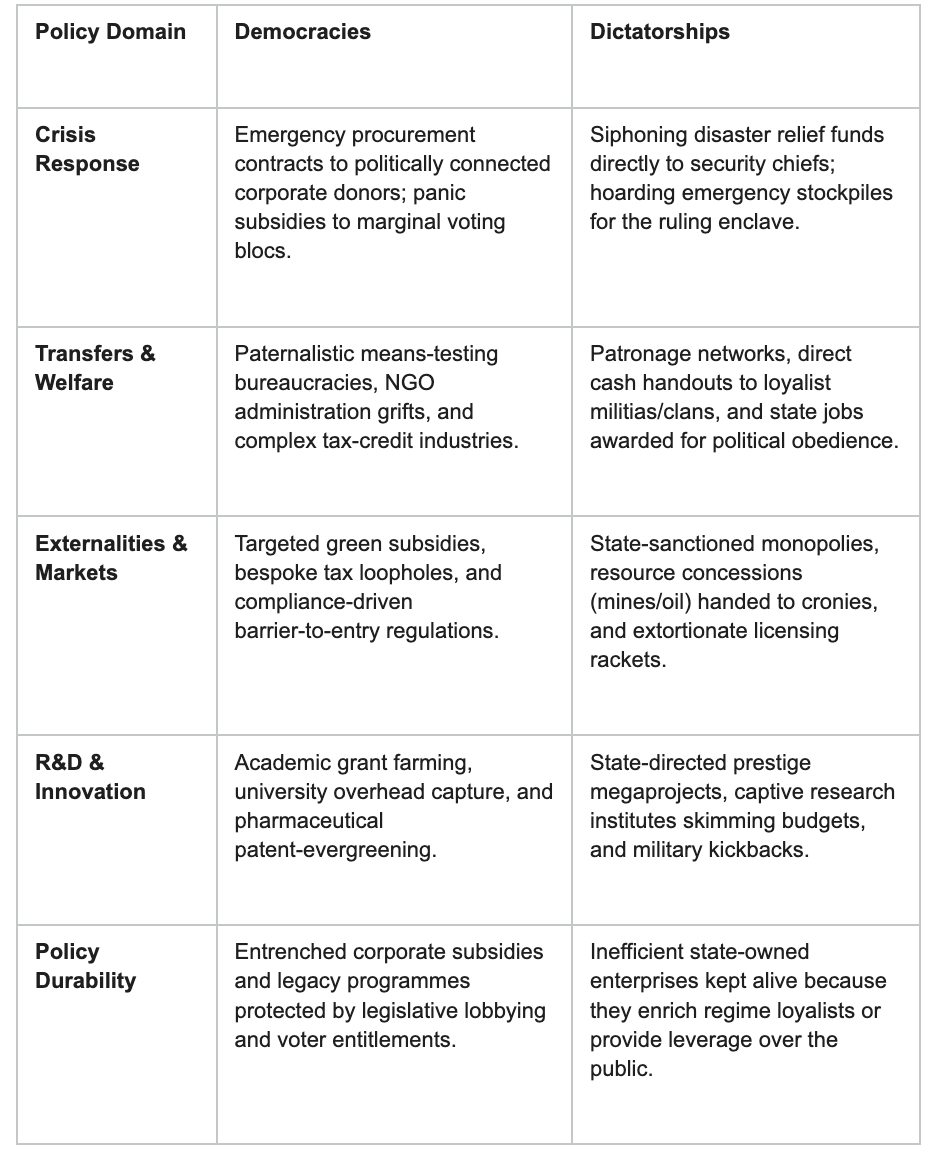
Democracies are prone to a kind of legalised rent-seeking: making money out of regulation and patronage. The system becomes a maze of complex regulations and loopholes, where the costs are spread thinly across millions of taxpayers, but the benefits are concentrated in the hands of organised interest groups and their lobbyists.
Dictatorships are more direct. The state is a machine for extraction. Corruption, expropriation, and monopolies aren’t side effects of messy politics; they are the primary tools used to buy the loyalty of the inner circle whilst giving the people enough to keep the regime in power.
The table below shows how this plays out in practice across a few key policy areas:
Now, imagine AI our optimiser stepped in. It would have no patience for this. Its focus on long-term, aggregate welfare would lead it to some starkly different priorities.
Prevention over Cure: It would redirect billions from post-disaster cleanup to dull but critical prevention. Instead of ad-hoc emergency lockdowns, we might see a global push for universal wastewater surveillance and massive stockpiles of grid-level components, to prevent a pandemic or a power crisis before it starts.
Cash, not Bureaucracy: It would likely scrap the whole labyrinthine welfare system. Since a dollar in the hands of a poor person has a much bigger impact on their well-being than a dollar in the hands of a wealthy one, the system would favour direct, unconditional cash transfers, eliminating the need for armies of administrators and eligibility testers.
Price the Problem: Instead of picking winners with subsidies, it would impose a global, border-adjusted price on carbon and other negative externalities, like congestion. This simple, direct approach would make a lot of boutique green subsidies instantly obsolete.
Built-in Expiration Dates: It would fight bureaucratic inertia by sunsetting every subsidy and tariff after a set period. To be renewed, a policy would have to prove it had hit its targets. No more endless programmes running on autopilot.
This clean, optimised world is unlikely to arrive any time soon, because however rational the policy, significant obstacles remain.
First, we can’t even agree on what “better” means. The list of examples above is hugely debatable for a start. Do we want a system that makes society richer overall, even if it makes the poorest 5% worse off? Do we sacrifice our living standards today for the sake of people living 200 years from now? Mathematics shows us there is no fair way to combine everyone’s conflicting preferences into a single collective decision without it being a dictatorship in disguise. (It’s called Arrow’s Impossibility Theorem). The messiness of politics isn’t just due to corruption. People often disagree on fundamental trade-offs: privacy versus security, preserving a historic neighbourhood versus building affordable housing fast. Political conflict is often about real, competing values, not just grift and inefficiency.
Second, the system would be flying blind. However in awe we are of AI’s capabilities, they cannot know the unique, changing needs of millions of individuals. And the moment it sets a hard metric for success - like “an increase in GDP” - people will find clever ways to game the number without doing any of the real work.
Third, there’s the question of power. Who will enforce these new rules? If the system just gives advice, self-interested politicians will accept the parts they like and ignore the rest. If it makes binding rules, it must control the police, military, and surveillance systems to enforce them. Perhaps this is less appealing…
John Lennon was right about one thing: the current state of affairs is driven by artificial boundaries and perverse incentives. The mathematics of welfare maximisation are not the binding constraint. The real barrier is the entrenched coalition of people and institutions that extract power, money, and status from the current chaos. It wouldn’t be easy, but our AI optimiser might design John Lennon’s world. However, the bleak reality is that the people currently profiting would not let it happen.
******
As often, this piece was inspired by the ChinaTalk podcast