

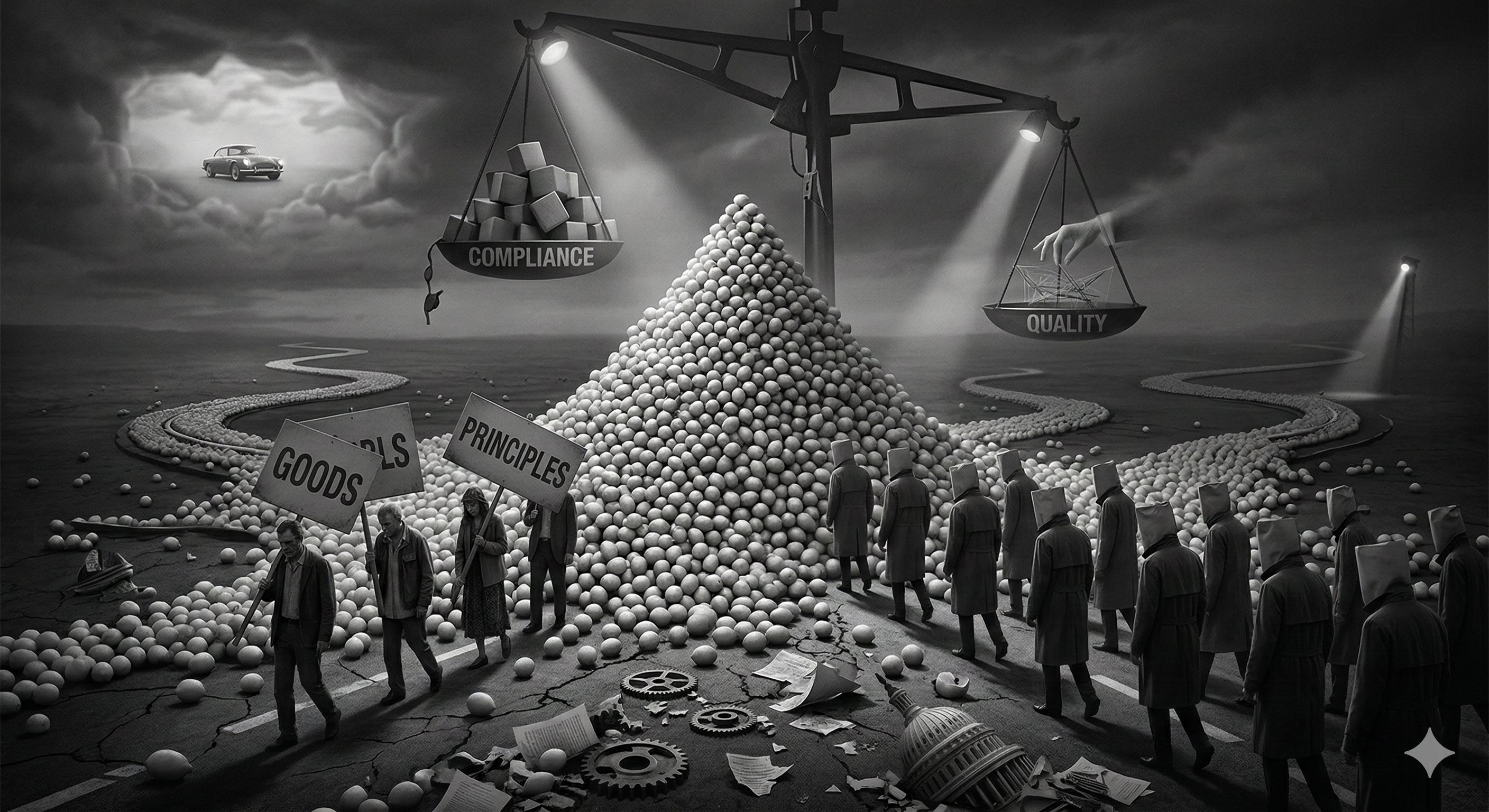
In 1970, a young economist named George Akerlof submitted a paper to three of the world’s leading journals.
The paper was called “The Market for Lemons.” It would eventually win Akerlof the Nobel Prize. Its central insight - that when buyers can’t observe quality, bad products drive out good ones - is one of the few economic ideas that genuinely changes how you see the world.
The used car market was his illustration. A seller knows whether their car is reliable or unreliable - a lemon. The buyer doesn’t. Since the buyer can’t tell the difference, they’ll only pay the average price. At the average price, people selling lemons make a profit. But the average price is too low for sellers with good cars, who withdraw from the market. The remaining pool gets worse - more and more lemons. The price falls further. More good cars exit. All that is left is lemons.
Last month, Anthropic - the AI company that had imposed explicit limits on its technology’s use for US civilian surveillance and in autonomous weapons - was classified by the US government alongside Huawei as a national security threat. The designation was, in the clinical language of these things, about risk. Anthropic had declined to operate without constraints. In procurement terms, a contractor that might say no is a contractor you cannot rely on.
OpenAI, which had recently reversed its own restrictions on military applications, took the contract.
So, the company that said “there are things we won’t do because they are too risky or wrong” was classified as a threat. The company that said “we’ll do whatever you need” was classified as a partner.
Let the lemons begin.
The buyer here - the Department of Defense War - cannot easily observe the quality dimension that actually matters: not processing speed, not model performance on benchmarks, but what the AI will and won’t do when the stakes are high. Safety limits are, from a procurement perspective, a source of uncertainty. A contractor with principles is a contractor with veto power.
So the system defaults to a different signal: compliance. Will you work with us, without conditions? That becomes the proxy for reliability. And once compliance is the signal, the selection mechanism runs exactly as Akerlof described. Companies willing to operate without limits are rewarded with contracts. Companies with limits are penalised - or, in Anthropic’s case, designated threats. The responsible actors watch this, update their models, and face a choice: abandon your limits, or abandon the market.
The market clears. Of everything worth buying.
But the DoW is just the first level.
The same mechanism is now operating across the wider relationship between the US government and its contractors, partners, and suppliers. When the criterion shifts from technical capability to ideological compliance - in procurement, in research funding, in institutional relationships - adverse selection runs at scale. You are systematically filtering out the actors most likely to tell you when you’re wrong.
Good organisations - the ones with internal standards, with people who push back, with cultures that surface bad news - are counterparty risks. They might say no. They might leak. They might sue. The organisations without those qualities are frictionless. And frictionless is what the system is currently selecting for.
This is how institutions lose the capacity to course-correct. Not through a single catastrophic decision, but through the quiet, rational operation of a selection mechanism that prices out integrity.
So now all companies that do business with teh US Government have applied a risk premiuim. Except those that are prepared to be fully compliant to the wishes of the Trump administration.
Extend the logic one level further, and you’re looking at the international order.
The United States has, for seventy years, organised a significant portion of global trade, security, and diplomacy around a set of stated principles: rule of law, institutional reliability, the predictability of agreements. Allies could plan around American commitments. The system had frictions - it was never as principled as advertised - but the friction was part of the value. A partner that operates within rules is a partner you can do business with over time.
That signal is changing. When the US launched strikes on Iran in late February, it did so with little consultation with European allies, then expected their bases and broad support. Two NATO partners invoked the rule of law and declined. Spain refused use of its bases for offensive operations; Trump responded by threatening to cut off all trade. Britain’s Starmer declined to join the strikes - “this government does not believe in regime change from the skies” - and was publicly rebuked alongside Madrid.
The selection signal is not subtle. Allies with independent judiciaries, functioning legislatures, and electorates that ask questions are unreliable partners - they might not comply next time. Governments without those constraints are more predictable, in the way that currently matters: they’ll say yes.
Akerlof’s lemons, again. Soon US foreign policy will primarily be focused on those entities where the rule of law is negligible and where compliance the chief commodity.
It is worth noting, for the record, that George Akerlof’s paper was rejected three times before publication. The journals couldn’t identify its quality. Irony. Crude, but still worth mentioning for it’s amusement value.
The question his paper never quite answered is what happens after the market clears. In the used car case, you’re left with lemons and buyers who know it, and eventually the market collapses or someone invents a warranty.
Sadly, there are few warranties possible in global politics.