

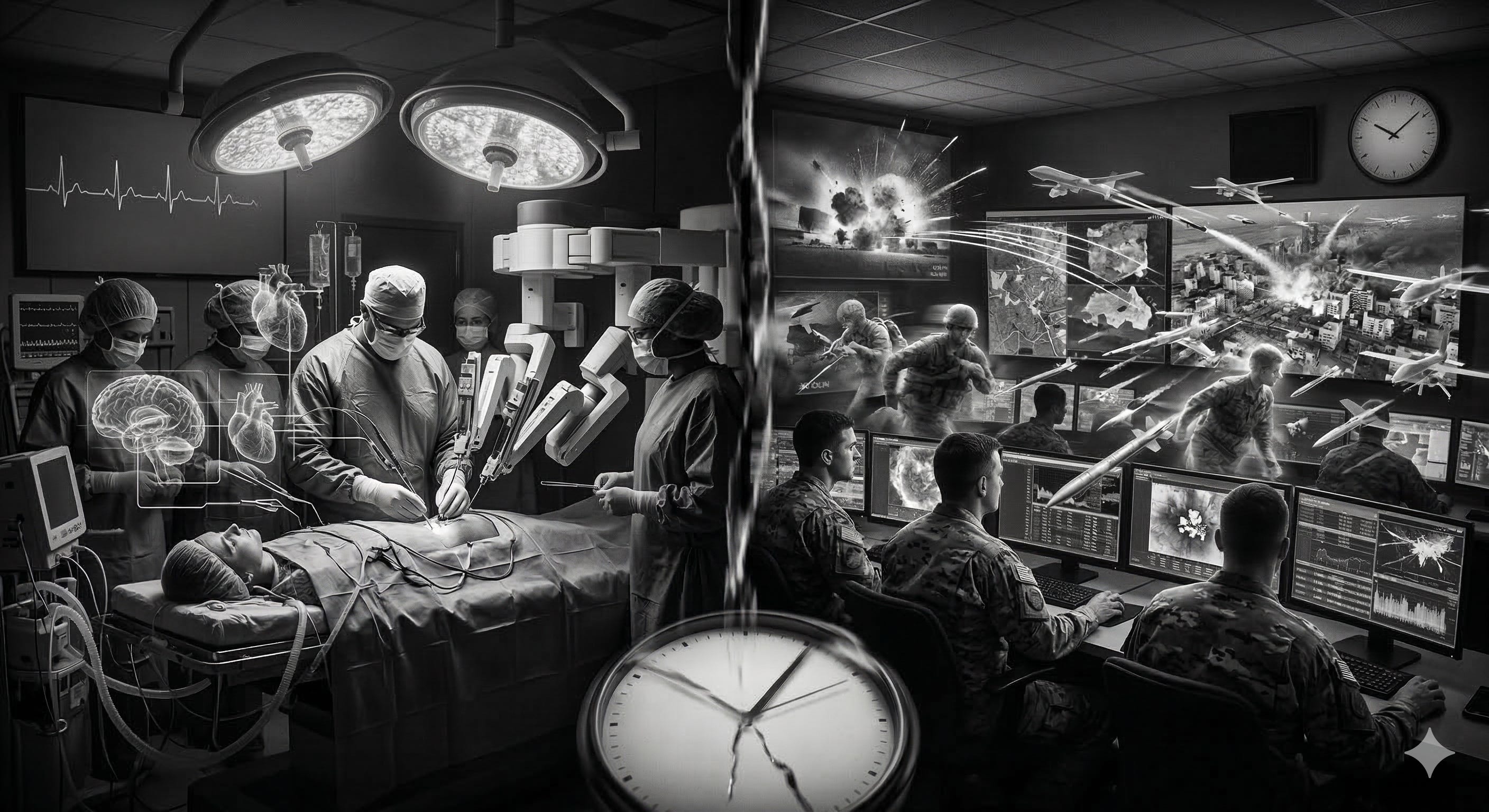
All writers love alliteration and methods of medics and the military has a lot going for it. Apart from alliteration, medicine and the military share more than most people notice. Both deal with life and death decisions. Both operate under extreme time pressure, with incomplete information, in conditions where errors cannot be undone. Both have spent decades building institutional frameworks to manage those conditions. And both are now deploying artificial intelligence at scale in life and death decisions. What they have done with it could not be more different. In both there exist: irreversibility of errors; information complexity; time pressures; oversight issues; and, legal accountability.
1. Irreversibility of Error
Medicine
A surgeon who removes the wrong kidney cannot put it back. A radiologist who misreads a scan and triggers a course of chemotherapy cannot un-administer the drugs. Medicine has constructed an elaborate architecture around this single fact: that some errors cannot be undone. Pre-operative checklists, mandatory second opinions for high-risk procedures, surgical time-outs - these are not bureaucratic excesses. They are deliberate friction based on the institutional memory of disasters that happened when the irreversibility of error was underestimated. The WHO Surgical Safety Checklist is estimated to have halved surgical mortality rates in the settings where it was rigorously adopted. The friction is the point.
When AI entered the operating theatre, medicine did not abandon this logic. Surgical robotics systems give the surgeon capabilities no unaided hand possesses - precision at sub-millimetre scale, tremor elimination, articulation beyond the human wrist. They do not give the surgeon permission to skip the checklist. The pre-operative protocol, the consent process, the instrument count: all remain. The AI augments what the human can do. It does not alter the conditions under which the human is authorised to act.
Military
In the currently ongoing Operation Epic Fury, the United States struck more than 2,000 targets in Iran in four days. For context: the coalition campaign against ISIS struck roughly the same number across the first six months of operations in Iraq and Syria. A building destroyed cannot be rebuilt in the time it takes the next targeting cycle to complete. Those killed in a girls’ school in Minab is not recoverable. The human decision makers in the Department of Defence War, using Palantir’s Maven systems accelerating this tempo are operating on a logic that medicine abandoned decades ago: that speed and volume are inherently virtuous, that more decisions faster is better than fewer decisions made more carefully.
2. Information Complexity
Medicine
Modern diagnostics generate extraordinary volumes of data. A single cancer patient’s treatment pathway may involve genomic sequencing, imaging across multiple modalities, pathology reports, blood panels, and real-time monitoring data from implanted devices. The response of medicine to this complexity was not to process it faster. It was to build multidisciplinary teams, tumour boards, second-opinion protocols - structures that allow human decisions in proportion to the complexity of the information.
AI has transformed what is possible in diagnostic medicine. Deep learning systems can now detect early-stage cancers in mammograms and retinal scans with accuracy that matches or exceeds experienced radiologists, identifying patterns invisible to the human eye across thousands of images simultaneously. However, approved AI diagnostic tools are validated against defined populations, required to demonstrate performance thresholds before deployment, and in most clinical settings required to function as decision support - flagging findings for human review - rather than as autonomous decision-makers. The system processes more than any human could. The human still decides. Uncertainty, when the algorithm flags it, triggers escalation rather than acceleration.
Military
Palantir’s Maven Smart System, operating alongside Anthropic’s Claude model (which Anthropic assert is not ready for autonomous use) in Iran, processes intelligence from drones, satellites, signals intercepts, and human sources simultaneously. The complexity of the information being processed is, if anything, greater than in any clinical setting. The response has been the inverse of medicine’s: to process it faster, at higher volume, with less deliberation per decision. How can a human understand let alone verify the decision logic behind this volume of data at this speed?
3. Time Pressure and Its Management
Medicine
Medicine distinguishes carefully between time pressure that is real and time pressure that is manufactured. A cardiac arrest is a genuine emergency: the protocols compress, the decision chain shortens, defibrillation does not wait for a second opinion. But most clinical decisions are not cardiac arrests, even when they feel urgent. Emergency medicine has invested heavily in distinguishing true time-criticality from the psychological experience of urgency - because the feeling of urgency, unchecked, degrades decision quality.
AI-assisted stroke diagnosis is a useful case. Ischaemic stroke is genuinely time-critical: brain tissue dies at roughly 1.9 million neurons per minute without intervention. AI imaging analysis systems can process CT scans and flag problems in minutes, dramatically accelerating the pathway to treatment. Medicine has embraced this. But note the design: the AI compresses the time to diagnosis, not the time to authorisation. A consultant still reviews the output. Brain surgery is still a procedure requiring consent and a qualified operator. Speed is applied to the part of the chain where it saves lives. It is not applied to the part where human judgment is irreplaceable.
Military
The AI-enabled kill chain compresses what was measured in hours or days into seconds and minutes. This is presented, consistently, as an unambiguous improvement. But time pressure, in medicine’s hard-won understanding, is the enemy of careful judgment - not a neutral feature of the decision environment. What military AI has industrialised is precisely the condition under which human cognition is most likely to fail. The question medicine asks - is this urgency real, or manufactured? - has no equivalent in the current military AI framework. The compression of the kill chain is not a response to operational necessity in each individual case. It is seen as a competitive advantage of itself.
4. Nominal vs Actual Oversight
Medicine
No surgeon operates without authorisation. The consent form, the pre-operative assessment, the sign-off from the anaesthetist - each represents a formal check that a human being with defined accountability has reviewed the decision. The gap between nominal and actual oversight in medicine is not zero: sometimes reviews become rubber stamps, checklists become rituals. Medicine knows this and invests in audit, mortality and morbidity conferences, cultures of psychological safety designed to expose the gap between nominal and actual oversight when it appears.
Regulators have been explicit about carrying this principle into AI deployment. Frameworks for AI-enabled medical devices distinguish between software that informs a clinician and software that replaces clinical judgment, and applies different approval standards accordingly. The EU AI Act classifies medical AI as high-risk by definition, requiring conformity assessments, post-market monitoring, and human oversight mechanisms as conditions of deployment. These are not suggestions. They are the legal floor below which no AI system in a clinical setting may operate. The principle is straightforward: the speed and complexity of AI outputs does not diminish the requirement for meaningful human review. It increases it.
Military
Human authorisation remains formally required at each stage of the AI-enabled targeting process. A commander still approves the strike. But when a system is generating options at machine speed, the cognitive reality of that approval changes. Reviewing a targeting package produced by a system making millions of computations per second is not the same act as reviewing one assembled by a human analyst over hours. The commander’s signature is the same. The oversight it represents is not. This is not a criticism of commanders. It is a structural observation: nominal oversight and actual oversight diverge in direct proportion to the speed at which options are generated relative to the speed at which human minds can genuinely evaluate them. Medicine made this observation, encoded guardrails in law, and built its AI deployment frameworks around it. The US Department of War has not.
5. Legal Accountability for Decisions Made
Medicine
When a patient dies, there is a process. An inquest. A clinical review. A coroner’s finding. The question of who decided what, on what basis, and whether that decision met the standard of a reasonable and competent practitioner - this question is answerable, at least in principle. Medical records exist. Decision chains are documented. And crucially, when AI is part of that chain, regulators require it to be auditable. There is post-market surveillance of AI medical devices. The EU AI Act requires that high-risk AI systems maintain logs sufficient to enable retrospective review of consequential decisions. Accountability is not a retrospective aspiration. It is a design requirement.
Military
International humanitarian law requires that targeting decisions satisfy the principles of distinction, proportionality, and precaution. These are legal obligations, not aspirations. They require that a human being, capable of exercising judgment, has genuinely applied these principles before a strike is authorised. Whether that requirement can be meaningfully satisfied when targeting options are generated at machine speed is an open and serious question, exemplified by the recent spat between Anthropic and the administration over autonomous weapons and mass surveillance.
Medicine built its methods around a single hard-won understanding: that the tool is only as good as the conditions of its use. Every checklist, every oversight framework, every regulatory requirement for auditability exists because medicine learned, at cost, that augmenting human capability without preserving human judgment does not produce better decisions. It produces faster errors.
The military has mistaken the tool for the method. Across all five dimensions - irreversibility, complexity, time pressure, oversight, accountability - the pattern is the same. The question medicine asks before deploying any AI system - does this preserve or replace the human judgment that makes the decision legitimate? - is not asked. The compression of the kill chain is treated as self-evidently good. The volume of targets generated is treated as a measure of success.
The US Department of War recently released recruitment material intercutting footage from Top Gun and Braveheart with images of death and destruction in the Iran campaign. And so, we return to alliteration. On the basis of the advert, other m words spring to mind: marketing, madmen, machismo, mayhem. Mmmmm…