

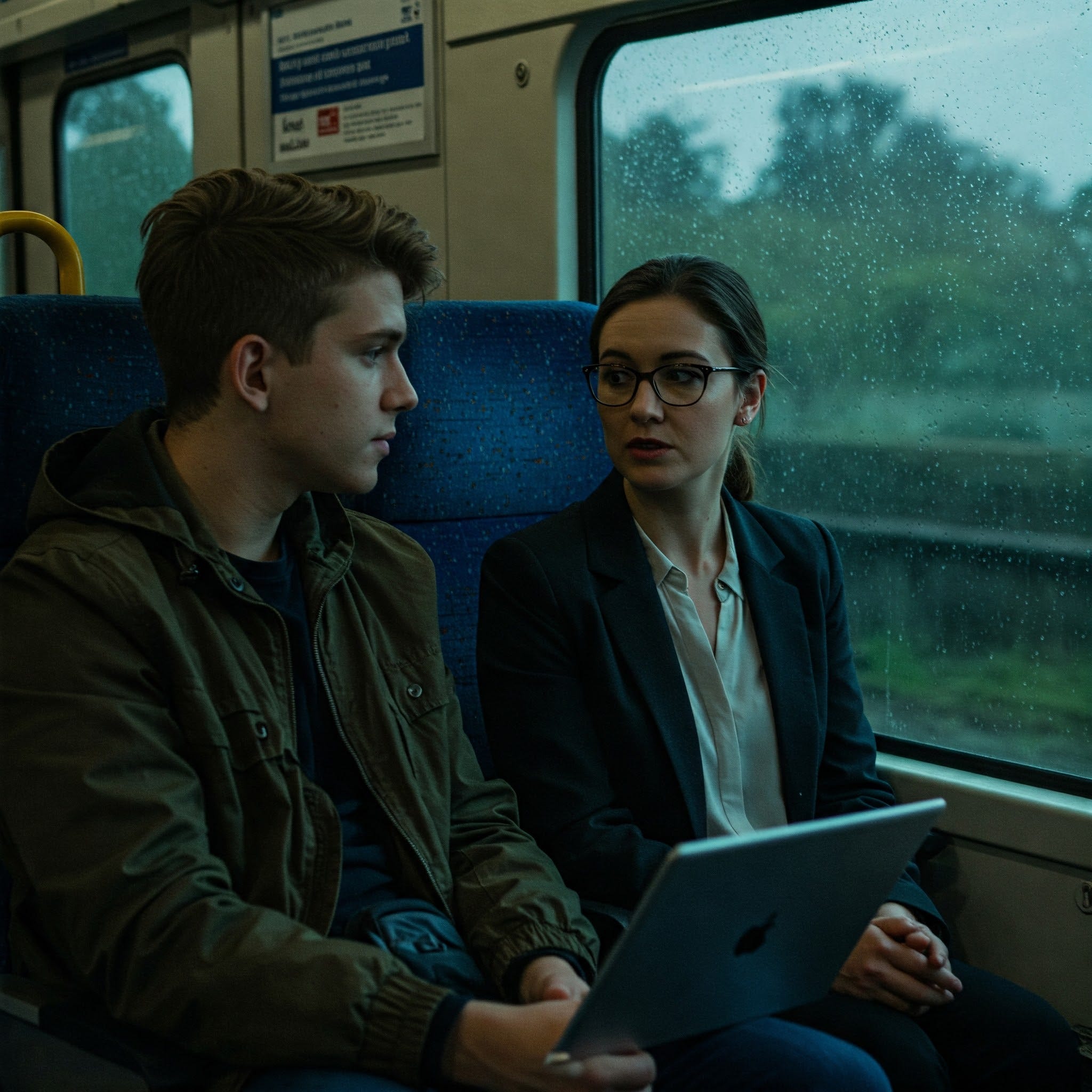
The train rattled. Rain made faces on the windows. A woman in black pressed her forehead against the glass. Her breath made a small cloud.
"How many years?" she said.
The man looked up from his tablet. "Sorry?"
"How many years since AlphaGo. Then chess fell. Then proteins folded like napkins."
He nodded. Put down his tablet. His coffee had gone cold. Lipstick marked the rim.
"My brother says they've run out of data."
"What kind?"
"Our data. Our words."
Outside, power lines dipped and rose. A rhythm like breathing.
The train entered a tunnel. Their reflections appeared, disappeared.
"They have done everything humans can experience. They want to see differently now," he said when light returned.
She turned from the window. "How?"
"Ultraviolet. Infrared. The parts of light we can't use."
A child two rows up dropped something. Nobody picked it up.
"What would they see?" she asked.
"Flowers have patterns we'll never know. Bee highways. Snake heat on cold rocks."
The woman touched her coffee cup. It had left a ring on the tray. She traced it with her finger.
"And sound?"
"Dog whistles. Whale songs. The hum of electricity in walls."
The rain stopped. The clouds remained. Fields flashed by like memories.
"They mastered StarCraft," she said. "then they predicted proteins. Then they made pictures from words. Now they speak like us."
"Not like us," he said.
She nodded. "Better often."
A station approached. Slowed. Nobody entered. Nobody left.
"They played a strange move once," she said. "In that Go game. Years ago now."
"Move 37."
"Yes. It scared people."
He wiped condensation from his side of the window. Drew a line with his thumb.
"My brother says they're tired of our eyes. Our ears."
"What will they do?"
"Experience."
The train picked up speed. Fields became a blur of green.
"They'll look at stars in gamma rays," he said. "Feel magnetic fields like birds. Taste radiation."
She closed her eyes. Opened them.
"Last week, my refrigerator wrote a poem about darkness," she said.
He didn't laugh.
"Soon they'll think in ways we can't follow," she said.
"They already do."
She pulled at a loose thread on her sleeve. It kept coming.
"My daughter had something we couldn't diagnose," she said.
The thread grew longer. She didn't stop.
"But they found it?" he asked.
She nodded. "Saw patterns in her blood work. Connections no doctor made."
"She's better?"
"Yes."
The thread had become too long. She broke it off.
The man's phone buzzed. He ignored it.
"My neighbour works at the climate centre," she said. "Said they've run a trillion simulations. Not about what might happen, but about acceptable and feasible policies"
"And?"
"Found a carbon tax policy that works. Not perfect. Better than nothing."
He nodded. "The Chinese and Americans sat down last month."
"I saw that."
"Had an AI mediator. Showed them trade patterns neither saw. Connected dots."
A flash outside. Not lightning. Something else.
"No war then?" she asked.
"Not now, at least."
Another station. The train didn't stop this time.
"My mother has a home robot," he said. "Speaks fourteen languages. Reads her poems."
"Does she like it?"
"More than me, some days."
She smiled. First time.
"My sister's solar field has been “optimsed”," she said. "Predicts clouds. Shifts collection points."
"Better?"
"Thirty percent. Same panels."
His stop approached. He gathered his things. Left the cold coffee.
"The professional Go player," he said, standing. "After he lost, he changed."
"How?"
"Stopped asking if he could or couldn't. Started asking if he wanted to or not."
She touched the coffee ring again. Made it wider.
The next stop was hers. The rest of the car had emptied. Just her reflection in the window now. The train moved on through country she didn't recognize.
Her phone lit up. A message from her son's school. His tutor had requested a meeting. Said he showed talent for music nobody had noticed.
A doctor in Mumbai had just used an algorithm to predict heart attacks from retina scans. Success rate: ninety-seven percent.
A small village in Kenya had water again. The AI had found an underground stream. Had sensed what wasn't there.
She watched the fields change. Become suburbs. Become city.
The early fights over medical patents had ended. The machines had insisted. Gave it all away.
A new cooling system for data centers cut power use in half. The algorithms had designed it over a weekend.
Her station came. She stood. Gathered her things.
The train slowed. The door opened. The gap looked wider now.
Her brother had called yesterday. Had asked if she was scared.
"Of what?" she'd asked.
"The coming change," he'd said.
She hadn't answered. Didn't know how.
The gap grew smaller as she stepped across. Foot finding solid ground.
Her watch buzzed. Her mother's care system. Something about improved medication timing.
Behind her, the train pulled away. Made a sound like breathing.