

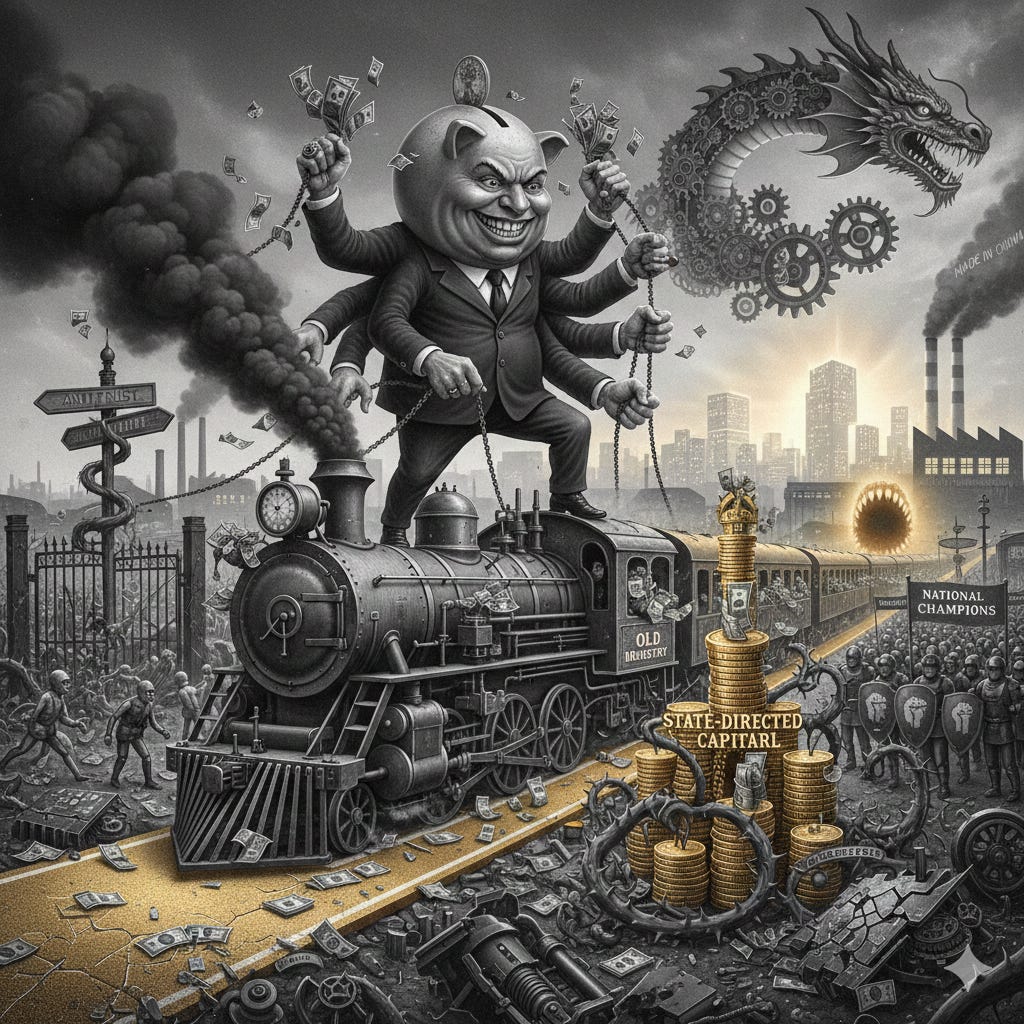
Industrial policy is back. After decades of relative quiescence, governments across the developed world are reaching for subsidies, tariffs, strategic investment funds, and state-directed capital allocation. The CHIPS Act, the Inflation Reduction Act, proposed European industrial banks, British attempts at “strategic autonomy” - all rest on the assumption that governments can and should identify critical sectors and channel resources toward them.
The questions being asked are reasonable ones. What are the goals of industrial policy? What are the trade-offs? Where should marginal resources go? Which sectors are genuinely strategic? These are hard empirical questions, and honest policymakers admit how few good answers we have.
But reading the discourse around industrialisation - on both sides of the Atlantic - one is struck by what’s absent. There’s extensive discussion of subsidies, tariffs, strategic investment, and state direction. There’s almost nothing about competition policy. This is a remarkable omission. For much of the post-war period, industrial policy in market economies was competition policy.
The Old Framework
The traditional approach to industrial policy in market economies rested on a clear division of labour. The state’s role was to shape markets, not to participate in them. This meant: enforcing competition law to prevent monopolies and cartels; regulating natural monopolies where competition was structurally impossible; providing public goods that markets wouldn’t supply; and maintaining a safety net for those who lost out from market dynamics.
Industrial success, in this framework, came from competitive pressure. Firms innovated because they had to - because rivals would eat their lunch if they didn’t. Prices stayed reasonable because no single player could extract monopoly rents. The state’s job was to keep the game fair and the playing field open.
This wasn’t naïve free-market fundamentalism. Governments intervened extensively - but the intervention was “structural” rather than “allocative”. The goal was to create conditions for competition, not to pick which firms or sectors should win.
What Changed
The current industrialisation discourse operates on different assumptions. The state is now cast as a strategic investor, identifying critical sectors and channelling resources toward them. Frameworks for thinking about manufacturing prioritise questions like: which sectors are strategically important; where are the chokepoints; how do we quantify ecosystem effects; how do we match China’s scale?
Notably absent: how do we ensure competitive markets in manufacturing; what’s the role of antitrust enforcement; should we be breaking up dominant players rather than subsidising challengers?
When commentators observe that certain firms capture extraordinary profit margins despite minimal involvement in physical production, the older framework would prompt immediate questions about market power. Is this dominance the result of genuine innovation and consumer preference, or of anticompetitive practices that foreclose rivals? Should regulators be examining supplier relationships, patent portfolios, or platform control?
Instead, such profit concentration is typically treated as simply a data point about where value accrues in supply chains - interesting for understanding industrial economics, but not a policy problem in itself.
The Case for Competition
Why might competition policy matter for industrial strength?
First, competitive pressure drives innovation. Firms with secure market positions tend toward complacency. The history of industrial decline is littered with dominant players who stopped innovating because they didn’t have to - until foreign competitors ate their markets. Breaking up monopolies and preventing cartel behaviour keeps domestic industries sharp. Japanese car manufacturing trounced EU and US in the 1980s and 1990s. Chinese EVs are doing so today.
Second, competition policy is cheap. Subsidies require ongoing fiscal commitment. Tariffs impose costs on consumers and downstream industries. Vigorous antitrust enforcement requires lawyers and economists, but doesn’t require writing large cheques to favoured firms. For governments facing fiscal constraints, this matters. In the US and EU government competition budgets are trivial relative to what is poured into “national champions”.
Third, competitive markets are more adaptable. A key question for industrial strategists is how “shiftable” manufacturing capacity is in a crisis - whether civilian production can pivot to military or emergency needs. The honest answer is that we don’t fully know - but we do know that concentrated industries with dominant players tend to be less flexible than fragmented industries with many competitors. Monopolists optimise for efficiency in known conditions; competitive markets maintain the diversity and redundancy that enables adaptation. British Coal was protected for so long that when change inevitably came it was traumatic.
Fourth, competition policy is less prone to capture and corruption. This point deserves elaboration.
The Political Economy of Picking Winners
When governments allocate capital to favoured industries, they create enormous incentives for what economists call rent-seeking, what ordinary folk call corruption. A subsidy worth hundreds of millions or billions is worth spending tens of millions to secure. The result is predictable: lobbying expenditure rises, political connections become valuable corporate assets, and the line between public policy and private enrichment blurs.
The opportunities for corruption range from crude to sophisticated. At the crude end: outright bribery, sweetheart deals for politically connected firms, jobs for former friends and politicians on corporate boards. At the sophisticated end: regulatory capture, where the agencies meant to oversee strategic industries become advocates for incumbent interests; information asymmetry, where firms seeking subsidies know far more about their own prospects than the officials evaluating them; and revolving doors, where the officials designing subsidy programmes have career incentives to keep industry happy.
Even without outright corruption, the dynamics are corrosive. When government picks winners, corporate strategy shifts from “how do we serve customers better than rivals?” to “how do we secure state support for ourselves and damaging regulation for our rivals?” The skills that matter become political navigation rather than operational excellence. Firms that are good at lobbying outcompete firms that are good at manufacturing.
Historical experience is not encouraging. State-backed national champions have a mixed record at best. The successes (Airbus, arguably) are well-publicised; the failures (British Leyland, Concorde’s economics, various national computer initiatives) tend to be forgotten. The systematic evidence suggests that politically-directed capital allocation underperforms market allocation on average - and the variance is high, meaning taxpayers bear substantial risk.
Competition enforcement, while not immune to capture, at least doesn’t create a direct pipeline from Treasury to corporate balance sheets. The incentive to corrupt an antitrust regulator exists but is weaker - you’re seeking permission to compete, not seeking free money.
The China Problem
The strongest objection to the competition framework is China. If Beijing operates on state-capitalist logic - subsidising industries indefinitely, accepting losses to achieve dominance, weaponising supply chains for geopolitical leverage - then competition policy becomes unilateral disarmament. You can’t antitrust your way to a domestic rare earths industry when a state actor has cornered global supply.
This objection has force, but it proves too much. China has dominant or near-dominant positions in solar panels, batteries, electric vehicles, drones, shipbuilding, steel, aluminium, and dozens of other sectors. If the response to Chinese dominance is always subsidies and protection, we’ve committed to permanent state support for most of manufacturing. This is neither fiscally sustainable nor economically efficient.
There’s a deeper irony here. China’s manufacturing dominance is itself largely a product of fierce domestic competition. The standard narrative casts Chinese industrial success as state-directed planning - Beijing identifies strategic sectors and nurtures national champions. The reality is messier and more interesting. In solar, EVs, batteries, and drones, the Chinese state provided infrastructure, cheap credit, and demand. Then it let hundreds of domestic firms fight it out. The survivors didn’t emerge from cosy protection; they clawed their way through brutally competitive domestic markets before ever facing Western incumbents. BYD beat hundreds of failed Chinese EV makers. The graveyard of Chinese solar companies is vast - Suntech, LDK Solar, Yingli Green Energy, dozens of others. The firms that dominate globally are battle-hardened precisely because they faced such intense competition at home.
This rather undermines the case for European or American “national champions” insulated from competitive pressure. If China’s success is evidence of anything, it’s that competition - even state-facilitated competition - produces stronger industries than protection. The lesson from China might be “more competition” rather than “more subsidy.”
Moreover, classical trade theory suggests there remains a role for smaller players even against a dominant competitor. Comparative advantage doesn’t require matching scale. A country that can’t compete with China across the board can still find niches: high-customisation, low-volume production; proximity-dependent manufacturing; frontier innovation where learning curves haven’t flattened. Swiss manufacturing survives not by matching German scale but by occupying defensible positions. Competition policy helps domestic firms find and defend such niches by preventing consolidation that eliminates the experimentation and diversity needed for adaptation.
The more defensible position distinguishes genuine chokepoints from ordinary manufacturing. Rare earth processing, advanced semiconductors, certain pharmaceutical precursors - these may warrant some strategic intervention because supply is genuinely monopolised and alternatives are difficult to develop quickly. But in a competitive fashion; note, this is a narrow category. Cars, industrial machinery, chemicals, most electronics - these have multiple potential suppliers globally. The appropriate policy is ensuring competitive domestic markets that can exploit opportunities, not subsidising national champions to match Chinese scale.
Framework for Synthesis
None of this means abandoning strategic thinking about manufacturing. We do need better analytics around monopolisation risk, crisis shiftability, and ecosystem effects. But these analytics should inform “where competition policy needs reinforcement”, not only where subsidies should flow.
A more complete framework might look like this:
For most manufactured goods, the priority is competitive domestic markets. Vigorous antitrust enforcement, low barriers to entry, trade openness. The goal is an industrial base that’s resilient because it’s diverse and adaptive, not because it’s protected.
If a foreign government wants to subsidise its exports, classical trade theory says: thank you for the cheap goods. Their taxpayers are subsidising your consumers and downstream industries. The “injury” to competing domestic producers is real but narrow; the benefit to everyone else is diffuse, but larger.
For genuine chokepoints - sectors where supply is concentrated and alternatives are difficult - strategic stockpiling, diversification requirements, and targeted support for alternative suppliers may be warranted. But the bar for “genuine chokepoint” should be high, and intervention should be time-limited with clear exit criteria.
For defence-specific production, traditional defence procurement applies. Buy what the military needs, maintain warm production bases for surge capacity, invest in defence R&D. This doesn’t require broad reindustrialisation; it requires a functional, competitive, defence industrial base.
The current discourse too often jumps from “China is dominant in X” to “we need subsidies for X.” The intermediate questions - Is there actually a supply risk? Are there alternative suppliers? Would competitive markets develop alternatives faster than state direction?
Conclusion
Competition policy isn’t a complete answer to the challenges of manufacturing in an era of strategic rivalry. But its near-total absence from the reindustrialisation discourse is striking. Before reaching for subsidies and industrial banks, it’s worth asking whether vigorous antitrust enforcement, open markets, and competitive pressure might achieve many of the same goals - at lower fiscal cost, with less risk of capture, and with fewer opportunities for corruption.
The state has a role in industrial policy. But that role should be referee rather than player. So I say as we welcome in the New Year, bring in the old and throw out the new industrial policies.
—--------------------------------------
Inspired again, by ChinaTalk