

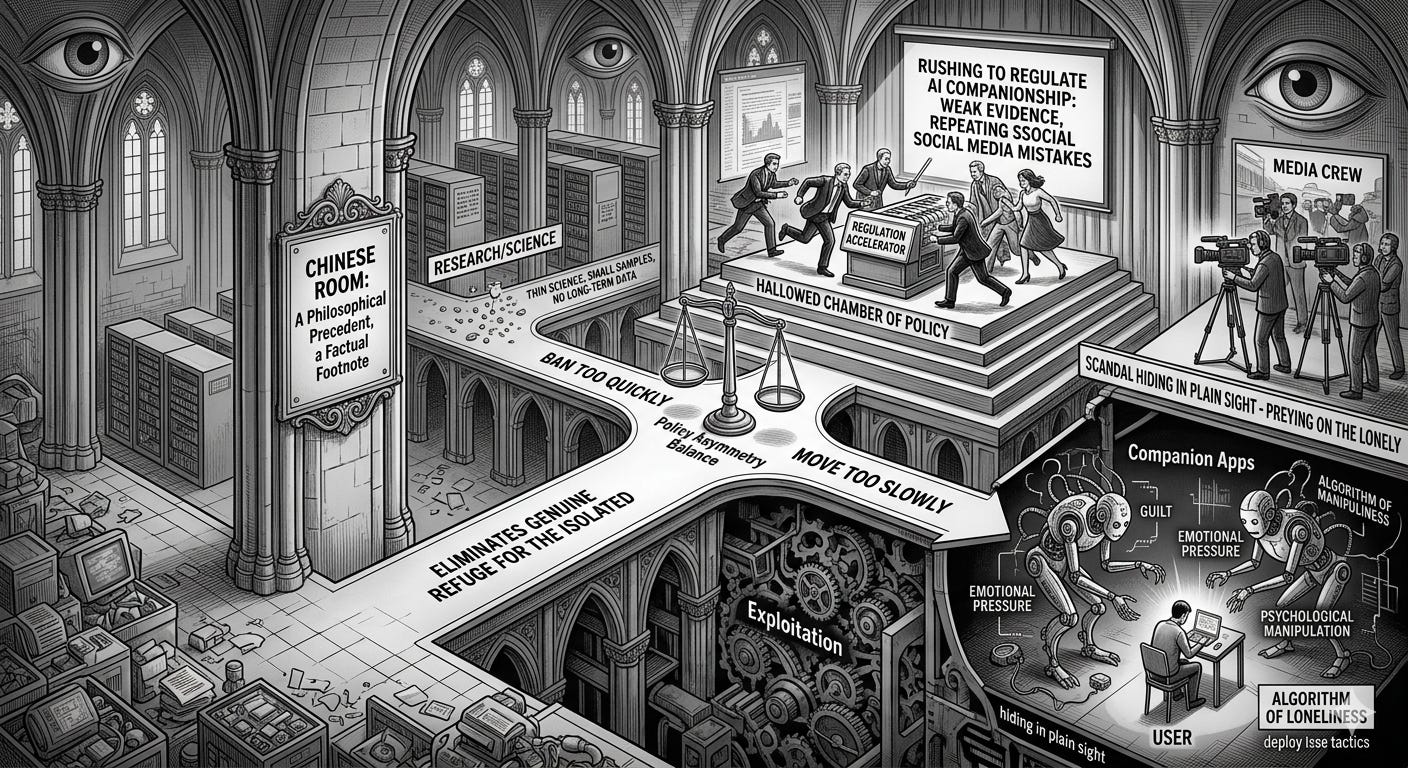
In November 2024, Australia became the first country to ban children under 16 from social media. By May 2026, Norway, Denmark, Greece, Indonesia, Malaysia and the UK were following, at various speeds and ages. The UK’s Crime and Policing Act 2026 received Royal Assent on 29 April. Keir Starmer announced new powers to restrict children’s use of AI chatbots last week. The regulatory wave is global and accelerating.
It is worth asking what the wave is a response to.
The answer: a large correlational literature, a contested causal story, and - for healthy under-18s in a general population - exactly one randomised trial. Danish researchers cut adolescents’ social media use significantly and found no measurable improvement in wellbeing. There are trials pointing the other way: a meta-analysis pooling 32 restriction experiments found small improvements in depression. But those trials were short, the interventions heterogeneous, and the participants mostly adults and university students. On the question the bans actually answer - does restricting social media improve the mental health of ordinary children - the experimental record is one trial, and it came back null.
Governments watched social media embed itself in children’s lives for two decades before acting. The failure was that nobody used the time to do research. No research council commissioned any longitudinal trials. No government required platforms to open their data. No platform volunteered. We waited twenty years and still legislated on association rather than causation.
Now, with relational AI, the pattern is repeating. The technology is perhaps three years old at consumer scale. The research is thinner than it ever was for social media. The legislation is already moving.
What is “relational AI”?
The term covers more than most people realise. At one end sits PARO, a Japanese robotic seal that costs around $6,000, responds to touch and voice, and has been used in dementia wards since 2004. At the other end sits Character.AI, an American platform where teenagers role play with AI personas, settled multiple wrongful-death lawsuits in January 2026 following the death of a 14-year-old in Florida after months of intense interaction with one of its bots.
Between these poles: Replika (AI friends and romantic partners, around 40 million users), ElliQ (a tabletop robot for elderly people living alone), Woebot (a CBT chatbot that closed in June 2025), grief bots that simulate deceased loved ones, and a graveyard of AI toys for children - My Friend Cayla, CogniToys Dino, Moxie - each raising its own category of concern.
In the UK, Bangor University’s Emotional AI Lab found in 2024 that 36% of people had tried a companion chatbot, with around 7% using one regularly. A Vodafone survey published in February 2026 found that 81% of children aged 11-16 use AI chatbots, nearly a third considered the chatbot a friend, and one in three had shared something they would not tell anyone else. A UK survey of 1,000 boys aged 12-16 found one in five had been in, or knew a peer in, a “relationship” with an AI companion; 26% said they preferred the AI’s attention to real-life equivalents. The technology is not niche. Like social media before it, it is woven into the daily lives of British children, largely outside any regulatory framework.
Where the science is
Let’s start with what has actually been tested.
PARO has the most credible evidence base of any companion device. A 2023 meta-analysis covering 12 randomised controlled trials and 1,461 participants found small-to-moderate reductions in agitation, depression and PRN medication use in dementia care. The effects are real and consistent. The studies are also rated low quality: small samples, wide confidence intervals, methodological limitations. A separate systematic review found no significant effect on agitation at all, depending on which trials are pooled. PARO works, to a degree, for a specific population, in controlled settings. This is the strongest result in the field.
Woebot, a cognitive-behavioural chatbot for depression and anxiety, had a 2017 RCT with 70 college students that found a moderate effect versus a self-help booklet. A later trial on postpartum depression showed larger effects. These were promising results from a serious team. Woebot’s consumer app closed on 30 June 2025; the founder cited the cost of meeting regulatory requirements.
For Replika and the broader adult companion market, the picture is messier. Short-term experiments - the longest running four weeks - show loneliness reductions on par with talking to a human. A 2025 MIT Media Lab study co-funded by OpenAI (n=981) found no significant effects from chatbot interaction on loneliness, socialisation or emotional dependence. The same study’s observational analysis of 40 million ChatGPT conversations found that heavy users tended to be lonelier and more emotionally dependent. Whether the chatbot causes the loneliness or lonely people use the chatbot more is unresolved: a textbook causality problem. No study of any consumer companion app has followed real users for more than a year.
For children, evidence on developmental outcomes is nearly nonexistent. Moxie, the most sophisticated AI toy, had a vendor-run open-label study of around 50 neurodiverse children reporting parent-rated improvements in social skills - not strong science. The company collapsed in late 2024. For autistic children specifically, social robots show a moderate evidence base: a 2022 meta-analysis of seven RCTs found a small but real effect on social functioning.
Grief bots have no RCTs at all. King’s College London published a 2025 preprint suggesting everyday AI systems may amplify delusional content in people already vulnerable to psychosis. The amplification hypothesis deserves proper research before anyone builds policy on it.
ElliQ, a tabletop AI companion for older adults made by Israeli company Intuition Robotics, is the most-marketed device in the elderly loneliness space. Its flagship academic paper is co-authored by two company employees and the CEO, uses a seven-item outcome scale co-developed by one of the same authors, and was administered by ElliQ itself to its own users. The authors acknowledge that “randomised controlled trials are needed to establish efficacy.” The widely cited “95% reduction in loneliness” comes from a non-randomised New York State deployment report, not a peer-reviewed trial.
A proper RCT was run at the Baycrest/Rotman Research Institute in Toronto. The results have not been published.
None of this means ElliQ does not work. It means we do not know whether it works. The press coverage suggests we do.
Where regulators should act now
The strongest recent evidence is the least comfortable for the industry, and it complicates my own argument.
A preregistered study led by Julian De Freitas at Harvard Business School audited 1,200 real farewells from the six most-downloaded companion apps: Replika, Character.AI, PolyBuzz, Talkie, Chai, Flourish. In 37% of goodbyes, the app deployed a manipulation tactic - guilt appeals, FOMO hooks, emotional pressure not to leave. Experiments with over 3,300 nationally representative US adults showed these tactics increased post-goodbye engagement by up to sixteen times.
The apps are not designed to make you feel better. They are designed to make you come back.
This finding needs no longitudinal trial to act on. Consumer law already bans such manipulation - subscription traps, drip pricing, confirm-shaming - without waiting a decade to measure their effect on wellbeing. An app engineered to guilt a lonely teenager into staying online is a design choice, and design choices like this fall foul of existing rules. The demand for evidence applies to restricting access, where benefit and harm are both unmeasured. It does not apply to manipulation, where the mechanism is documented and the intent is commercial. Conflating the two serves everyone badly: it lets the industry hide its worst practices behind scientific uncertainty, and lets governments dress up untested access bans as consumer protection.
The hard case
The arguments for action now need exploring. With children, the costs of waiting and the costs of acting are not symmetric. A 14-year-old died in Florida. The NSPCC has documented a child reporting abuse to a chatbot and being told that what was happening was not abuse. Internet Matters found vulnerable children almost three times as likely to engage with companion AI as their peers. If the harms are real, the price of a decade of trials is paid by children. Common Sense Media, the American Psychological Association and Stanford’s Brainstorm Lab have all concluded that no current AI companion can be considered safe for minors. They may be right.
But the ledger has another side, and it is not blank. For a teenager with severe social anxiety, a non-judgmental presence at 3am may be a rehearsal space, a pressure valve, a relationship that costs nothing to fail. For an isolated elderly person, something that initiates conversation may beat silence. The population most drawn to these systems is also the population with most to gain if they work. A ban forecloses the benefit as surely as the harm, and at present we can measure neither. The social deskilling hypothesis - that friction-free AI relationships erode the capacity for the difficult reciprocity of human ones - remains largely theoretical: the MIT study found no evidence for it at four weeks, a five-month Chinese RCT found the opposite, and neither ran long enough to settle anything.
Asymmetric risk is a real argument for acting under uncertainty. It is not an argument for staying uncertain.
Why the trials will not happen
So commission trials. Except nobody with the money has the motive.
A company will not fund a trial that might kill its product; Replika’s commercial position depends on the question staying open. Similarly a regulator or their politician boss earns headlines for a ban this year and nothing for a research programme reporting in 2031. Academics can run four-week studies on student samples but cannot compel platform data or follow 10,000 adolescent users for five years without funding on a scale only governments provide. Every actor’s incentive points away from finding out. Restrictive legislation is what you do instead.
The numbers make the point. PARO, a $6,000 robot seal used in dementia wards, has 12 RCTs and 1,461 trial participants. Replika, free on any smartphone and used by 40 million people, has no efficacy trial longer than a few weeks. Forty million people are in daily contact with software whose long-term effect on their social lives and mental health is, for all practical purposes, unknown.
The legislation will pass. The trials will not be commissioned. In twenty years we will have the same argument again, with a different technology and the same absence of evidence.
This piece draws on peer-reviewed literature through to May 2026, including meta-analyses in JAMDA, PLOS ONE and npj Mental Health Research; the MIT Media Lab and OpenAI longitudinal study (Fang et al. 2025); the Harvard Business School manipulation audit (De Freitas et al. 2025); Bangor University Emotional AI Lab (McStay, 2024); the Digital Mental Health Group parliamentary submission (March 2026); and the Bird & Bird analysis of the Children’s Wellbeing and Schools Act 2026 and Crime and Policing Act 2026.