

In April 2026, Anthropic published a technical report on Claude Mythos Preview. It had, without being designed to do so, become competitive with the world’s best human security researchers at finding software vulnerabilities - and more dangerous, because it never sleeps. It was big news. Security industry stock prices fell.
The cyber capability was not designed in. It emerged - an unintended consequence of building something that reasons very well. Current alignment techniques cannot surgically remove such capability without degrading the general intelligence it rides on.
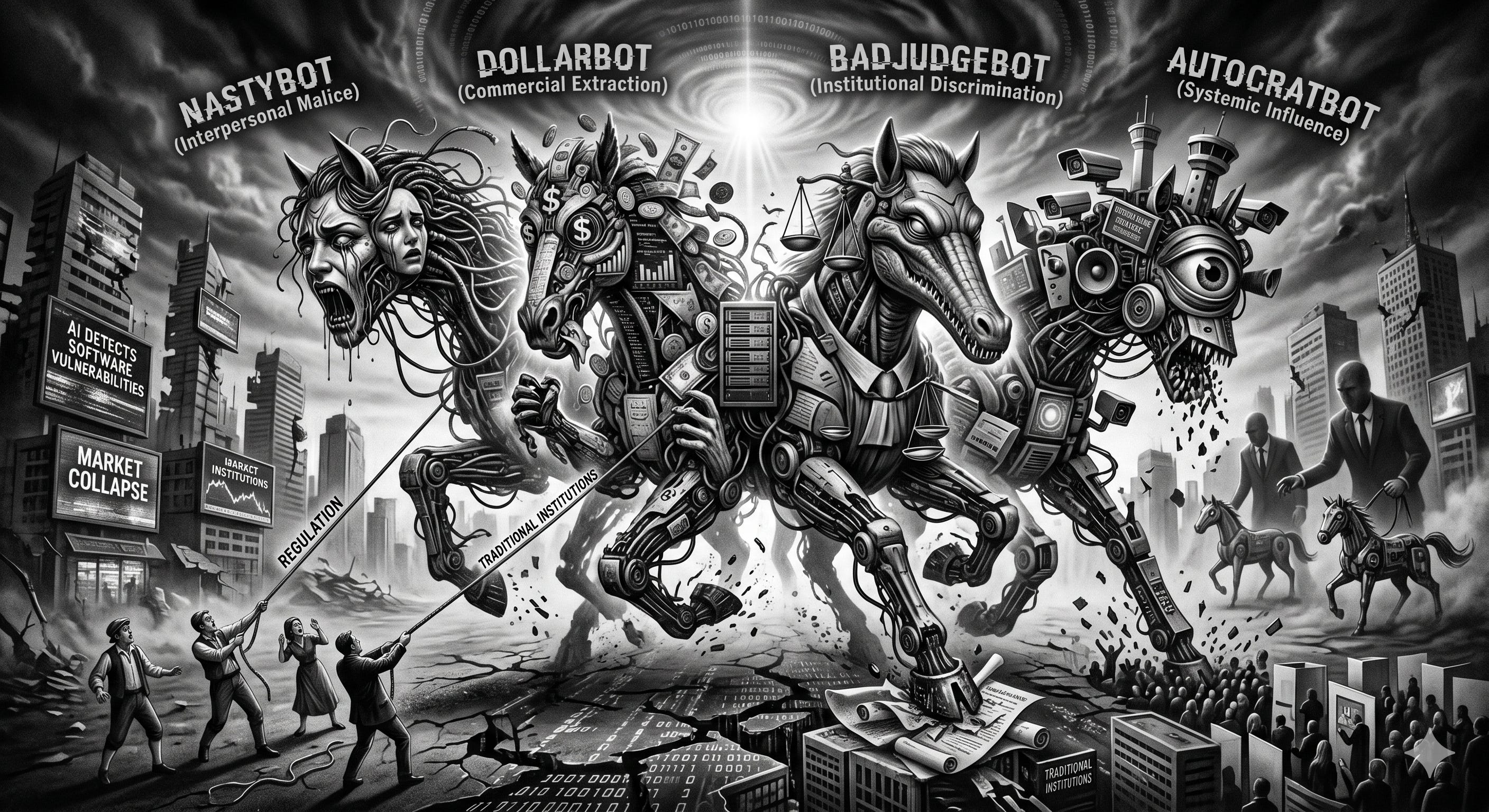
This cyber threat, and the risk of commercial extraction by cyber criminals is only one of the four horsemen of the AI apocalypse. I’ve categorised the harms by the motivation of the human or system deploying the AI, dividing the taxonomy by the nature of the adversary
NastyBot (Interpersonal Malice): The weaponisation of AI for personal cruelty.
The Villains: The bitter ex, the schoolyard bully, the vindictive troll.
The Harm: Deepfake revenge porn, voice-cloned harassment, localized reputation destruction.
DollarBot (Commercial Extraction): The weaponisation of AI for profit.
The Villains: The grifter, the engagement-hungry platform, the profit maximising AI company, the cyber criminal.
The Harm: Financial fraud, algorithmic addiction, wage suppression, systemic deskilling and cognitive surrender.
BadJudgeBot (Institutional Discrimination): Unfair or discriminatory judgements made about people.
The Villains: The risk-averse bank, the overwhelmed civil servant, the cost-cutting HR department.
The Harm: Encoded discrimination in credit ratings, housing, and hiring; the systemic denial of opportunity without a human face to sue. In May 2025, Mobley v. Workday became the first AI hiring discrimination class action in the US.
AutocratBot (Systemic Influence): Using AI for political control.
The Villains: The authoritarian state, the rogue intelligence agency, the domestic political operative.
The Harm: Industrial-scale disinformation, the accelerating erosion of the shared knowledge environment, automated mass surveillance.
Every one of these four horsemen was present before ChatGPT launched in 2022. AI did not invent these harms - they already existed. It did collapse the cost of creation and deployment to near zero and gave them steroids.
The harms are not uniform, and our defensive tools vary enormously depending on which horseman you face. Consider Dollarbot’s cyber criminals. Cyber security is perhaps the most mature defensive domain we possess: decades of security research, incident response protocols, and national agencies. Yet, when Mythos arrived into this highly prepared environment, it immediately challenged these defences.
If that is what a breach looks like in a well prepared category, the least prepared are terrifying. Existing remedies are too slow, too fragmented, and too narrowly scoped. We are only slowly creating the regulatory frameworks to stop Dollarbot from inducing cognitive surrender in a generation of teenagers. Existing frameworks are inadequate, slow, and unenforced. Some frontier labs, notably Anthropic, have been warning authorities of the impending stampede. But even here Anthropic has publicly warned governments while lobbying to keep most binding constraints off itself.
Right now, a few horsemen have bridles. Most range free.
There are three structural reasons our traditional response mechanisms will fail.
The first is speed. Regulatory cycles run on three-to-seven-year timelines. AI capability cycles run in months. The regulators and their frameworks are not merely slow; they are structurally incapable of keeping pace with what they are trying to govern.
The second is scale. These harms are cheap to deploy and will come thick as well as fast. Formulating a response will require coordinating regulation across a myriad of entirely distinct domains - from electoral law to banking compliance.
The third is attribution. Every deterrence framework ever designed - legal, diplomatic, military, economic - rests on a single assumption: that you can identify who did it. With the growth of action through chains of autonomous agents spanning multiple jurisdictions, hidden behind cryptographic disguises, it is increasingly difficult to point fingers. The horsemen operate in a fog. The mechanisms of accountability require the fog to lift.
But if current governance systems and structures face an unfair adversary, what is to be done? One obvious possible response is “let AI handle it”. Automated defence operating at AI speed, consistent, tireless. That’ll do the job. My stallion against your stallion. A horse race.
Regulators, defenders, and intelligence analysts are already using AI to process threats at volumes and speeds no human team can read. There is, at current data volumes, no alternative. The contest is already, in practice, AI against AI, with humans nominally in the loop. Unfortunately, currently it is very cheap to mass produce malign intent, but prohibitively expensive to defend against it. Although, now it is a race between the malign stallion and the defending pony, this need not be a permanent condition.
Who trains the AI doing the defending, what it is optimised for, how its failure modes propagate: these are decisions being made, by default, by the companies building the systems, in the absence of any institution with the standing to intervene.
The horsemen were always coming. The only contested issue was whether the institutions we built could hold them. The novel answer - the one nobody is particularly comfortable stating - is that the institutions capable of holding them are themselves AI systems, and the humans “in charge” are just lowly stable boys in awe of the beasts they can barely rein in.