

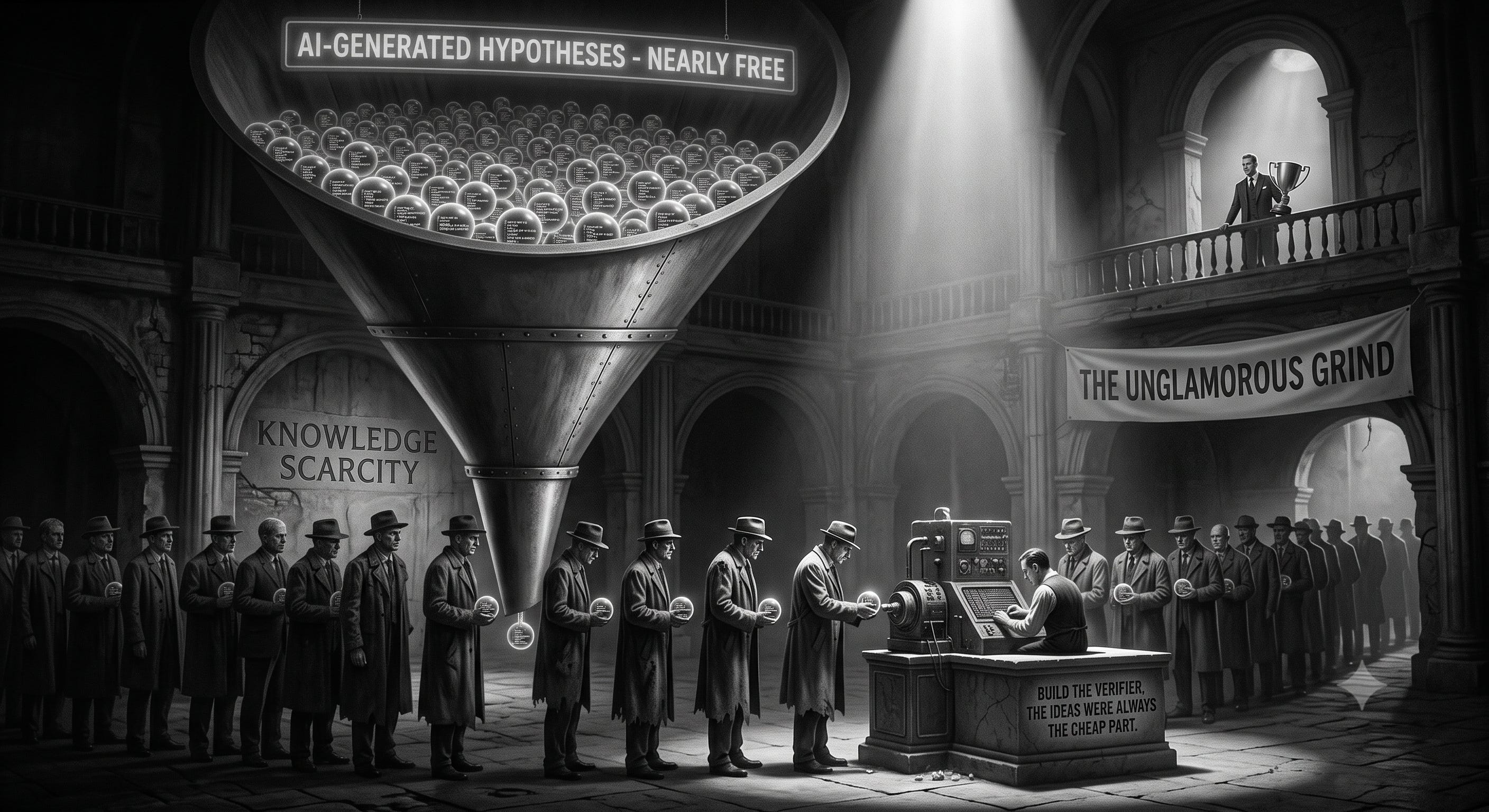
In 2012, four researchers working across three drug companies gave a name to the most expensive joke in science. They called it Eroom’s Law - Moore’s Law spelled backwards - because the number of new drugs approved per billion dollars of research had done the exact opposite of computing power. It had halved, roughly every nine years, since 1950. Over the same stretch the industry had made molecules absurdly cheap to produce. Combinatorial chemistry and high-throughput screening lifted the output of candidate compounds by orders of magnitude. Approvals fell anyway.
Artificial intelligence promises to do for the scientific hypotheses what combinatorial chemistry did for the molecule: make them nearly free.
It sounds like abundance. More ideas, faster, cheaper, from anyone. But the pharmaceutical record is not a story of abundance. It is a warning about scarcity bottlenecks. Making the cheap step cheaper does not affect the expensive one. It just creates a bigger queue elsewhere.
The cost of science was never spread evenly. Generating a hypothesis sits at the front of the pipeline, and that front has now collapsed to almost nothing. Building the experiment and validating the result - the testing, the lab, the years of replication, the slow work of convincing a sceptical field you are right - have not moved at all.
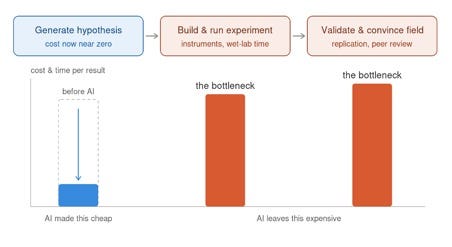
Where the cost of science went. The front of the pipeline has collapsed to near zero; the middle and the end have not. The bottleneck simply moved downstream. (Schematic, not to scale.)
Surely more ideas are better, even if the downstream bottlenecks hold? Chenglei Si and colleagues at Stanford ran a test: more than a hundred working researchers, blinded, scoring AI-generated research ideas against expert ones. The AI ideas were rated more novel, and the result was published at a serious venue. A victory - until the same team made forty-three researchers actually build the ideas, a hundred hours of work each. Once the ideas met reality, the AI scored lower on every measure that mattered, and the ranking inverted. The human ideas survived contact with a lab because you could you actually test themun.

Novelty evaporates on execution. AI ideas look more original on paper, then fall below expert ideas once someone has to make them work. (Si et al., Stanford: ideation study, ICLR 2025; execution follow-up, 2025.)
The public record demonstrates the nature of the problem. Berkeley’s autonomous “A-Lab” announced forty-one new materials in seventeen days; on inspection most already existed, and Nature issued a correction conceding they were new to the software, not to the world. DeepMind’s GNoME dropped 2.2 million predicted crystals into the literature; an independent audit found essentially none that were at once credible, novel and useful. The single most-cited claim that AI had supercharged discovery - forty-four per cent more materials, thirty-nine per cent more patents - was disavowed by MIT, which stated it had no confidence in the data. The AI wins that survive scrutiny, AlphaFold chief among them, are accelerators. Nevertheless, AlphaFold hands you a structure you still have to confirm at the lab bench.
Science has always advanced at least as much through instruments as through ideas, yet it has always paid the idea source while ignoring the experimental verifiers. Warren Weaver understood this in the 1930s. At the Rockefeller Foundation he funded not theories but tools - the ultracentrifuge, electrophoresis, X-ray crystallography - and the researchers willing to stake a career on them. The bet returned something like fifteen Nobel Prizes. The Higgs boson was predicted in 1964 and confirmed in 2012 by a twenty-seven-kilometre machine and several thousand people; the prize went to two theorists, not the builders of the verification machine. Mendel had the right idea in 1866, and it stayed, correct and useless, for thirty-four years, because no community was ready to validate it.

Who does the work, who takes the bow. The instruments and the validation do most of the effort. The idea collects the prize.
The experiment does the work. The idea takes the prizes (eg Nobel). AI is arriving, precisely, as an instrument - a hypothesis-and-analysis machine - into a system whose prizes, funding and prestige all point at the wrong end of the process flow.
So the question is not whether AI can dream up the next theory. It is whether AI can collapse the cost of verifying which theories are strong and which are wrong. A good AI can rank a thousand candidates by which experiment would be most informative per $, so the scarce hours of instrument time are spent on the few ideas that matter. It can run the design-make-test loop in an autonomous lab, choosing the next experiment to identify the best hypotheses fastest. Least discussed and most valuable, it can robustly assess studies: reproducing analysis, catching a statistical sleight of hand, flagging a duplicated image or a contaminated cell line, red-teaming a paper before a journal does. The same technology drowning peer review could, pointed the other way, become its immune system.
Two cautions: a verifier trained on past success rewards resemblance to past success, so it sharpens incremental science and discards the anomalies that look wrong - which is what a genuine breakthrough always looks like at first. Mendel would have failed the filter. And, second, every verifier is only as good as its ground truth, which is the expensive, scarce thing to begin with.
So what? What does this idea-experiment imbalance say for how public and private sectors should think about the impact of AI on science?
The public sector reflex, when a technology makes ideas cheap, is to fund more ideas. It is the wrong reflex. If hypotheses are becoming free, the rate-limiting input is the verification downstream of them: experiments, instruments, and the capacity to verify. That argues for spending on the unglamorous grind - synchrotron time, cryo-electron microscopes, autonomous labs, and the technicians who keep them running - rather than another grant round chasing the cleverest proposal. It argues, too, for defending the part of science AI is overwhelming. Peer review is already having to absorb many AI evils: AI-written reviews, hidden prompts smuggled into preprints, and fabricated citations in accepted papers. The machinery that decides what is true is the actual national asset, and it is being polluted faster than it is being funded. Pay the referee, not only the striker.
Venture capital in the private sector has placed the opposite bet. Isomorphic Labs raised 600 million dollars in 2025 and a further 2.1 billion in 2026, but no drug from them has dosed a human. No AI-designed drug has been approved, and the reason is the reason Eroom’s Law held: the binding cost is verification, and verification is a slow, physical, expensive complement that AI has not yet made cheap. Public and private operators should follow scarcity to where the durable rents actually settle. Currently that is not on whoever generates the hypothesis - that is now free, and free things earn nothing - but on whoever owns the scarce thing the hypothesis still needs - verification.
The believers say AI will finally let science think faster. It might. But science was never short of ideas. It was short of ways to find out which of them were true, and that is the one thing we have just made more valuable, not less.
Build the verifier. The ideas were always the cheap part.