

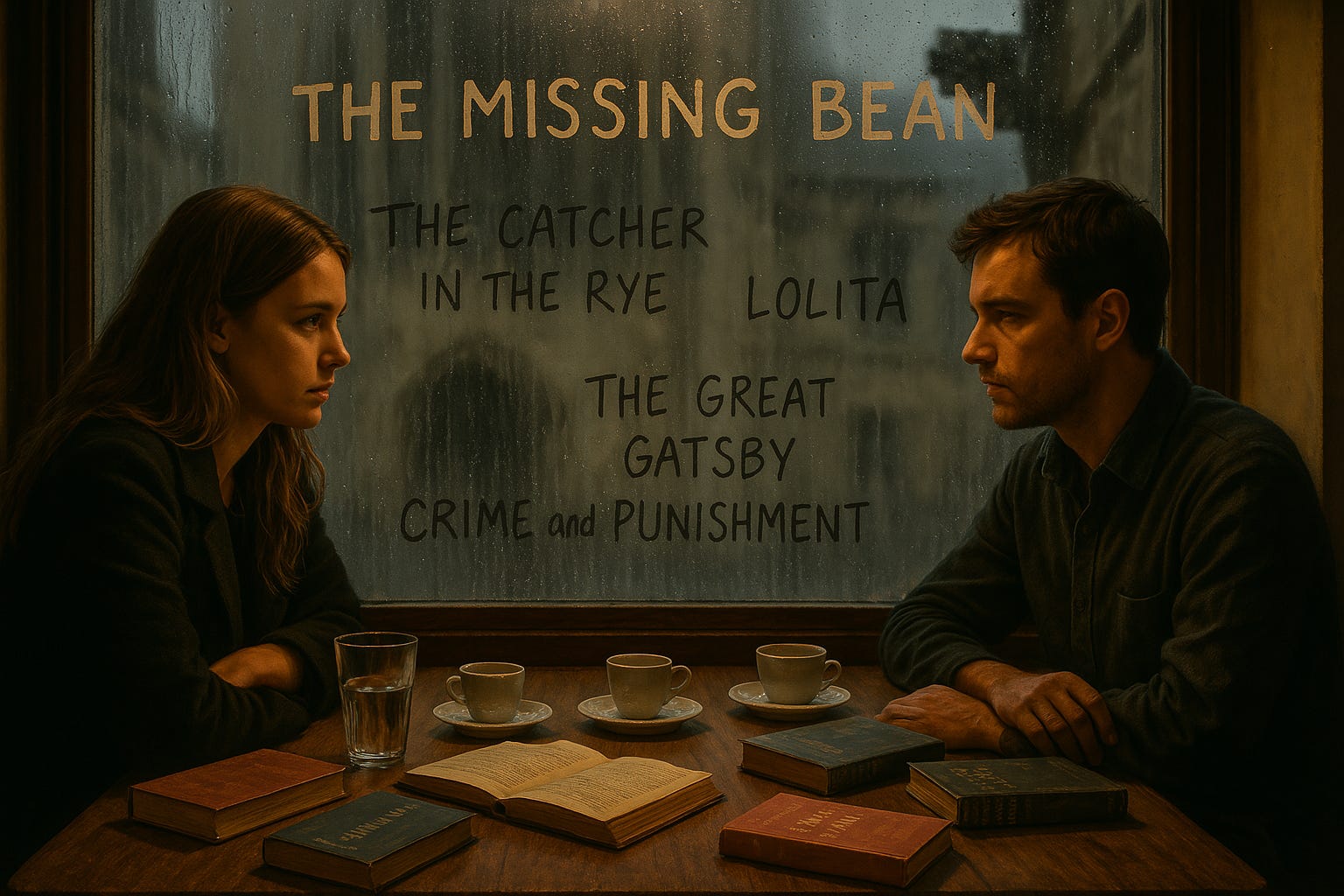
They sat across from each other at a corner table in The Missing Bean, just off the Broad. Rain streaked the windows, blurring the view of Oxford's ancient stones. Three empty espresso cups stood between them like small monuments. A fourth, half-full, had gone cold. Through the window you cold just make out gargoyles peering down from the college across the street.
"I don't think Holden was that bad," she said, refilling her glass.
"You wouldn't," he said.
She looked at him. "What's that supposed to mean?"
"Nothing." He traced a finger through the condensation on the window beside them. "Just that you always defend the characters nobody likes."
"I didn't say I liked him."
"You've been defending him for twenty minutes."
"I've been trying to understand him," she said. "There's a difference."
The café lights were dim, bright bulbs that cast long shadows across their faces. A bell jingled as students came and went, shaking off umbrellas, their voices hushed like they were entering a library instead of a coffee shop.
"Gatsby was the same way," he said. "Building his whole life on a lie and you called it romantic."
"It was romantic. Misguided, but romantic."
"Like us," he said, not looking at her.
She sipped her espresso. Said nothing.
"Remember when we read Lolita in that book club?" she asked finally. "The one with your colleagues?"
"I remember you were the only one who finished it."
"Because everyone else was so quick to judge. They couldn't see past their disgust to appreciate what Nabokov was doing."
"Or maybe they just called a monster a monster."
"That's reductive," she said.
"That's honest."
She laughed, a sharp sound. "Right. Because you're all about honesty."
He stared at the café's chalkboard menu. They'd first gone to this cafe three years ago, ducking in from an Oxford rain not unlike today's, when things were different. When they still believed certain versions of themselves.
"You never told me what happened with Lisa from your department," she said.
"Nothing happened."
"That's what Stevens would say in Remains of the Day. Nothing happened, nothing happened, until his whole life passed him by."
"Don't psychoanalyze me using books," he said.
"Don't lie to me using nothing."
Their eyes met briefly. Then away.
"I saw your texts," she said.
He didn't deny it this time. Just nodded slowly, as if confirming something he'd known all along.
"You check my phone now?" he asked.
"You left it on the table. Unlocked. Maybe you wanted me to see."
He considered this. Maybe he had.
"It wasn't what you think," he said.
"It never is."
She stood up, carried her cup to the counter where a barista with tattoos and a nose ring nodded thanks.
"I've been unhappy too," she said quietly. "But I didn't..."
"Didn't what?" he asked. "Find someone else to talk to? Someone who doesn't criticize every goddamn thing I do?"
"I was going to say I didn't give up."
The rain grew heavier. The kitchen felt smaller.
"Remember that part in Crime and Punishment," he said, "where Raskolnikov convinces himself he's justified? That he's different, special. Above it all."
"Yes."
"I think about that a lot lately."
She leaned against the counter. "Which one of us is Raskolnikov in this scenario?"
"Both of us," he said. "Neither of us."
She nodded. They were good at this—discussing characters as proxies for themselves. Easier than looking directly at the wreckage.
"I'm moving out next week," she said.
He looked up at her. Not surprised. "Where?"
"My sister's. Until I figure things out."
"You've been planning this."
"Yes."
Neither mentioned the obvious—that while she accused him of betrayal, she'd been making escape plans for weeks. They each had their narratives. Their versions of events that cast them as the reasonable one, the wronged one.
"I'll help you pack," he said.
"No need."
Outside, the rain stopped abruptly. The silence that followed seemed louder somehow.
"Maybe we're more like Ahab," he said, finishing the last of his coffee. "So fixated on being right that we wrecked everything else."
She almost smiled. "At least we read good books together."
That much was true. That much they could agree on.