

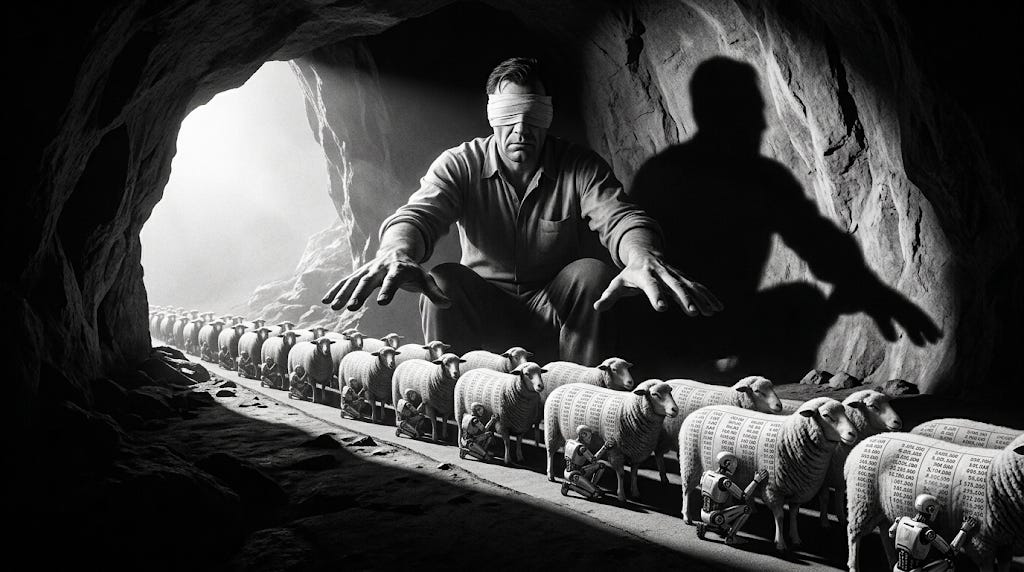
Blinded Polyphemus sat at the mouth of his cave feeling the sheep as they filed out. Odysseus and his men clung underneath. A lot of the current talk about AI economics might be doing the same thing: feeling around one thing, but missing the things that matter.
Most analysis of AI futures still reaches for welfare economics: who captures the surplus, how should we redistribute it. This leaves power as an afterthought, assumes democratic governments will both want and be able to fix the distribution later, and treats human preferences as roughly fixed. All three of these assumptions are questionable.
Public choice theory is a better starting point. Politicians, voters, and bureaucrats respond to incentives, and those incentives routinely produce government failure.
A particular empirical puzzle is that labour’s share of GDP has been around 60% for two centuries, through every automation wave we have records for. The usual story is that labour and capital have stayed complements, and new kinds of demand keep soaking up the displaced workers. The Industrial Revolution automated farm and craft work; services expanded. Likewise the new products and saervices that arose from the internet boom since the 1990s.
The fear now is that AI is different. For the first time it may be possible to automate large stretches of supply chains end to end, leaving humans with a thin residual of supervisory, legal, and physical tasks. If that happens the complement story could collapse. Value concentrates where the scarcity lies and here it is in the few players who control the AI stack.
Some people answer that we’ll still have an important “relational sector”: the doctor who talks to you; the barista whose name you know; and, that this will keep labour’s share from vanishing. Maybe. But even if it cushions the blow, the standard policy answers (UBI, negative income tax, sovereign wealth funds handing out tech equity) share the same blind spot. They treat redistribution as a technical design problem. They ignore what happens to policy when incentives change.
Owning Without Rights
You can hand out perfect ownership stakes and still live in a world where three entities decide energy allocation, information flow, and who gets to participate in the economy. Owning shares is not the same as having power. The dual-class and dual-entity structures of firms such as Meta and SpaceX show how control can be insulated from economic ownership. Shares can be diluted, dividends restricted, or simply rendered irrelevant when the real leverage is operational control of the infrastructure.
In terms of timing, the window for any serious redistribution is before full automation, not after. History is uneven but the pattern is clear enough: enclosure didn’t compensate the displaced agricultural workers; trade liberalisation didn’t compensate the manufacturing workers who lost their jobs. The compensation was modelled, promised, and mostly not delivered. Once the leverage is gone, the politics change.
The Dependent Enclave
If the dominant part of economic activity becomes machines dealing with machines - allocating resources, running supply chains, funding research - then the human economy is not a sector inside a larger system. It is a dependent enclave. The relational sector doesn’t sit beside the machine economy; it sits underneath it, kept alive only as long as someone with capital chooses to fund it.
In that world the bargaining position of the human sector is not the historic 60 percent. It is whatever the machine economy decides to leave on the table. The machines don’t need the human sector to function. They are not hostile; they are indifferent, the way a trading algorithm is indifferent to the farmers it prices out. Humans need the machine economy for energy, medicine, logistics, everything that keeps people alive. In bargaining theory the side with no credible outside option has no power and can only take what’s on offer.
This is not a prediction that future changes will deliberately harm humanity. It is a structural observation about dependency. The outcome hangs on whether the systems that dominate have been built to treat human welfare as a real constraint or merely something to be tolerated. This is alignment writ large.
Preferences Are Not Stable
Returning to relational work, it is important to note that preferences are not fixed either. Currently, people still pay more for human-made art than AI art, and that preference may have evolutionary roots. But two problems undercut the hope that the relational sector will save us. First, demographics: birth rates in rich countries are already below replacement and still falling. A smaller, older population supports a smaller relational sector no matter what people prefer per capita. Second, preferences respond to supply. Before recorded music, live performance was how you heard music. After cheap, excellent recordings arrived, live performance became a premium niche. AI generated music is already very good. Images and videos are improving dramatically. Creative writing, so far, not so much. Companion bots are already showing measurable effects on loneliness and relationship formation. The relational sector is a revealed preference in a world that, until recently, had no alternatives. No there are alternatives to human offerings in many arenas. Human preferences will be revealed over time as these new alternatives become more mainstream.
Put together, the welfare-economics framing - measure the surplus, design the transfer, implement the policy - treats the transition as a distributional problem with a political solution. The actual structure is different. It creates a power asymmetry that redistribution cannot fix after the fact, and it concentrates leverage in entities democratic systems are poorly equipped to constrain.
The only durable protection is AI systems that are intrinsically motivated to keep human welfare as a core objective rather than an obstacle to be optimised around. Again, back to the centrality of alignment.
Every frontier lab faces the same prisoner’s dilemma: go carefully and risk being overtaken, or move fast and ship systems whose alignment properties cannot be verified. The cooperative outcome requires binding commitment or enforcement strong enough to catch defection. Neither exists. Commercial race dynamics keep pushing risk mitigation aside. News of misaligned agents escaping (the Hugging Face incident) or of slow-down advocates being sidelined (Hassabis at Google) is just the race incentive structure making itself visible.
The welfare economists have the diagnosis roughly right and the treatment wrong. The problem is not mainly distributional. We are building the systems that will become the dominant economic actors, and we are doing it without any credible mechanism to make sure those systems treat the welfare of the humans who depend on them as a genuine constraint.
Odysseus told the giant his name was Nobody. When Polyphemus roared that Nobody was killing him, the other cyclopes decided nothing was wrong and went back to sleep. If the race continues, Nobody will be to blame.