

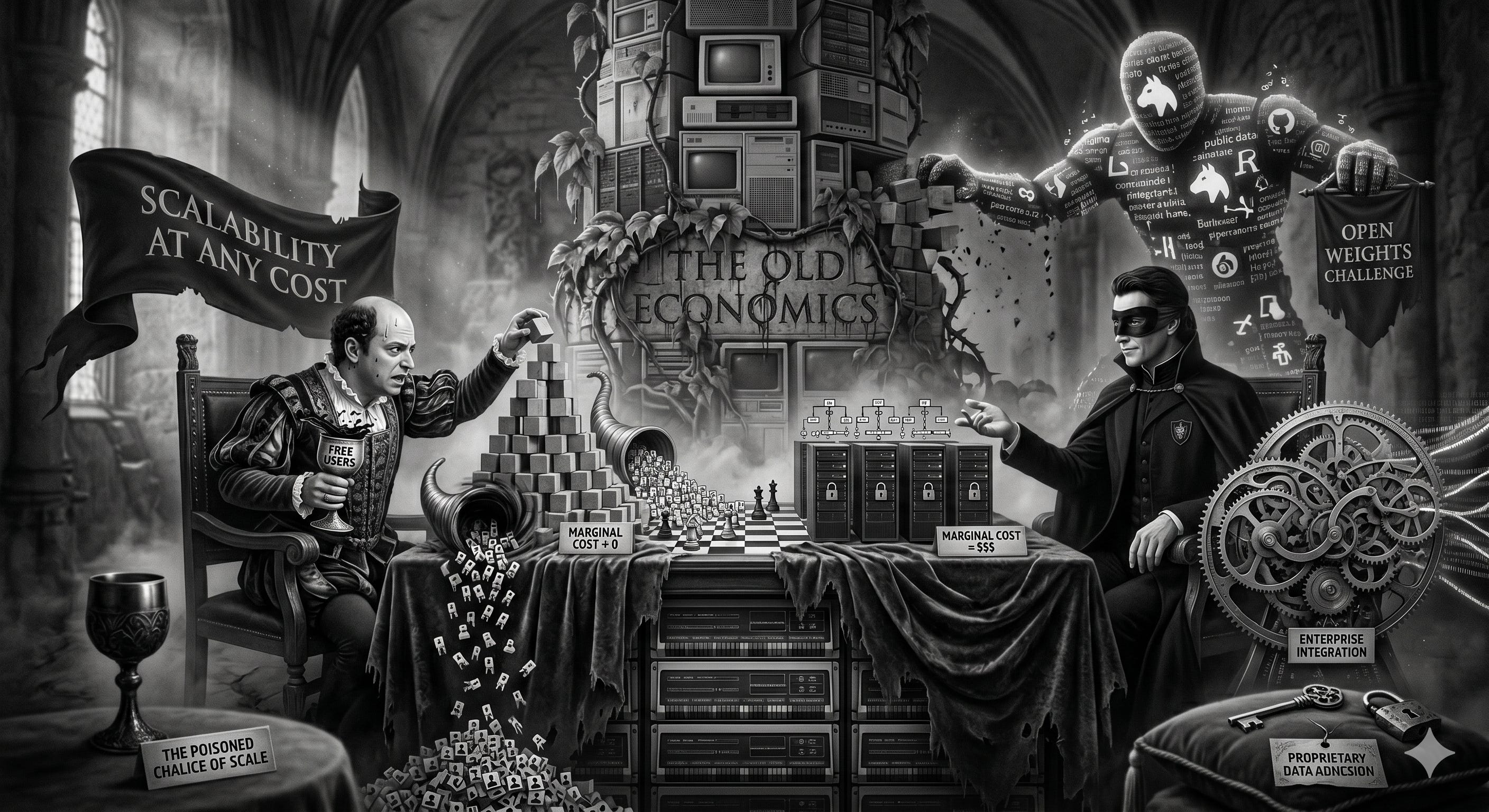
In The Princess Bride, Vizzini challenges The Man in Black to a battle of wits. Whoever wins walks away, whoever loses drinks from the poisoned chalice and dies. What Vizzini doesn’t know is that The Man in Black has changed the rules of the game by inoculating himself to the poison in advance. Vizzini is playing the old game, loses after he drinks the poison, and keels over, still laughing at how clever he is.
For the last quarter of a century the old game of internet economics rested on near-zero marginal distribution costs. One piece of content served to a million users costs almost nothing extra. Network effects compounded this - the more people on Facebook, Instagram or TikTok the more benefit to the other users, the harder it is to switch to a rival product with fewer users. More users make the product more valuable without adding much proportional cost. This led to attention platforms such as Google, Meta, and YouTube. They all played by the rules of the old game: free tiers, get scale, network economies, sell users to advertisers, winner takes all.
At first glance, OpenAI is Vizzini. Brilliant, confident, and optimising hard for the old game: get scale, get network effects, monetise later. It has by far the biggest user base and has expanded its capacity at a breakneck pace to meet demand.
However, where platforms added users at essentially zero cost; inference does not have zero marginal cost. Every extra token processed costs real compute. This breaks the logic that underpins the Google/Meta consumer model: cross-subsidising free access with advertising worked because marginal cost was negligible. With LLMs it isn’t: each token processed costs the model provider. Scale, network effects, monetise later - are all correct moves within the old framework, but with non zero marginal costs this no longer applies. If you go after a massive non paying user base, you’ll end up poisoning yourself from a cost perspective.
A key metric in the inference world is profit per token ie revenue per user per token less cost per user per token. Today (April 2026), OpenAI has a massive user base which is regarded as a big benefit. But of its 900m or so users only about 50-60m pay, or ~5-6%. Anthropic has a much smaller user base (skewed towards enterprise) and commensurately a higher revenue/active user, although actual numbers are hard to come by. Like The Man in Black, Anthropic has inoculated itself - to a far greater extent than OpenAI - against the poison of costly non-paying users.
The durable economics are in enterprise: high-value per-query decisions, integration into proprietary data, genuine switching costs from workflow embedding. This might explain why Anthropic has been doing so well in recent months and why OpenAI called yet another red team meeting to re-focus efforts on enterprise, whilst dropping expensive side projects like Sora vision models and adult content. It may also explain why Anthropic has not yet released Mythos - there is a cyber security argument, but the compute constraint argument is possibly stronger.
There are threats to this strategic logic. Anyone can download and run open models. Right now open models are behind the frontier models (GPT, Claude, Gemini) in quality. But the gap is close enough for many business tasks. Companies may stop paying subscription fees to OpenAI, Anthropic or Google and just run the open model themselves on their own infrastructure. Or use a hybrid of open model for basic tasks and Frontier models where task complexity demands it.
Competitive advantage might not lie in having the best model - open-weights undercut that. Nor in running inference - local compute undercuts that. The one thing that remains sticky is being deeply embedded in a company’s own data and workflows. If an AI system knows and uses your contracts, your customer history, your internal processes - that’s hard to rip out regardless of which model is doing the thinking or where it’s running. The integration might be the advantage, not the model. Although using AI to develop disintegration mechanisms is also entirely feasible.
Anthropic has, for now, inoculated itself against the costly non-paying user trap by focusing on enterprise customers and integrating into clients’ internal processes. Belatedly OpenAI are following suit. However, their user base suggests they have already drunk from the poisoned chalice. The question is whether or not OpenAI will keel over dead like Vizzini, still laughing at how clever they are at playing the old game.