

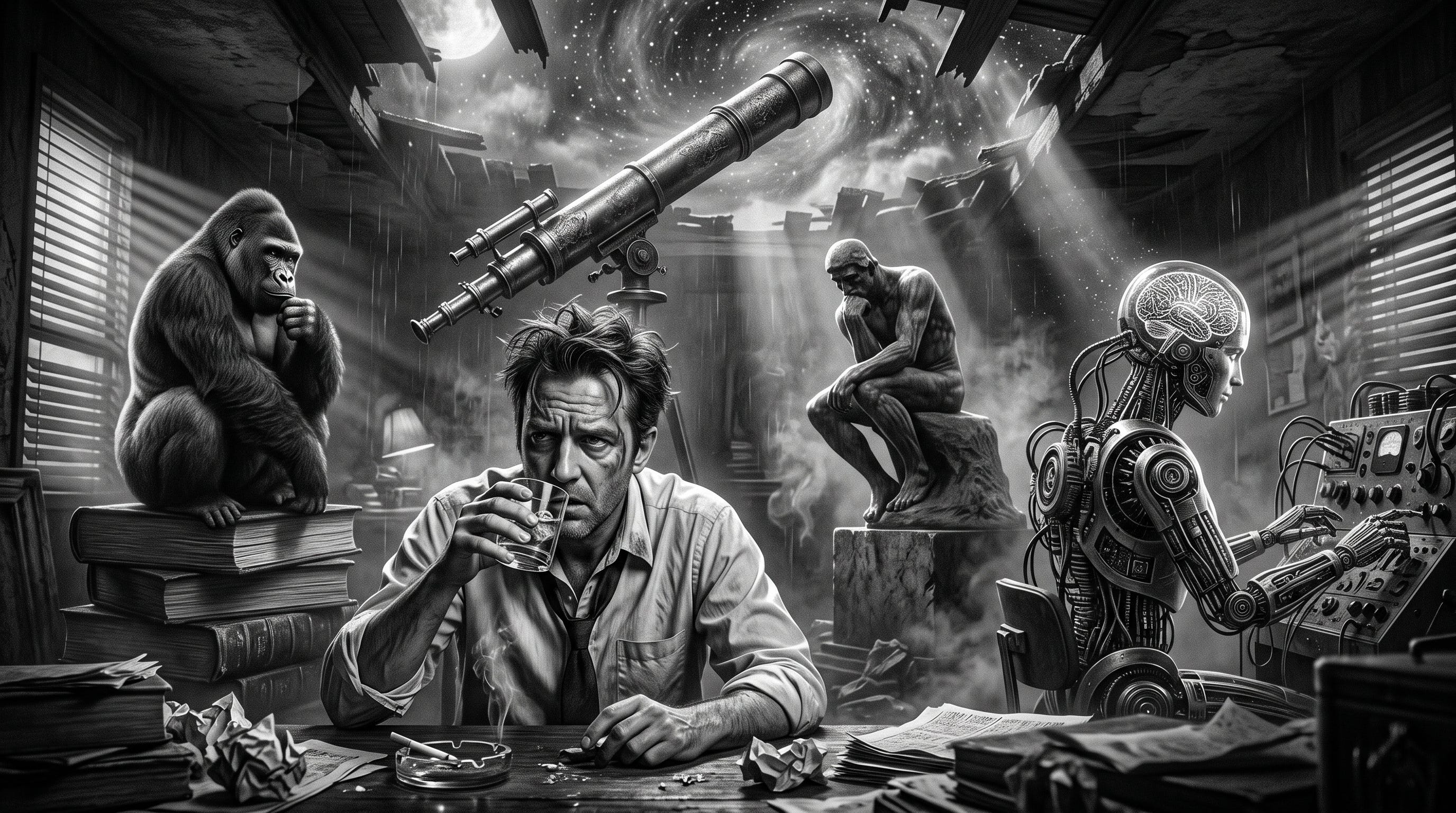
Sigmund Freud named three great wounds to human pride: the cosmological blow (Copernicus), the biological blow (Darwin), and the psychological blow (Freud’s unconscious). Each discovery stripped away a layer of human exceptionalism. Arguably, we survived all three because we retained one final, comforting advantage: we were still the smartest thing in the room. We alone could reason, plan, and calculate. Artificial Intelligence threatens to change that, inflicting a fourth wound that ends our monopoly on advanced cognition.
We are just in the foothills of AI, whatever people want to call this form of non-human, synthetic cognition. Whether it is ‘true’ reasoning or merely sophisticated pattern-matching matters little; it changes how knowledge is made. Further breakthroughs are en route. Maths last week; physics next? Our notion that humans are special is suffering death by a thousand cuts. The response appears to be a mixture of panic, boredom and revolt.
Our ancestors did not bravely accept the facts of Copernicus, Darwin or Freud either. Those ideas were only survivable because society built buffers to dull the pain. These intellectual anaesthetics gave institutions time to adapt.
When Copernicus published his book in 1543, the theologian Andreas Osiander added an unsigned, cautious preface. He told readers that a moving Earth was not physical truth. It was just a useful mathematical trick to calculate planetary positions. You did not have to believe the Earth moved; you just had to use the maths. Eventually, the Catholic Church placed Copernicus’s De Revolutionibus on the Index of Prohibited Books in 1616; 73 years after publication. There was negligible public impact. With low literacy and no visible change to daily life, the general public remained entirely unaware of the cosmological shift.
Three hundred years later, the Victorians reacted more swiftly to Darwin. On the Origin of Species sold out on its first day. Many absorbed the blow by turning descent into ascent: Herbert Spencer’s phrase “survival of the fittest” was quickly pressed into service as cosmic permission for laissez-faire economics and empire. Yet the reception was never uniform - religious, scientific, and progressive critics pushed back hard. Still, the dominant cultural move was the same: keep man (the gendering is deliberate) as the hero of the story by baptising natural selection as progress.
With Freud, the psychiatric and neurological establishment initially dismissed psychoanalysis as unscientific, methodologically loose, and excessively obsessed with infantile sexuality. Many still do. In Vienna, critics framed it as a dubious medical cult. On the other hand, writers, artists, and the Surrealists adopted Freudian ideas quickly. Psychoanalysis provided a secular vocabulary for modern alienation, creative expression, and stream-of-consciousness narrative. However disparaged today, Freud’s wound was showing that conscious reason is not the captain of the ship - that beneath our polished logic lies animal instinct and the irrational unconscious.
So how do we react to AI, this new wound to our pride? With societal anaesthetics, much as we have before: denial, salvation, and mysticism.
First, we use the Osiander anaesthetic: we deny, we call AI “just a tool.” People compare AI to a calculator, a spreadsheet, or a steam engine. A stochastic parrot. A normal technology. A tool is passive. It waits for a human hand to pick it up. It has no goals and no agency. By calling an autonomous, learning system a “tool,” we pretend that the human is still the master craftsman. This comforts the user. Yet autonomous agent workflows executing multi-step operations without human intervention are taking away that particular comfort blanket.
Then, we use the Victorian painkiller: we sell a story of techno-salvation. Nineteenth-century thinkers turned Darwinian struggle into a story of inevitable human triumph. Today, tech leaders promise that AI is a continuation of human evolution. We will cure all diseases, solve climate change, and create effortless wealth and abundance for all.
The Freudian approach is a mystical retreat: “Machines have no lived experience, no consciousness, no artistic spark.” We concede raw computation to the machine, but retreat into romanticism, insisting that empathy, soul, and subjective experience are the ‘true’ marks of worth.
Each of these painkillers makes the wound more bearable. Each allows us to believe that, despite appearances, we remain in control. Pride intact.
Not so fast. Unlike the other wounds to our human pride the difference with the current cognitive revolution is the speed of change. Copernicus and Darwin eventually changed how we saw ourselves, but they did not change how the world worked for everyone straight away. After 1543, the sun still seemed to rise in the east. Farmers planted crops on the same schedule. Sailors used the same charts. After 1859, factory owners still hired human workers, and clerks still wrote ledgers by hand. The new ideas stayed in books, lectures, and church debates for decades. They did not make someone redundant. They did not write code, diagnose illnesses, or draft legal contracts.
Because those ideas lived only in human heads, society had time to build mental defences. You can ignore a telescope for fifty years. You can argue about fossils for a century. You cannot ignore a machine that does your job better and cheaper than you do today. There is no time for a slow cultural adjustment when the technology updates every six months and restructures industries in a few years or less. Government and regulation in particular, is not currently capable of moving at this pace.
If the anaesthetics of denial, salvation, and mysticism will not work this time, we are left with no choice but to face the wound without painkillers. This requires an unsparing reevaluation of human worth: decoupling our dignity from our economic utility and our intelligence. We may have to accept that being the smartest thing in the room was never what made us human in the first place.
We need to choose our painkillers quickly. Scotch, anyone?