

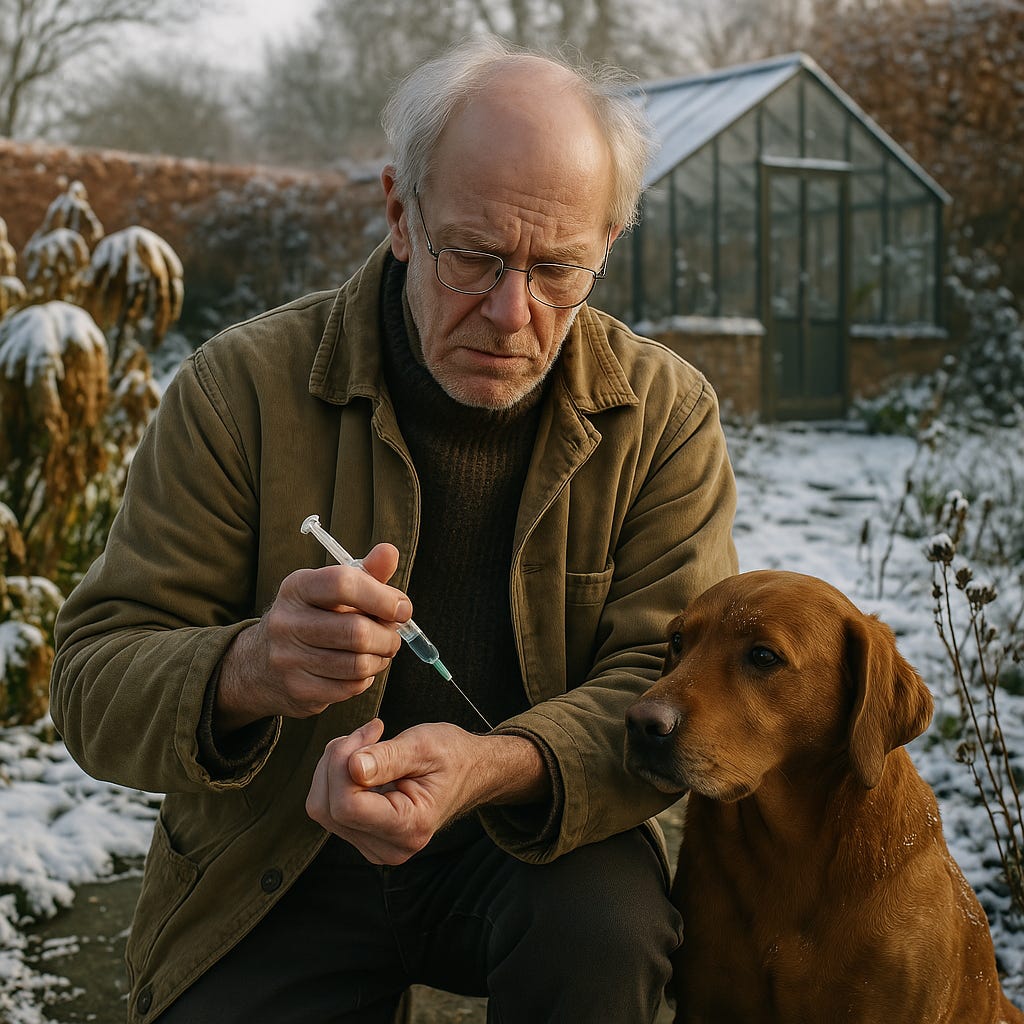
Morris wakes before dawn. Pain again. Always the pain. Like electricity through water.
He swings his feet to the floor. Brewer, the dog, stirs in the corner. Old Brewer. Brown eyes watching. Good company in a silent house.
The cottage is cold. October in Oxfordshire means frost etching crystal patterns on windows. Outside, late dahlias struggle against the chill, their deep burgundy heads heavy with morning dew. The beech hedge has turned copper, dropping leaves that collect against the garden wall. His hands shake as he makes tea. Three sugars. He needs the energy today.
Entry #217: Tremor intensity 7/10. Sleep duration 3.2 hours. Proceeding with vector modification.
Morris was a geneticist once. UCL. Specialized in nuclease functionality. Published papers on enzymatic efficiency in heterochromatin regions. Good job. Good life. Then the tremors started. Small at first. Like seeds before they sprout. Oh, irony…
Huntington's. The diagnosis came three years ago. CAG trinucleotide repeat expansion. Forty-nine repeats where twenty should be. A stutter in his genetic code. No cure, they said. Experimental treatments, they said. Waiting lists. Five years minimum.
He refused to wait. Trees in his orchard wouldn't last five years without care. The espaliered pear trees against the south wall. The heritage apple varieties - Cox's Orange Pippin, Blenheim Orange, russets and greenings - that his grandfather had planted. The cherry that bloomed so spectacularly each April, petals like pink snow covering the lawn.
Equipment fills his shed now. Centrifuge from Germany that hums like distant bees. PCR machine from South Korea that clicks through cycles like a mechanical heartbeat. Electrophoresis rig from California that separates DNA fragments like he once sorted seeds by size. All ordered online. Different accounts. Different shipping addresses. Seven proxies. Paid in cryptocurrency. Digital breadcrumbs scattered too widely to follow.
"Your package has shipped," the emails read. No questions about why a private citizen needs research-grade equipment.
The garden provides cover. Neighbors see only a man who likes his vegetables. A retired academic with dirt under his fingernails. They don't see what grows in the back greenhouse. Don't see the sterile hood built from mail-order parts. Don't see the incubator modified from kitchen appliances.
"Come on, Brewer." The dog follows him outside. Paws making dark prints in the morning frost. Loyal witness to forbidden science.
His notes are meticulous. Each entry handwritten despite the tremors. Adeno-associated viral vectors, serotype 9, blood-brain barrier penetrant. sgRNA sequences targeting the expanded CAG repeats. Three attempts at the design, each more elegant than the last. CRISPR-Cas9 constructs modified with cell-penetrating peptides. Nature's scissors, reshaped by human hands.
Morning sun breaks through clouds. Morris harvests tomatoes from the Victorian glasshouse, its iron frame rusting at the joints. Fruit heavy and red as blood. Black Krim, Brandywine, and San Marzano varieties. Each with different genetic strengths. He collects late runner beans too, their pods hanging like green fingers from bamboo tripods. Nasturtiums provide splashes of orange and yellow among the fading greens, attracting the last hovering bees. Then moves to the shed. Two worlds. Two types of cultivation.
He scans lab supply websites at night. The blue light of his laptop reflecting off glasses. Orders reagents from different vendors. Names and compounds that would mean nothing to most: Lipofectamine. Polyethylenimine. Puromycin. Plasmid synthesis companies that don't ask questions. Offshore labs that ship anywhere. Seven different credit cards maxed out. The price of playing God with your own genes.
Confirmation emails arrive at 3 AM. "Thank you for your order." No one asks why he needs enough supplies for a university lab.
He prepares today's injection. Batch seventeen. Modified SpCas9 with improved fidelity. PAM site modifications for broader targeting range. The previous sixteen failed. Hands trembling worse now. Movements like autumn leaves in wind.
Brewer watches from the doorway. Ears alert. Concerned. Always concerned. Dogs know things humans pretend not to see.
"It's fine, boy." It isn't fine. Nothing has been fine since the diagnosis. Three words that became a death sentence.
The needle pierces skin. A sharp inhale. Cold alcohol swab. Warm pain. The solution enters his bloodstream. Microscopic messengers carrying hope encoded in nucleic acids.
Later, he weeds the garden. The raised beds with their oak borders, soil black and rich with decades of compost. Carrots need thinning. Too many crowded together, like the CAG repeats in his DNA. Their feathery tops dance in the breeze. Potatoes need hilling, the earth mounded to protect developing tubers from light. Maris Pipers for roasting, Pink Fir Apples for salads. The lavender hedge buzzes with the last insects of the season. Rosemary and thyme release their scent as his trembling fingers brush against them. Work keeps his mind off the experiment. Off the fear. Off the hope.
Night comes. Fever follows. Immune response to the viral capsid. Body fighting the cure it doesn't understand. Thirty-eight point seven degrees. Sweat soaking sheets. Expected reaction. He records his symptoms in a notebook. Handwriting barely legible. Not from tremors this time. From fever.
Entry #224: Fever peak 39.2°C at 0300. Lymphocyte count elevated. Proceeding as expected.
Days pass. Striatal neuronal activity should be modifying now. The invisible battle in his cells. The tremors seem less. Perhaps imagination. Perhaps hope. Perhaps science.
Week two. Definite improvement. His handwriting steadier. The 's' in his signature no longer a lightning bolt of pain. PCR verification of edited DNA from blood samples shows successful targeting. Bands on the gel like a ladder leading upward. He celebrates with Brewer. Extra treats. Premium kibble ordered online. Someone should benefit from his credit card debt.
Then blood in his urine. Pink swirls in clear water. Off-target effects. Not in his notes. Not expected. The scissors cutting where they shouldn't.
More tests. More injections. Homology-directed repair this time. Nature's template system. Fix, don't cut. The shed becomes his hospital. Smell of disinfectant mixing with garden soil tracked in on his boots.
Brewer brings a ball. Red rubber worn from teeth. Morris can't throw it today. Tomorrow, maybe. The dog waits. Dogs are patient with broken humans.
His neighbor Mrs. Patel leaves scones by the gate. Ginger and cinnamon. She worries. Everyone worries. No one knocks anymore. They've learned.
Month three. December arrives with bitter winds. Walking becomes difficult. The garden transitions to winter dormancy, yet still needs tending. Frost-blackened dahlia stems need cutting back. Tender perennials require protection from the cold. But the garden overgrows. Tomato vines in the glasshouse reach beyond their cages, unpruned. Fallen apples rot beneath the orchard trees, their sweet fermented smell attracting blackbirds and fieldfares. The unraked leaves form a sodden carpet across the lawn. Like his cells multiplying beyond control.
The cottage phone rings. Old landline. Rarely used. His sister. He doesn't answer. What would he say? "I'm rewriting my genome in the garden shed"?
Entry #251: Mobility decreasing. Kidney function compromised. Adjusting vector design.
Batch twenty-two. Base editor system now. No double-strand breaks. Specific cytidine deaminase fused to Cas9 nickase. C to T conversions to disrupt the CAG expansion. This one has to work. Has to. The garden won't wait another season.
Snow falls. December in Oxfordshire. White blanket transforming the garden into a monochrome painting. The box hedges that divide the kitchen garden into orderly rooms wear white caps. The skeletal apple trees stand stark against gray skies, their twisted branches holding perfect lines of snow. The stone birdbath becomes a frozen disc. Only the winter vegetables—kale, Brussels sprouts, parsnips—stand defiant against the cold, their frosted leaves toughened by the chill. Brewer sleeps beside his bed now. Always close. Warmth against the cold.
Morris orders prime editing components. New technology. More precise. Less off-target effects. Express shipping from a biotechnology startup in Singapore. Another maxed credit card. What is debt to a dying man?
The confirmation arrives Christmas morning. "Your order has shipped." Holiday surcharge accepted.
He synthesizes the pegRNA himself. Guide and template in one molecule. Elegant. Nature would approve. Targets only the expanded repeats. Leaves the healthy allele intact. Like pruning a tree without harming the trunk.
The injection is painful. Prime editors are larger. Harder to package in viral vectors. The needle seems enormous in his trembling hand.
Three days of low fever. Three days of waiting. Three days of Brewer watching. Then something different.
Entry #263: Tremor intensity 3/10. Sleep duration 6.8 hours. Blood parameters normalizing.
Morris wakes one morning. The tremors gone. Completely gone. Hands steady as summer air.
He stands. Steady. Walks the garden path. Footprints in snow. Clear-headed. The world in sharp focus for the first time in years.
Blood tests confirm it. CAG repeat length reduced from 49 to 23. Below the disease threshold. The stutter in his genetic code smoothed out. The numbers don't lie. Science doesn't lie.
He monitors for off-target effects. Liver function normal. Kidney function improving. Blood parameters stabilizing. His body learning to live with its new instructions.
Spring comes. February snowdrops push through frost-hardened soil, followed by crocuses in purple and gold. March brings daffodils nodding in the breeze along the cottage path. Seeds waiting in packets on the windowsill—tomatoes, peppers, and aubergines need an early start. The greenhouse needs cleaning, its glass panels clouded with winter grime. The garden awakens, hungry for attention. Rhubarb unfurls crimson stems. Buds swell on fruit trees. The dark soil warms, ready for turning. The garden needs attention. Needs his hands. Steady hands now.
Morris plants new roses. Varieties he thought he'd never live to see bloom. David Austin climbers with their complex old-fashioned blooms. Bourbon roses for their fragrance. Alba roses for their hardiness and history. He digs deep holes, enriched with compost and bonemeal. Prunes the canes back hard to encourage strong growth. In the newly turned vegetable beds, he sows rows of lettuce, radishes, and spinach. Sets onions in regimented lines. The fruit trees explode into blossom—first the plums, then cherries, then apples in succession. Bees return to the lavender and the newly planted borage patch with its star-shaped blue flowers. Brewer chases butterflies—tortoiseshells and peacocks emerging from winter hibernation. Both man and dog have energy they'd forgotten. Both reborn with the spring.
He compiles his research. Three hundred pages of notes. Data tables. Gel images. Blood work. Anonymizes the data. Uploads it to science preprint servers through secure channels. Seeds of knowledge scattered to the wind.
Scientists notice. Questions arise. "Who is this anonymous researcher?" "How were these results achieved?" Breakthrough treatments appear in clinics six months later. Other Huntington's patients improving. Other gardens being tended by hands that should have failed by now.
His sister visits. Sees the change. The steady hands pouring tea. Three sugars, from habit now, not necessity. Tears flow.
"How?" she asks. Looking at the roses. Looking at his hands.
"Garden therapy," he says. Winks at Brewer. Some secrets are better as seeds, buried until ready to grow.
He keeps his secret. Keeps his garden. Keeps getting better.
The tremors never return. The disease retreats like winter before spring.
Morris orders seeds online now. Not genetic parts. Just regular seeds. Heirloom tomatoes in rainbow varieties—Black Russian, Green Zebra, Yellow Pear. Climbing roses. Sweet peas for summer scent. Foxgloves for the shade beneath the apple trees. Heritage vegetable varieties preserved by generations of gardeners—Blue Solaise leeks, Purple Queen beans, Musquee de Provence pumpkins. Plants with their own genetic stories. Plants that will outlive him for the right reasons. Each with their own carefully evolved DNA, perfect for their purpose.
Next year's garden will be his best yet. He plans for all four seasons now. Winter structure from evergreens and ornamental grasses. Spring bulbs naturalized through the lawn. Summer abundance from perennials and annuals carefully staggered for continuous bloom. Autumn color from Japanese maples and late asters. A calendar of growth and rest, perfectly balanced. And the year after. And after.
In the shed, under a tarp, the equipment gathers dust. Tools used once, for their intended purpose. Like his grandfather's scythe, hung up after the harvest.
Entry #365: No symptoms. Garden thriving. Treatment successful. Case closed.