

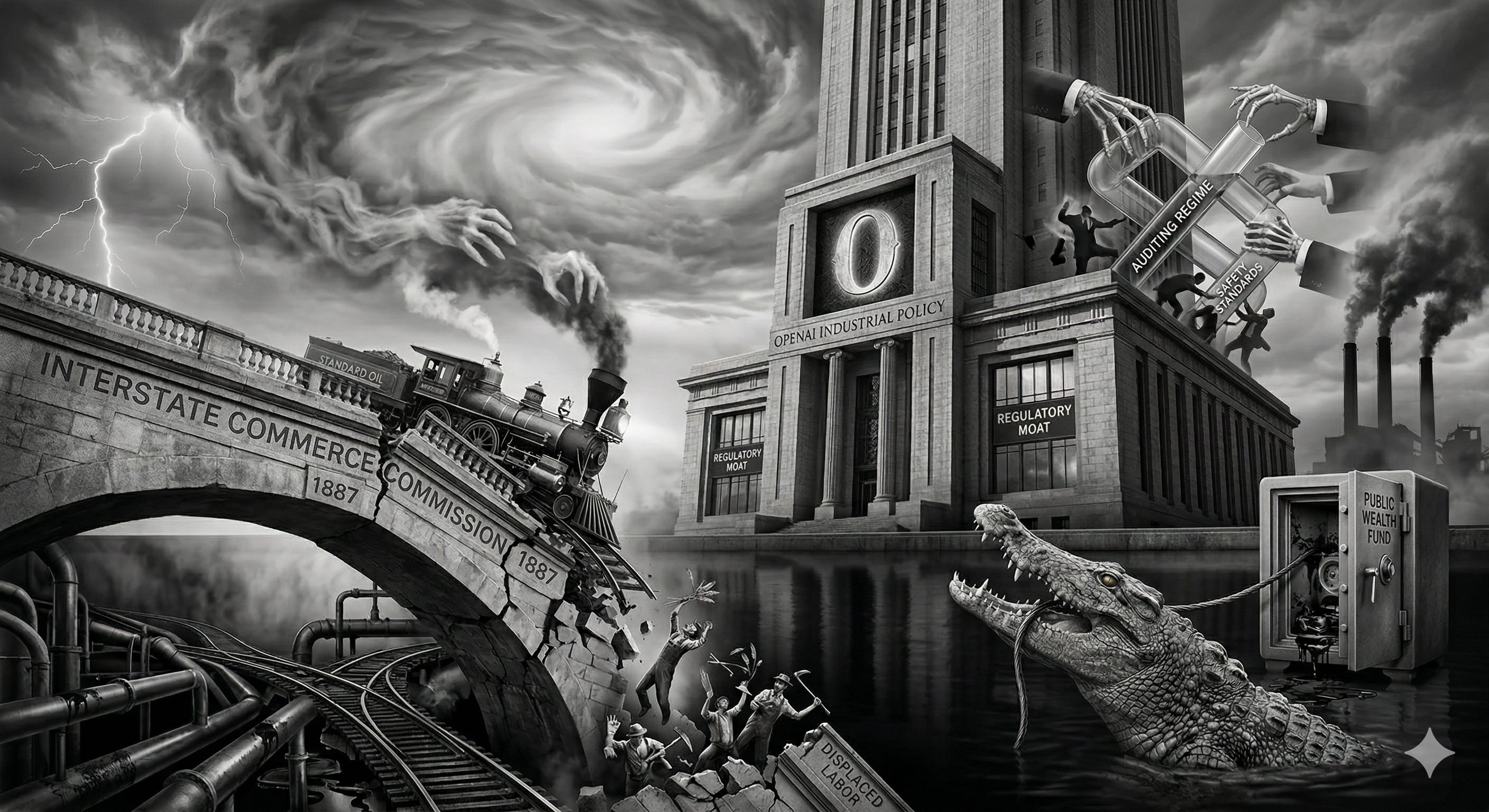
In the US, the Interstate Commerce Commission (ICC) was established in 1887 to regulate the railways. Rockefeller and Standard Oil exercised significant control over the railways through secret rebates and drawbacks. Rockefeller was initially opposed to the ICC, but quickly realised that a weak, industry-influenced regulatory body was preferable to either genuine competition or more aggressive state-level intervention, and shifted to supporting it. With the ICC, he could further enhance the moat protecting his businesses ensuring Standard Oil remained one of a small number of firms with significant market power and high barriers to entry.
Today, there is a whole branch of economics dedicated to this area of study: public choice theory. In this view of the world, politicians and regulators are self-interested agents, not benevolent public servants.
In the world of AI, OpenAI’s moat consists primarily of capital intensity, chip and energy access. This week revealed it’s first stab at adding a regulatory moat for itself. Its April 2026 industrial policy paper on AI governance invokes the US Progressive Era, the time of Rockefeller and Standard Oil, as a precedent for reshaping the social contract after technological upheaval. It treats markets as the default and intervention as requiring justification, which is the right starting position. However, it is clear that, like Standard Oil, this is an industry leader trying to design AI regulatory architecture for itself. Every proposal for auditing regimes, safety standards, and international frameworks creates entry barriers that OpenAI’s scale makes easier to absorb than most competitors and new entrants.
The Progressive Era was primarily a response to the concentration of industrial and financial power - Standard Oil, the railroads, JP Morgan - and to urban squalor and labour exploitation in manufacturing in the US. Reinvigorated antitrust law was the main policy response. Strangely, reinvigorated anti-trust law does not figure high in OpenAI’s policy prescriptions. Not to say that industrial policy might not play a role, but the examples OpenAI quotes were not responses to “a world reshaped by electricity, the combustion engine, and mass production.” Rather, monopolies and monetary policy failure. They do not confer historical legitimacy to their arguments around AI regulation and policy.
OpenAI’s main proposals fall into three groups: labour, redistribution and governance.
Labour market adjustment - worker voice mechanisms, portable benefits, retraining pathways, adaptive safety nets, the 32-hour week pilots, care economy expansion. All address the same underlying problem: workers displaced or degraded by AI adoption, and existing social insurance not fit for the transition.
Redistribution of AI-generated returns - the Public Wealth Fund, tax base modernisation (capital gains, corporate tax, automation levies), efficiency dividends, microgrants for AI-first entrepreneurs. The shared premise: productivity gains will accrue to capital and a small number of firms unless mechanisms actively redirect them.
Governance and safety architecture - auditing regimes, the AI trust stack, incident reporting, model containment playbooks, international information-sharing, guardrails on government use, public input mechanisms. These are the proposals about who watches the systems, who sets the standards, and what happens when something goes wrong.
On labour market adjustments, OpenAI believes, as many do, that AI will have significant, imminent effects on labour markets. Unfortunately, the academic literature provides weak support for any of its proposed remedies:
Government retraining programmes: the literature provides weak support for the proposition that government retraining programmes reliably work at scale.
Worker voice: small positive effects in high-union, high-trust contexts that don’t transplant easily.
Portable benefits: theoretically sound, empirically untested at scale.
Adaptive safety nets: good theory, measurement problem in practice.
32-hour week: promising for white-collar knowledge work, weak evidence for broader applicability.
Care economy: no evaluation evidence, real fiscal sustainability problem buried in the proposal.
There is, sadly, stronger support for the proposition that the adjustment to technology change is real, painful, and unequally distributed. The railway and oil booms of the 1880s and 1890s produced aggregate gains that were real and large, and an adjustment that was real, painful and generationally long. Farmers who had borrowed against local grain prices were destroyed when railways created national commodity markets overnight. Skilled craft workers whose trades were mechanised found no retraining pathway - only the factory floor or emigration. The policies that eventually mattered - the Sherman Act, the Clayton Act, the income tax, workers’ compensation - arrived after the displacement, not before it, and required a political crisis to force through.
Then there is the Redistribution of AI-generated returns. It is true that labour’s share of national income has been falling since the 1980s across most advanced economies, and there is reasonable evidence that automation has accelerated that trend. So the historical diagnosis is sound. However, the problem is that every redistribution mechanism proposed runs through institutions that OpenAI either designs, influences, or benefits from commercially. A genuinely redistributive industrial policy would start by asking how to prevent concentration in the first place - through competition policy, interoperability requirements, open model weights, or antitrust action against vertical integration in AI infrastructure. Surprisingly, none of those appear in the document. Instead we have:
Public Wealth Fund: works when seeded by genuine windfall with independent governance; untested and structurally compromised when the fund’s beneficiary designs it.
Tax base modernisation: theoretically sound, modest empirical support for automation levies, significant definitional problems for AI.
Efficiency dividends: no evidence base; structurally voluntary without enforcement mechanisms the document doesn’t propose.
Microgrants: modest evidence from development settings that don’t transfer cleanly; zero evidence for the AI-specific version.
The redistribution proposals are weaker on evidence than the labour adjustment proposals, and more compromised by the conflict of interest at the document’s centre. The labour proposals are mostly conventional policy with a thin evidence base. The redistribution proposals are either untested, unenforceable, or designed in ways that benefit OpenAI. Increasing competition is not part of the portfolio.
In his time, Rockefeller had simultaneously the largest concentration of industrial wealth in American history and was the largest philanthropist of his era - the University of Chicago, the Rockefeller Institute, the General Education Board. The philanthropy was real and did genuine good. It was also structurally convenient: it redirected the question of what to do about Standard Oil’s profits away from antitrust and toward gratitude. You didn’t want to break up the trust if the trust was funding your hospital.
OpenAI’s redistribution proposals have the same architecture. The Public Wealth Fund, the microgrants, the efficiency dividends - they are the philanthropy. They accept concentration as the premise and propose to distribute some of the proceeds. The one question they don’t ask is whether the concentration should happen at all. Rockefeller never asked that question either.
The governance section is the most novel of the three, with the least existing evidence base - but the most instructive analogues from other high-stakes domains.
Auditing regimes: sound framework, independence problem unsolved. AI trust stack: technically speculative, no evidence base.
Incident reporting: strongest proposal, robust analogues from aviation, liability protection problem unresolved.
Model containment: governance theatre for the worst-case scenario.
International information-sharing: nuclear analogy is instructive but cuts against the proposal’s likely effectiveness; no excludable input to control.
Government guardrails: thin evidence, access problem unsolved.
Public input: democratic theory without operational track record.
The governance proposals are more coherent as a set than the redistribution proposals, and draw on better analogues. But coherence is not the same as feasibility. The three proposals with the strongest evidence support - auditing, incident reporting, and to a lesser extent international coordination - all require structural conditions the document doesn’t establish: genuine auditor independence, liability protection for reporters, and participation by, very importantly, China.
Comparing these proposals with 1887’s ICC, it had subpoena power on paper and almost no capacity to use it in practice. Railway companies submitted their own rate schedules, their own cost breakdowns, their own traffic data. The commission audited what the railways chose to present. OpenAI’s auditing regime proposals have the same structural gap. The entity being audited has the information. The auditor does not.
On the other hand, the document does create a template that suits the current political moment. A Public Wealth Fund seeded by AI companies, with the government taking equity stakes in exchange for regulatory favour, is precisely the kind of arrangement the Trump administration has shown appetite for. Examples include the sovereign wealth fund executive order, the crypto reserve, the various Gulf state investment discussions, the Intel investment and the TikTok restructuring. OpenAI’s Sam Altman has also demonstrated skill at this game, having secured the Stargate announcement with SoftBank and Oracle in January with considerable White House fanfare.
The current administration’s penchant for transactional arrangements with favoured companies is real, but it cuts both ways. Trump’s circle has shown as much interest in concentrating AI capability in friendly hands as in distributing it broadly. OpenAi’s language about democratising access and shared prosperity is unlikely to survive contact with an administration that thinks in terms of bilateral deals and loyalty relationships.
Any organisation like OpenAI, or Standard Oil before it, wanting to build a moat wants stable, predictable rules that lock in market position. The current administration’s instinct is more extractive and less institutionally stable - bad for long-term monopoly rents, even if good for short-term access. There may be crocodiles in the moat, Sam. Beware the crocodiles.