

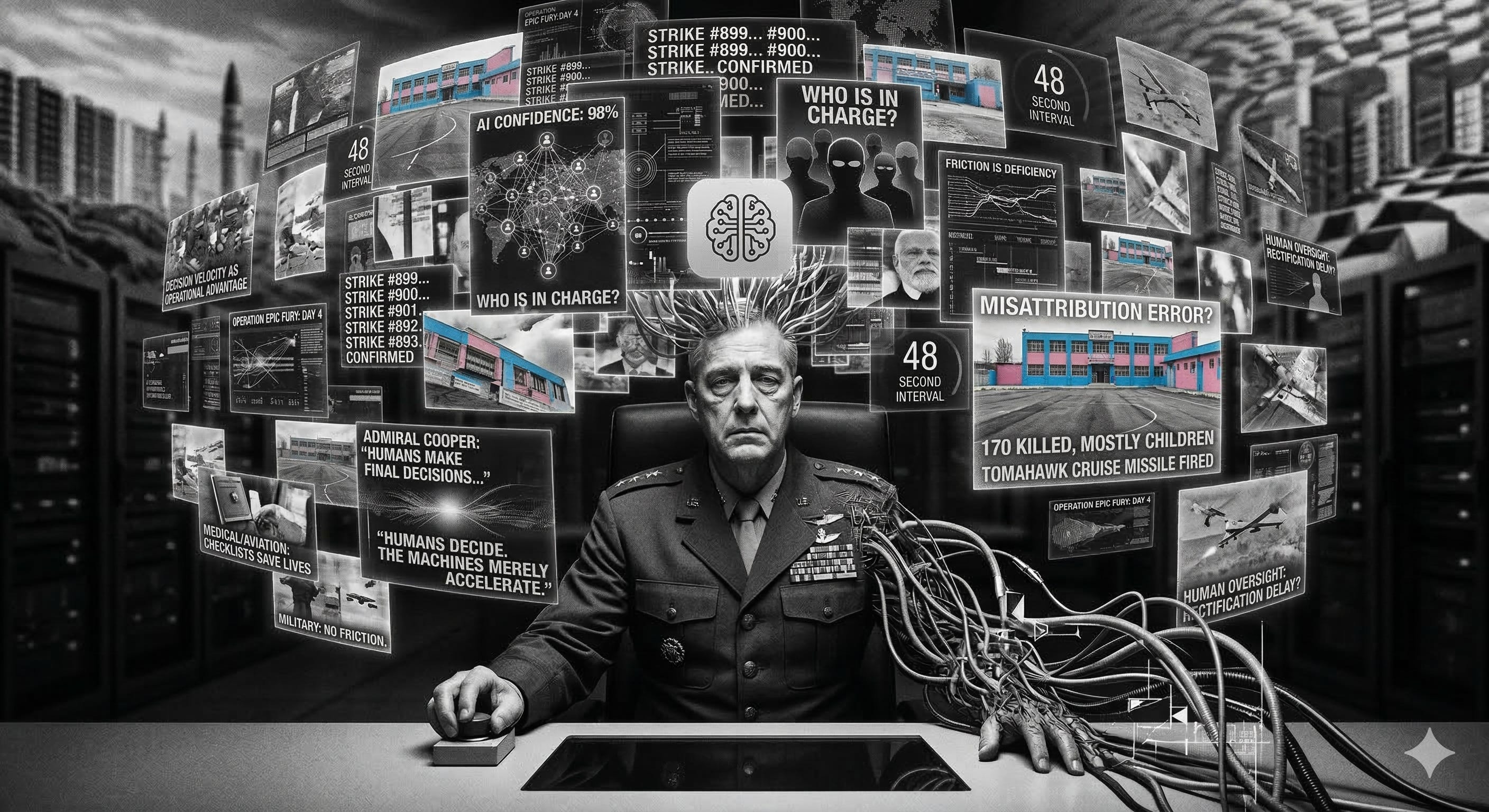
Admiral Brad Cooper would like you to know that humans are in charge.
“Humans will always make final decisions on what to shoot and what not to shoot and when to shoot,” he said last week, in a video posted to X in the context of the US-Israeli bombing of Iran. The AI systems, he explained, turn processes that used to take hours and sometimes even days into seconds. Humans decide. The machines merely accelerate.
This is technically accurate in the same sense that a judge who signs whatever the clerk puts in front of them is technically deciding. Cognitive overload is soon followed by cognitive surrender.
In the first four days of Operation Epic Fury, the United States struck more than 2,000 targets. In the first twelve hours alone, US and Israeli forces carried out nearly 900 strikes - an operational tempo that would have taken days or even weeks in earlier conflicts. That is one strike every forty-eight seconds, around the clock, for half a day. Each one, according to Admiral Cooper, the product of human judgement.
The humans were busy. Or had they already cognitively surrendered?
What does a human do, precisely, when the system presents a target?
They look at a screen. The screen shows a location, a confidence rating, an intelligence summary assembled by an algorithm from drone feeds, satellite imagery, and signals intercepts. The algorithm has done the reasoning. The human has, at most, a few minutes to review a conclusion they cannot independently verify, using information they did not collect, processed by methods they cannot inspect.
They approve it or they don’t. If they don’t approve, they are slowing the operation. If they do approve, they are exercising oversight.
Misattribution errors do not announce themselves. The algorithm does not flag its output as a guess. On the 28th of February, a Tomahawk cruise missile struck the Shajareh Tayyebeh school in Minab. The building was painted bright blue and pink, with sports fields clearly visible on the asphalt. It had been partitioned from an adjacent military base in 2016. The site remained in military databases as an active target. More than 170 people were killed, most of them children. Whether the AI failed to update the target’s status, or whether the failure was human throughout, is still under investigation. Either way, the answer will attribute the error to a specific step, and will miss the point entirely.
The point is that the human reviewing the target had no means to distinguish a correct identification from an incorrect one at one strike every forty-eight seconds.
Military doctrine has been moving in one direction for thirty years. Faster targeting. Shorter kill chains. Decision velocity as operational advantage. Pete Hegseth has said the US military will become an “AI-first warfighting force across all domains.” Friction - delay, doubt, the pause before action - is treated as a deficiency to be engineered out. Anthropic disagreed - publicly and unsuccessfully - when Hegseth’s team pushed to remove the constraints the company had placed on what its models were capable of deciding.
Medicine drew the opposite conclusion from the same human limitation. The reason surgical checklists exist, the reason drug dosages require countersignature, the reason hospital committees review high-stakes decisions, is precisely because humans under time pressure make systematic and predictable errors. Deliberately introducing friction can mitigate that. Aviation reached the same conclusion… after enough crashes. The response to cognitive limits was to add friction deliberately - to slow the process to the speed at which human judgement can actually function.
But soon even these frictions will become redundant. Wharton professor Ethan Mollick coined the phrase “jagged frontier” to describe AI capability: not a smooth advancing line but an irregular boundary, superhuman in some areas, surprisingly weak in others. In 2023, when he first used it, the jagged bits - the things AI couldn’t do - were the reassurance. Look, it’s really good at translating in multiple languages, but it can’t count the letters in “strawberry.” The concept has become less useful, he now says, because the frontier is narrowing. The increasingly small blob of human capabilities is rapidly being overtaken by the self reinforcing abilities of ever improving AI. Quite quickly there will be nothing left where humans beat AI in the mental domain.
Instead, AI’s will set up agent committees, adversarial panels, safety checklists to introduce friction and safeguards into their own processes. The military chose speed over friction. Medicine and aviation chose the opposite. Neither human answer is sufficient once the machine outperforms the human in both speed and judgement.
As these changes filter through, there will be a reckoning, and it will not be primarily about targeting algorithms or school strikes or safety committees. It will be about what we are. Homo sapiens has been the pre-eminent cognitive entity on this planet for roughly three hundred thousand years. The entire edifice of human organisation - law, sovereignty, the chain of command, the concept of accountability itself - rests on the assumption that humans are the ones doing most of the thinking. This will be a profound blow to our fragile egos.
That assumption is looking wobbly. The psychological adjustment this requires is not small. We are not good at being second.
Which brings us back to the opening question: who do you want in charge Trump, Xi, Modi, Putin or Claude?
I mean, when you put it like that…