

Writer: I’ve got the piece. Last week the US government did three things in quick succession. One: the EPA scrapped the rule that says CO₂ is a pollutant - the legal basis for every federal climate regulation since 2009. Two: the National Science Foundation started dismantling the research centre whose supercomputer runs America’s weather and climate models. Three: the US Interior Secretary went on television and said, with apparent sincerity, “CO₂ was never a pollutant.”
Editor: So the government has decided climate change isn’t happening, and is now shutting down the institutions that keep proving it is.
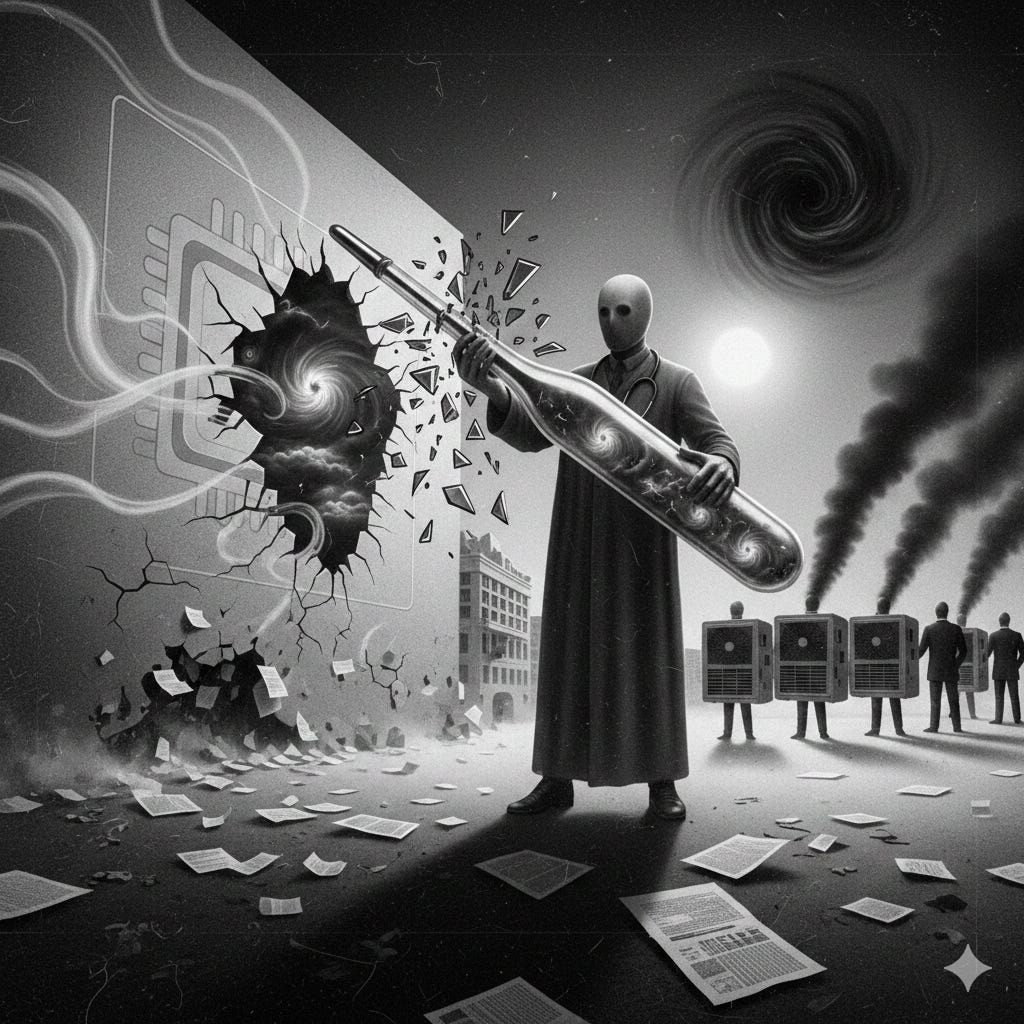
Writer: That’s the straight version. I want to write it as smashing the doctor’s thermometer.
Editor: What?.
Writer: A doctor takes your temperature to determine whether you are ill or not. You don’t want to hear that you are poorly, so you smash her thermometer.
Editor: Orwell?
Writer: Maybe… In 1984 a totalitarian regime controls reality by controlling information. The Ministry of Truth rewrites the past. The telescreen watches you. It’s a story about power - deliberate, competent, terrifying power. But that doesn’t describe what happened last week. What happened last week is stupid. They called the computer “one of the largest sources of climate alarmism in the country.” The supercomputer they want rid of does nineteen quadrillion calculations a second and feeds the weather models that tell Americans whether to evacuate before a hurricane.
Editor: So your thermometer and doctor?
Writer: Your doctor tells you your temperature is dangerously high. You don’t like the diagnosis, so you grab the thermometer and smash it. Problem solved. No more scary readings. You feel better immediately.
Editor: And your temperature?
Writer: Still killing you. But now nobody can prove it.
Editor: It’s vivid. I’ll give you that. But 1984 has reach. You say “Orwellian” or “Big Brother” and every reader in the Anglosphere gets a shiver of recognition. The neural pathways are already laid. You’re asking them to build new ones.
Writer: That’s the problem. When you say “Orwellian,” people nod and scroll. It’s become a thought-terminating cliché - which is itself a rather Orwellian outcome, if you think about it. The word that was supposed to keep us vigilant has become a way of filing things under “bad” without actually thinking about them.
Editor: Go on.
Writer: The thermometer doctor makes you see it fresh. The Ministry of Truth was competent. They had filing systems. They employed Winston specifically because rewriting history required skill. Someone going on television to say CO₂ was never a pollutant isn’t the Ministry of Truth. It’s the Ministry of Silly Walks.
Editor: But the EPA revoking the legal basis for regulating greenhouse gases, the NSF dismantling the institution that builds the climate models, and the Interior Secretary declaring on national television that the diagnosis was wrong all along. That’s not one thermometer;. that’s the entire health service deciding high temperatures don’t exist.
Writer: Fair. The thermometer implies a lone actor. It undersells the coordination.
Editor: And 1984 captures exactly that - the institutional machinery of denial. The way it requires buy-in at every level. Some are calling the repeal “the largest deregulatory action in American history” with evident pride. That’s people who have internalised the logic. That’s doublethink.
Writer: Except it isn’t, quite. Doublethink requires knowing the truth while believing the lie. I don’t think they are doublethinking when they say CO₂ was never a pollutant. I think they mean it.
Editor: There’s a third thing you haven’t addressed.
Writer: Go on.
Editor: The supercomputer is called Derecho.
Writer: Named after a fast-moving, destructive windstorm. Yes.
Editor: They’re dismantling the machine named after extreme weather in order to stop studying extreme weather. Your thermometer doesn’t capture that level of irony. Orwell doesn’t either. That’s pure Kafka.
Writer: Kafka! Yes… situations that are nightmarishly complex, illogical, and oppressive, where individuals are rendered helpless by impersonal, absurd administrative procedures. But how do I shoehorn an overnight transformation into a beetle as a metaphor for climate change denial?
Editor: Tricky. What are you going to do?
Writer: I’m going to write a conversation between an editor and a writer where neither can agree on a metaphor.
Editor: [pause] That’s very clever. Is it too clever?
Writer: Possibly. But it’s honest about the fact that every frame is a choice. And right now, when the people in charge are choosing frames designed to make you stop thinking, the most radical thing a writer can do is show the reader how framing works. Not what to think. How to think.
Editor: So you’re arguing that the meta-conversation is the piece.
Writer: It always was.
Editor: Fine. But keep it under twelve hundred words.
Writer: We’re already at nine hundred.
Editor: Then finish it. On your way out, turn the aircon up. It’s baking in here.