

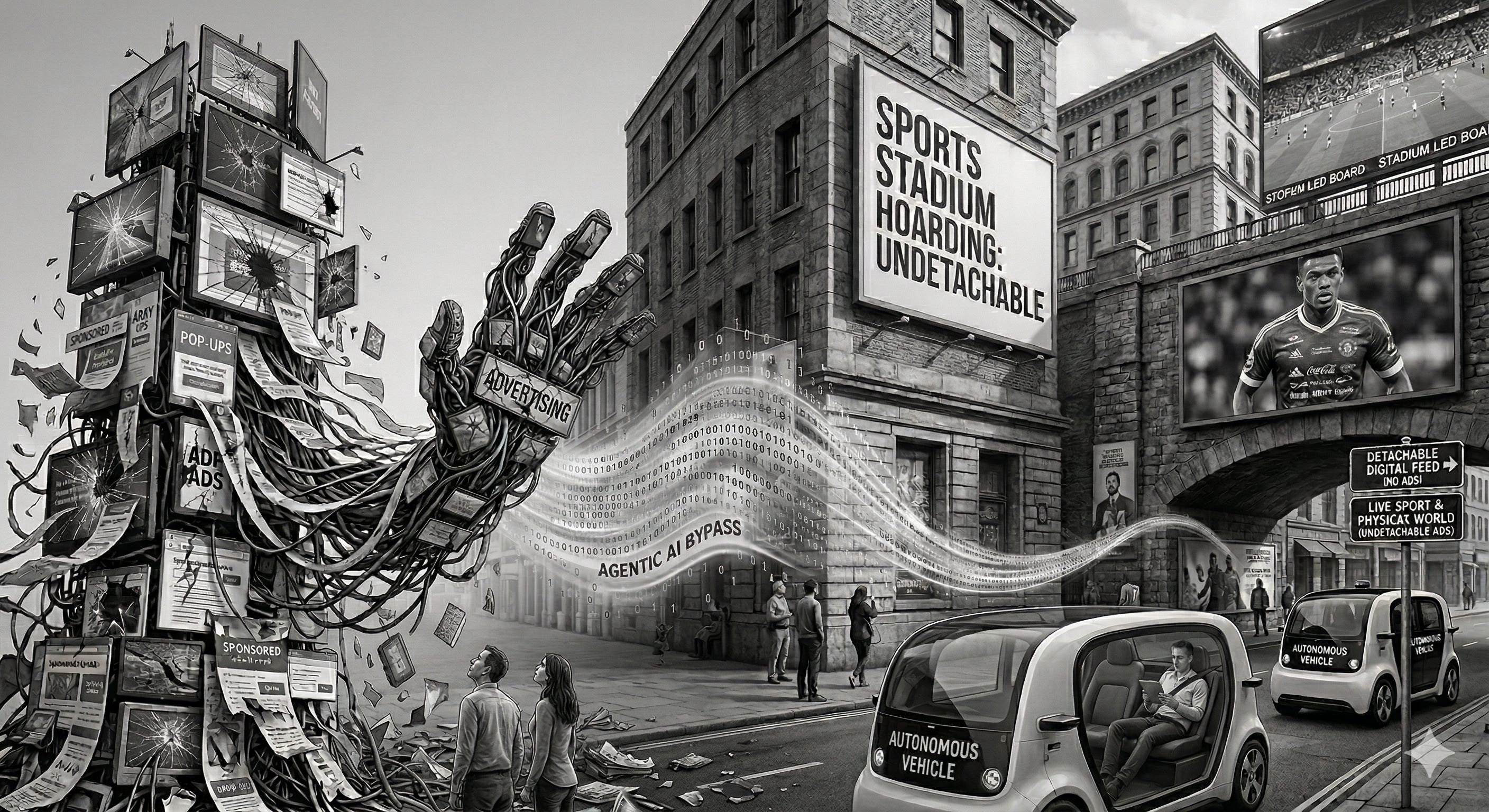
For twenty-five years, the price of information was attention. You wanted something; they made you look at their ads to get it. Google, Meta, TikTok and to a lesser extent X, have grown rich capturing eyeballs for advertisers. However, agentic AI is discovering a path that goes around their tollbooths.
The first few months of 2026 have seen extraordinary advances in the world of agentic AI. OpenClaw, an open source agent framework, was one of the fastest-growing open-source projects in history. This month Jensen Huang, CEO of Nvidia, called OpenClaw “The most important software release probably ever”. All the frontier labs in the US, China and elsewhere are creating similar capabilities.
One of the things you can ask your AI agent to do is remove adverts from whatever digital feed you are consuming. It can report back on searches, a lot of social media and most advertising supported websites, ad free. The advertising industry, particularly the attention economy, should take notice.
The attention economy of the last quarter century was built on a single structural fact: to get information, you had to pass through a surface covered in advertisements. Google put ads next to search results. Facebook put them in the feed. Many publishers on the open web wrapped content in pages loaded with ads and hoped you didn’t look away before the impression registered. You wanted something. They made you look at their ads to get it.
Ad blockers stopped a little of this. Agentic AI can remove much more.
An agent - software that acts on your behalf, retrieving, filtering, booking - does not consume content the way a human does. It reads the page and reports back. The ads attached to that page never reach you. You want to compare the price of several brands of toothpaste. Your agent will search the web, draw up a comparison table and give it to you. You won’t see all the ads that you will have seen for the last quarter of a century. The agent will deliver your content, ad free in thirty seconds. The sponsored posts, the promoted results, the targeted displays - all of it sits unread on servers you never visited.
The history of advertising is the history of scarcity migrating. Each new medium created a fresh surface to advertise on, driving down the price of the previous medium, and left advertisers scrambling to follow the eyeballs. Television gutted national radio. The internet annihilated classified advertising in print. Each disruption followed the same logic: the new medium was cheaper to reach and easier to measure than what it replaced. Agentic AI is somewhat different in that it works for the consumer to remove the ads.
There were some survivors of each disruption. Television could not replace radio’s drive-time intimacy, so some local radio survived. Sport stadium hoardings, the bus-stop panel, the shirt sponsor visible every time a player raises their arms are hard to replace in real time. Outdoor advertising was widely predicted to collapse when the internet arrived. It grew. The reason is structural: you cannot block a billboard. More precisely, you cannot have an agent read it on your behalf and report back. The advertising is woven into the physical fabric of the thing you came to see.
Sport is a great example of undetachable advertising. Live sport is one of the few remaining contexts where the advertising is genuinely attached. You can remove the stadium hoardings, the players shirts, or logos on the pitch. But it is hard. The emotional intensity of the content means viewers tolerate the surrounding commercialisation at levels they wouldn’t accept elsewhere. Agents cannot easily break this as it is intimately woven into the fabric of the event.
The same principle applies to certain types of online video. An agent cannot watch a TikTok on your behalf and report back the experience. It cannot convey the personality of a creator whose personality is the content, however, laden with product placement and branded goods they are. These formats survive because detaching the ads destroys the reason for consuming the content at all.
What will not survive is the detachable adverts. The banner ad. The pre-roll. The sponsored interstitial post in the infinite scroll. The search result page that Google has spent a decade converting into an advertisement. These exist as a layer on top of content, and agents can easily strip away these layers.
Significant parts of the attention economy will be affected. Meta’s feed. X’s timeline. The Google results page - are all mechanisms for routing you to information through a surface covered in advertising. Remove the ads and the revenue disappears with them.
Meta’s pivot toward AI assistants, Ray-Ban smart glasses and on-device agents is not a product strategy so much as a survival strategy: own the agent layer before the agent layer owns you. The logic is defensible. Meta holds fifteen years of social graph data, location history and consumer behaviour - genuinely useful data for building a personalised agent. The bet is that users will accept an agent that is not fully neutral in exchange for one that knows them well.
The bet has a structural flaw. The agent’s value to a user is precisely its neutrality - the confidence and trust in the agent that when it books a restaurant or filters a news feed, it is acting for you rather than for an advertiser. An agent users know is optimising for Meta’s revenue is an agent users will route around. Advertisers need the agent to be compromised. Users need it not to be.
Similarly, Google’s advertising revenues have held up, but there will come a time when advertisers will ask who is watching this?
Undetachable ad content will become more valuable. Billboards, bus stops and physical assets. Live sport is another example. No doubt Meta, Google, X and others will fight back making it harder for agents to detach ads. They may find methods to embed ads more deeply within their existing surfaces. Maybe people will be happy to employ ad sponsored agents to do their work for them - although the ad monies go elsewhere in this scenario.
The toll booth operators - Meta, Google, X and others - are now funding the road that bypasses them. Ironically, their data centres power the agents detaching ads from their content, reducing their future income. And the old advertising media with undetachable ads will continue. As you drive past in your robotaxi, the billboard will still be there.