

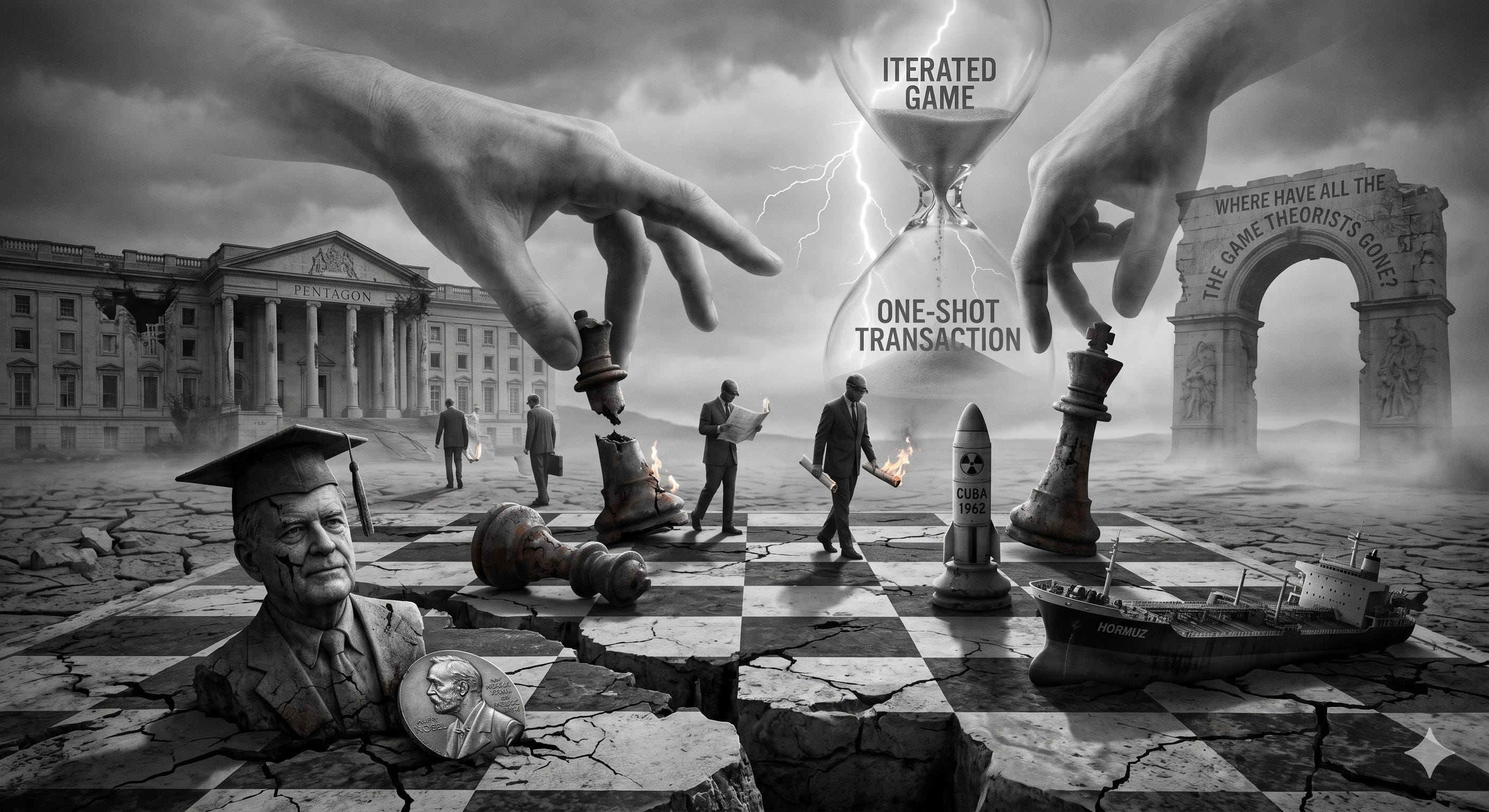
For more than half a century, game theory sat at the heart of American strategic thinking. Thomas Schelling, for example, economist, Nobel laureate, adviser to governments, spent his career mapping the logic of conflict between rational actors. One central insight was deceptively simple: the power to hurt is bargaining power, but only if the threat is credible. Credibility depends on reputation. Reputation is built across time, across repeated interactions, between the same counterparties. You cannot spend it in one round and expect it to be there in the next.
The Kennedy administration had Schelling’s ideas in the room during the Cuban Missile Crisis. McNamara’s Pentagon demanded that every strategic decision be modelled, stress-tested, war-gamed. The discipline existed because people in power understood something that now appears to have been forgotten: geopolitics is not a series of one-off transactions. The other side has a memory. So does the market. So does the ally watching from the sidelines.
The current administration’s record suggests there is an absence of game theoretic thinking. The evidence?
In March, with the Strait of Hormuz effectively closed and oil prices climbing from $67 to $93 a barrel, Pentagon press secretary Pete Hegseth stood at a briefing and told reporters the US had planned for exactly this scenario. “We planned for it. We recognise it,” he said. Asked how soon the strait would reopen, neither he nor the Chairman of the Joint Chiefs offered an answer. The plan, it emerged, extended precisely as far as the press conference.
On April 17, President Trump announced triumphantly that Iran had agreed never to close the strait again. The following day, Iran closed it.
The same pattern runs across every theatre. In January last year Trump and Vance infamously embarrassed Ukrainian President Zelensky in a staged meeting. This year, Trump told Fox News Radio in March that the US knew more about drones than anyone. “We have the best drones in the world,” he said. By April, American forces at Prince Sultan Air Base in Saudi Arabia were running Ukrainian counter-drone software and receiving instruction from Ukrainian specialists - because Ukraine had spent three years learning to intercept the Iranian Shahed drones that Russia had been launching at its cities, and the US had not. Diplomacy is not a one shot game. It’s a repeated game, with long term considerations and possibilities down the road.
The Anthropic episode is also revealing. In February, the Pentagon designated Anthropic - America’s most safety-focused AI frontier lab, the first permitted to operate on classified military networks - a national security supply chain risk. The designation, historically reserved for foreign adversaries, meant defence contractors had to certify they were not using its technology. Chinese labs meanwhile, whose data is processed using mainly US chips, received no such designation. Simultaneously, the administration implied it might invoke the Defence Production Act to compel Anthropic to hand over its models, because they were too essential to national security to lose. The two positions - existential threat, indispensable asset - were held at once, apparently without discomfort. Shortly afterwards Anthropic chose not to release Mythos, a powerful model which coincidentally has enormous cybersecurity prowess. Now, with Mythos, despite ongoing court proceedings around the supply chain risk designation, the Administration is very keen to talk to Anthropic.
Thinking through tariffs completes the picture. Trade is the canonical iterated game: the same players, across decades, with long memories and domestic political constraints of their own. When the US imposed tariffs and China retaliated, Beijing’s position was straightforward. Xi Jinping faces no midterm elections. He can absorb more pain, for longer, than any American president whose approval rating moves with the price of groceries. In addition China has a monopoly on rare earths processing. China restricted rare earths and waited for the inevitable climb down. Markets have a name for the tariff reversals: TACO - Trump Always Chickens Out. The irony is that the label may now be doing its own strategic work. A president who no longer folds to avoid being seen as folding is still being played.
Why this absence of strategic thinking? Three explanations present themselves and they are not mutually exclusive.
There is the institutional explanation The people who understood iterated game dynamics - the career diplomats, the strategic planners, the officials who had watched the same interactions across administrations - have been systematically removed. Expertise of this kind is not innate. It accumulates over careers and transfers through institutions. When the institutions are gutted, the expertise goes with them. Never mind the DOGE cuts, Hegseth at the DOD has fired the army chief of staff and the navy secretary as well as top Pentagon lawyers.
The second is temperamental. Trump’s formation is New York real estate. In property development, you rarely encounter the same counterparty twice. Full information is not expected. A deal that leaves the other side with nothing is a good deal. The mental model is zero-sum, one-shot, and positional. It produces excellent results in the domain it was built for. Applied to geopolitics, however, the counterparties are permanent, reputation is the currency, and every move is observed by a dozen other players calculating their own response.
Finally, maybe they are simply playing a different game. If the objective function is domestic political theatre - the triumphant announcement, the strong-man posture, tonight’s coverage - then the strategy is not failing. It is succeeding at a different game. Hegseth’s press conference was not aimed at Iran. Trump’s strait announcement was not aimed at shipping markets. The Anthropic blacklist was not aimed at national AI competitiveness. Each was aimed at a domestic audience, evaluated on a 24-hour cycle, optimised for a different set of “attention” payoffs entirely.
The problem is that the two games are running simultaneously. Every move that wins the domestic round sends a signal in the geopolitical one. Iran watched the strait announcement and closed the strait. China watched the tariff reversals and recalibrated its pain threshold. Ukraine watched the dismissal of its drone expertise and signed military cooperation agreements with Saudi Arabia, the UAE and Qatar. The audience for American strategic communication is not only American.
Schelling understood this. The whole architecture of Cold War deterrence rested on it. The threat had to be credible to the adversary, not merely popular with a particular home audience. When those two requirements diverge - when the move that plays well domestically undermines credibility abroad - you are no longer playing one game. You are playing two and losing the one that matters.
The performative warrior ethos of Trump and Hegseth runs on visible decisive action - the press conference, the announcement, the humiliation of an adversary in the room. These are precisely the moves game theory identifies as credibility-destroying.
The US game theorists are not hard to find. They are in the universities, the think tanks, the policy institutes. I am one. I was once in the room, albeit in the UK. Today, in the US they are publishing, advising, appearing on panels and podcasts. They are watching the Hormuz press conference and running the numbers on Chinese AI chip consumption and noting, with professional precision, exactly what is being destroyed and at what rate. But US game theorists no longer appear to be in the room.